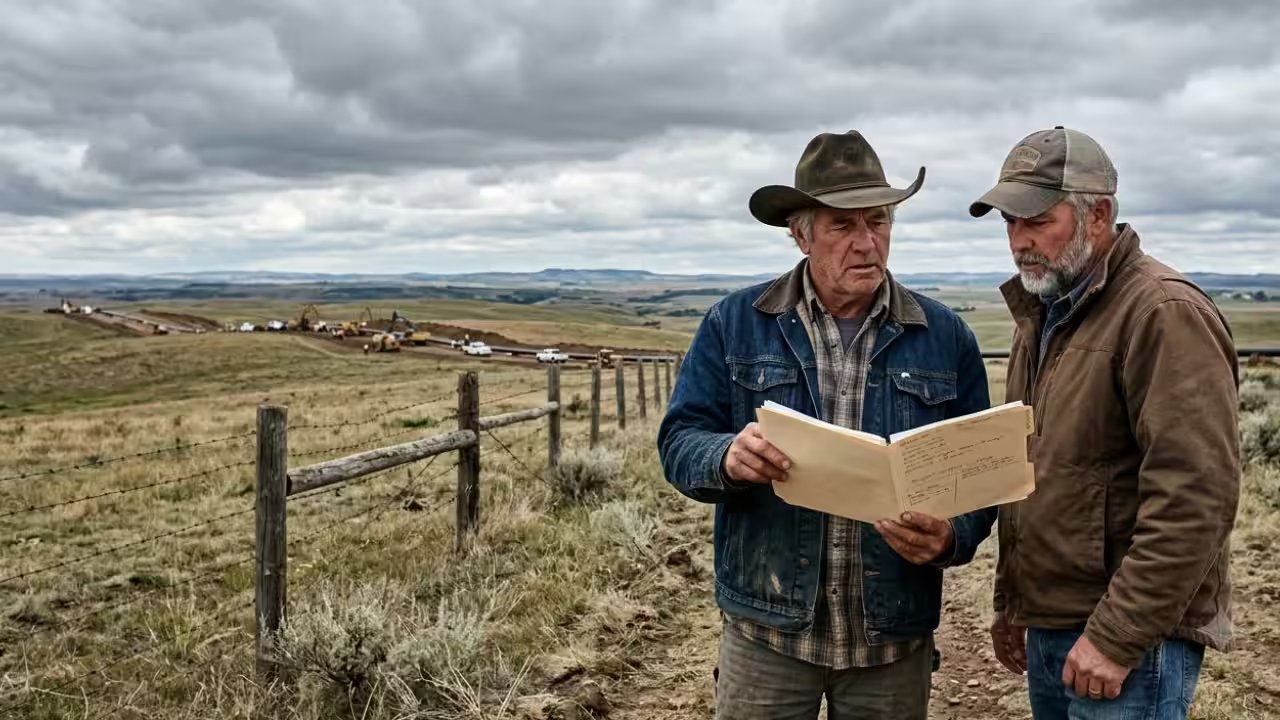
The US Supreme Court hears arguments on Monday over a question that could reshape property rights across the country: must a private natural gas pipeline company pay the legal bills of the landowners it displaces? The case pits North Dakota rancher Leonard Hoffmann and his neighbors against WBI Energy Transmission, with $383,375.76 in attorney’s fees at stake. It’s a fight over who controls the rules when a private entity wields the government’s power to seize land.
The dispute traces back to 2018, when WBI informed Hoffmann and other ranchers it intended to acquire an easement for a pipeline. Although WBI is a private firm, it holds a federal certificate under the Natural Gas Act that grants it eminent domain powers. According to the Institute for Justice, the public-interest law firm representing the ranchers, WBI initially offered roughly half the market value of the property. The landowners pushed back, taking the valuation dispute to court. They eventually settled the price of the land but left the legal fee issue unresolved.
A federal district court in North Dakota sided with the ranchers, ordering WBI to reimburse the $383,375.76 in fees, citing state law. But the US Court of Appeals for the Eighth Circuit overturned that decision in March 2025. The appeals court ruled that because WBI exercises federal eminent domain powers, federal law—not state law—governs the compensation. This creates a split with the Third, Fifth, Sixth, and Eleventh Circuits, which have generally allowed state compensation rules to apply in similar private condemnations.
The legal battle now hinges on the interpretation of the Fifth Amendment’s “just compensation” clause. Hoffmann’s lawyers argue that Congress did not expressly displace state laws when it delegated eminent domain powers to pipeline companies. They contend that states remain the primary source of property rights rules. WBI, however, argues that Congress intended a uniform federal system, pointing out that while the Natural Gas Act adopts state procedural rules, it deliberately omits state compensation standards. The US government has filed a brief supporting WBI’s position, arguing that when Congress delegates these powers without adopting state rules, the federal Fifth Amendment standard applies, which typically does not cover attorney’s fees.
For Hoffmann and his neighbors, this isn’t just about legal theory. It’s about the financial burden of defending their land. If the Supreme Court sides with WBI, private companies could potentially avoid paying legal costs, leaving landowners to fight for fair market value without the safety net of fee-shifting. The Court’s decision will set the precedent for how private pipelines and other infrastructure projects interact with private property rights nationwide.