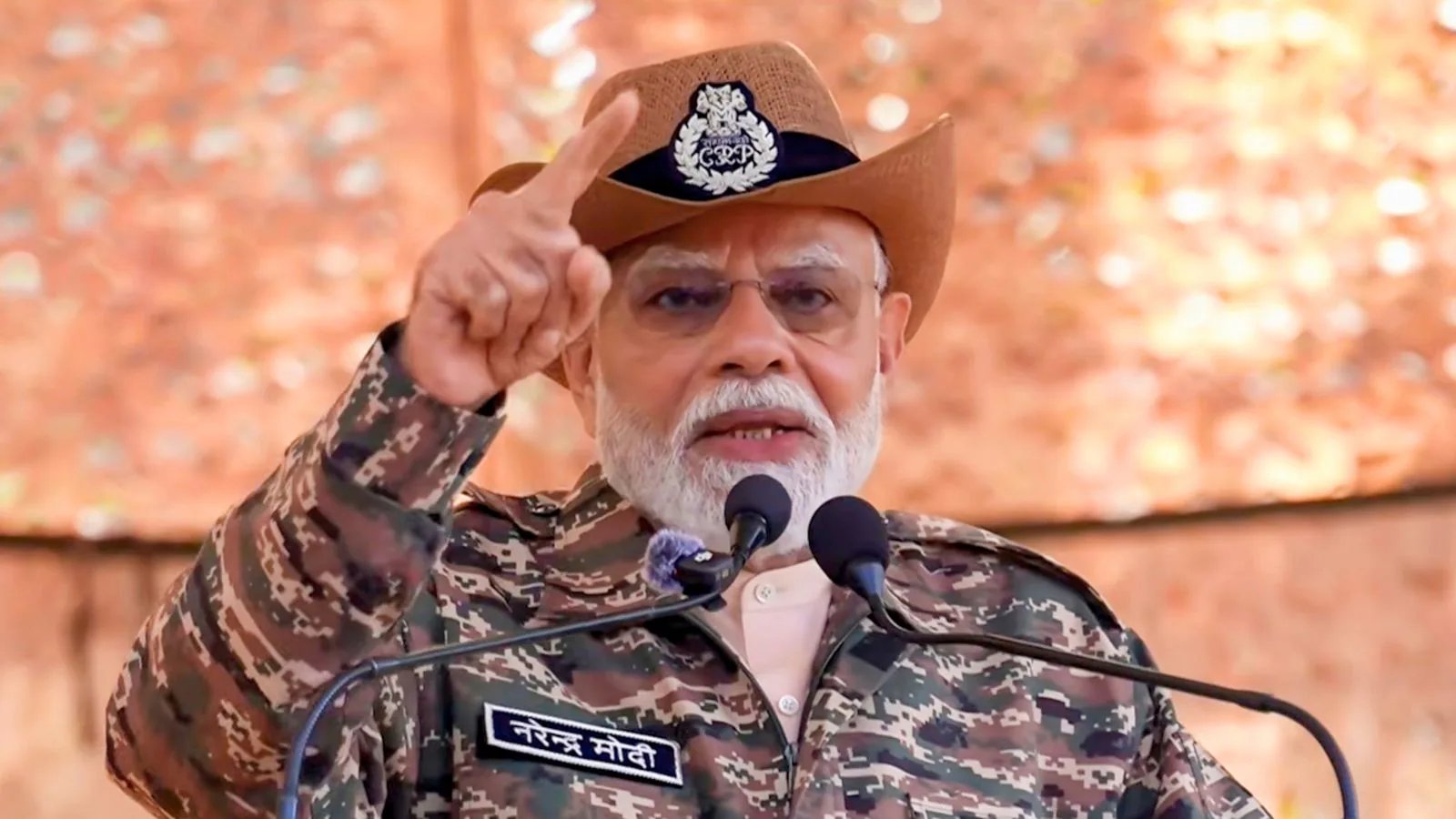
BASTAR, Chhattisgarh — Prime Minister Narendra Modi spent Diwali alongside counter-insurgency forces in Bastar, declaring that India has broken the territorial spine of Maoist terror across all districts.
Had anyone made that claim a decade ago, security planners would have balked. Bastar was the bloody engine room of India's internal conflict. Today, government forces hold the ground. For the first time in 47 years, not a single Central Reserve Police Force soldier was killed in action over the preceding twelve months. That zero-casualty metric closes one of the most violent insurgent eras in modern Indian history.
But the celebration carried a hard political warning. Modi cautioned that armed combatants in the dense forests were only one facet of the insurgency. Ideological proxies—whom he branded "dimagi Naxals"—remain active, embedded inside civilian institutions, activist spaces, and political parties.
"The danger has not passed," Modi told troops gathered at the field outpost. "While armed Naxalites have been eliminated, 'dimagi Naxals' have taken control of various organisations. Even today, they continue to incite people against the Constitution and democracy. These ideological Naxalites have infiltrated several political parties and diverse organisations. We must identify them, defeat them, and ensure the nation's security."
The contrast with earlier security baselines remains stark. In 2010, Maoist fighters ambushed a security patrol in nearby Dantewada, killing 66 CRPF personnel; later that year, an insurgent landmine blew apart a civilian transport in the same district, killing 41 people. Modi noted that between 2004 and 2013, the count of uniformed personnel killed in action routinely eclipsed the number of insurgents neutralized. Aggressive offensive sweeps, sweeping intelligence networks, and state-backed road corridors systematically dismantled those fortified base areas.
The prime minister first introduced the phrase "dimagi Naxals" from the ramparts of the Red Fort on Independence Day, igniting a sustained domestic row. Opposition leaders and anti-establishment figures accused the ruling party of weaponizing the tag to criminalize dissent. Yet the administration has stepped up inquiries into non-governmental organizations and fringe campaign outfits.
That operational shift burst into public view recently when Union Minister Jitendra Singh targeted the satirical outfit Cockroach Janta Party during an address in Bengaluru. Singh asserted that investigators assembled definitive paper trails showing founder Abhijeet Dipke and strategist Ashutosh Ranka rerouted off-the-books funds from hostile overseas networks to stoke domestic unrest. The CJP rejected the accusations, demanding the government present its documentary evidence in open court.
National security planners view the ideological phase as far more stubborn than clearing jungle encampments. Securing forests required raw firepower and road construction. Dismantling political entryism demands institutional surveillance, forensic asset tracing, and sustained legal pushback—a battle line Modi signaled the state will hold aggressively heading into the next legislative calendar.