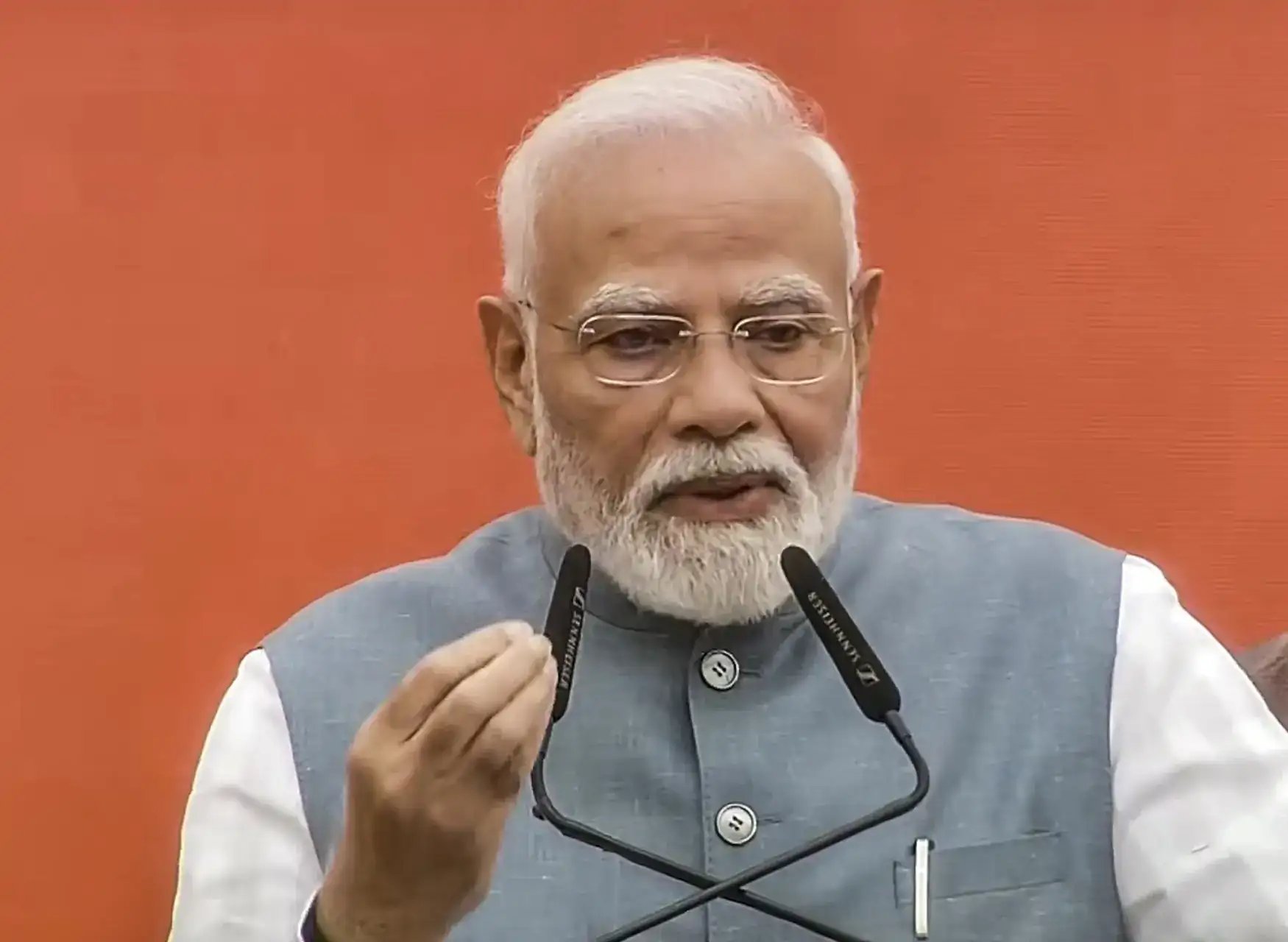
NEW DELHI — Prime Minister Narendra Modi turned the clock back twenty-four years on Thursday, recounting to a room of senior journalists how beat reporters scoops beat his own party brass to announce his 2001 appointment as Gujarat Chief Minister.
The news landed without warning. Sitting in his modest room at the Bharatiya Janata Party's former 11 Ashoka Road headquarters in New Delhi, Modi found himself cornered by a clutch of persistent reporters demanding sweets. Only two to four senior party leaders knew the decision had been sealed. Modi denied the whispers flat out.
The reporters refused to back down.
"They told me that I was being sent to Gujarat to take over as Chief Minister," Modi said, detailing how the pack accused him of hoarding secrets when he genuinely knew nothing. The tip proved exact. Days later, several of those same reporters boarded trains and planes to Gandhinagar entirely at their own personal expense—not to file pool dispatches, Modi noted, but out of personal camaraderie forged across years of shared tea and party briefings.
Political transitions in early 2000s New Delhi operated on shoe-leather sourcing rather than instant digital alerts. Modi spent entire days operating out of the party office, organizing logistics and arranging plastic chairs for press briefings before his sudden shift to administrative power in Gandhinagar.
Yet the reporters knew before the official paperwork cleared the central parliamentary board. Modi admitted the memory still carries a sharp edge of disbelief—noting how field journalists broke through the tightest political cordon in the capital.
I have interacted with media and seen it evolve from days of press releases to Instagram reels.
Prime Minister Narendra Modi
The communications apparatus has since changed beyond recognition. From hand-delivered cyclostyled statements to algorithmic video feeds, the medium transformed, yet Modi insisted the physical grit of field reporting remains irreplaceable, pointing out that beat reporters routinely plunge into active disaster zones and hostile terrain where institutional access stalls.
Pivoting from historical tradecraft to governance outcomes, the Prime Minister framed his administration's economic record against previous decades of anti-poverty rhetoric. He argued that structural welfare spending had fundamentally moved the needle beyond vintage slogans.
"There were slogans of Garibi Hatao. But the poverty has been removed by this government," Modi asserted. He cited World Bank estimates indicating that 50 crore citizens have climbed out of poverty over the past 12 years through targeted welfare delivery and infrastructure outlays.
The Prime Minister laid out specific benchmarks and historic coordinates during his address:
| Milestone / Governance Parameter | Official Record / Stated Metric |
|---|---|
| Political Transition | Named Gujarat Chief Minister (October 2001) |
| Ashoka Road Decision Circle | Restricted to 2 to 4 senior party leaders |
| Poverty Eradication Trajectory | 50 crore people elevated above poverty line (World Bank citation) |
| Information Arc | Transition from physical press releases to Instagram reels |
| Strategic Directives | Media focus on national success stories and anti-drug campaigns |
Modi pushed journalists to direct their investigative muscle toward structural achievements rather than transient political friction, stressing that India's sprint toward developed-nation status demands rigorous chronicling of ground-level development.
He closed with an appeal on internal security and public health: enlist newsrooms directly in the nationwide offensive against drug trafficking networks. The government plans to roll out fresh inter-agency enforcement drives against narcotics syndicates over the coming quarters, with public awareness campaigns slated to lead the domestic agenda.