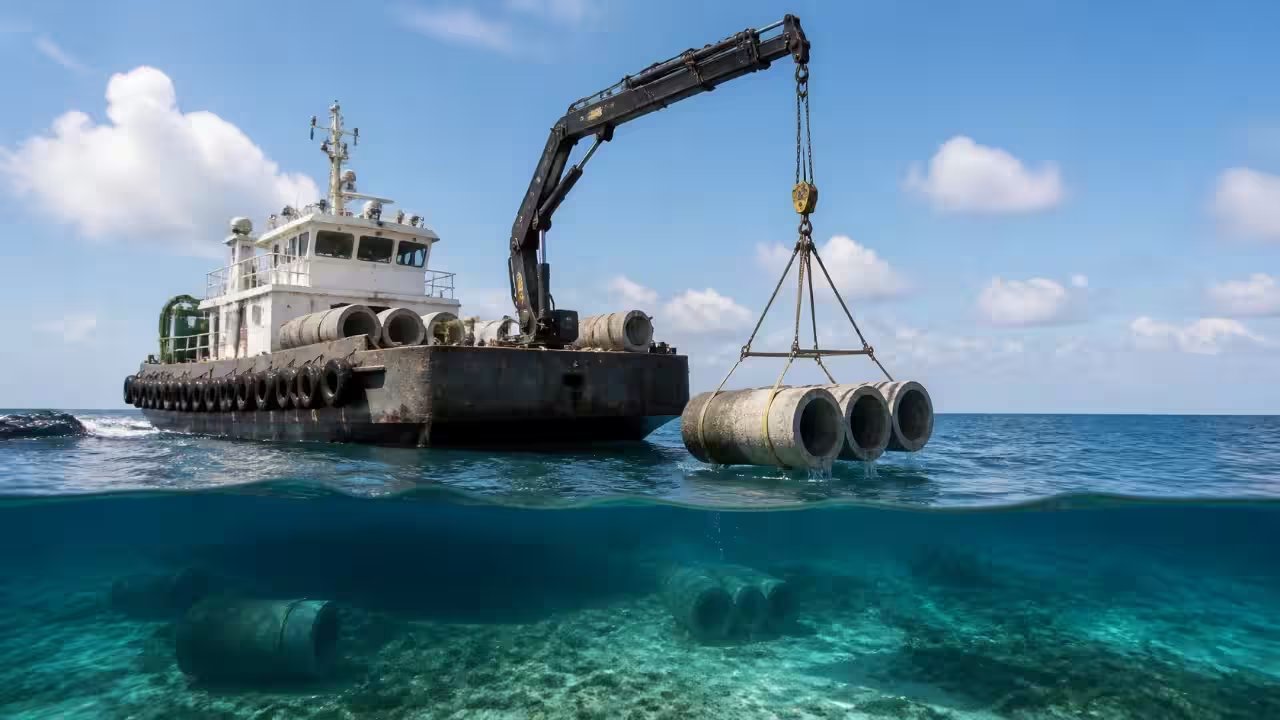
The Jacksonville Offshore Sport Fishing Club lowered nearly 200 concrete pipes, culverts, and other surplus structures onto the seabed of the Atlantic Ocean. The site, known as Harm’s Ledge, sits 28 miles off the Mayport jetties near Jacksonville, Florida, at a depth of roughly 90 feet.
The logic is straightforward. Much of the ocean floor off Northeast Florida consists of loose sand, which offers little for marine life to grab onto. By sinking these concrete structures, the project introduces hard surfaces, openings, and varied shapes. Fish can hide in the culverts, while algae, barnacles, and corals colonize the outer surfaces over time.
The operation required a forklift to load the barge, followed by careful lowering to the seabed. Think It, Sink It, Reef It, an organization focused on artificial reef initiatives, guided the methodology. The project began taking shape in early 2025 when the fishing club started exploring the use of donated concrete. It took grant applications, coordination with the Jacksonville Waterways Commission, the Florida Fish and Wildlife Conservation Commission, and the US Fish and Wildlife Service to get the materials into the water.
This isn't an instant fix. An artificial reef doesn't become a thriving ecosystem the day it hits the bottom. Long-term success depends on water conditions, material composition, and the species that eventually move in. But if the plan works, the site offers shelter, feeding grounds, and spawning areas for fish in a region where natural hard-bottom habitats are scarce.
The installation also marks a renewal of Jacksonville's effort to develop offshore reef habitats, described by local reports as the city's first major project of this kind in several years. Organizers hope this becomes the start of a longer-term program in Northeast Florida, turning construction waste into a permanent home for marine biodiversity.