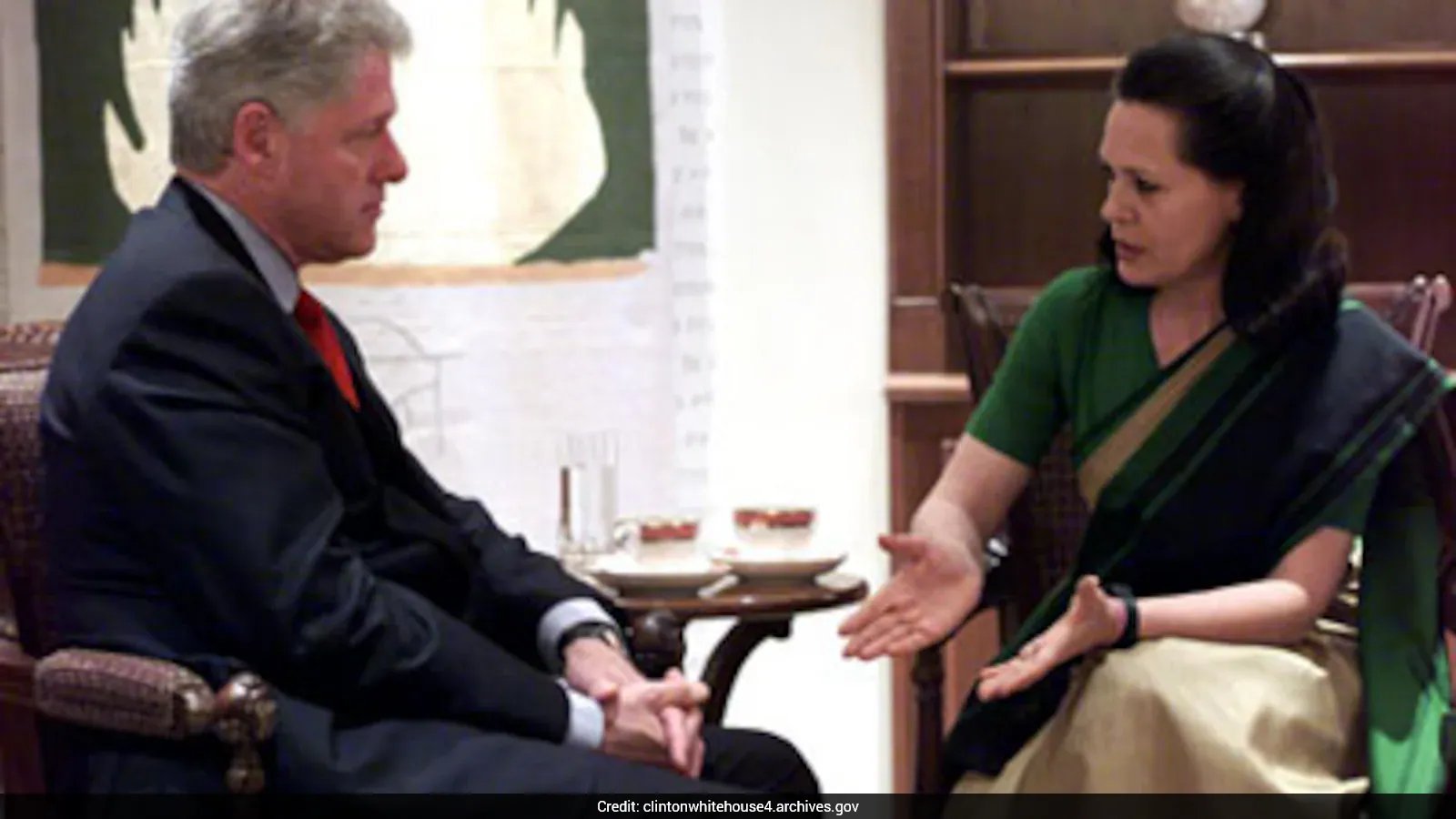
State banquets are rarely candid. The script is rigid, the toasts are rehearsed, and the smiles belong to protocol. But in her newly released memoir, Belonging: A Journey Of Love, Sonia Gandhi strips away the diplomatic varnish to chronicle what world leaders did when they assumed nobody was taking notes.
Central to her sharpest recollections is former US President Bill Clinton during his 2000 visit to India. Clinton stayed at New Delhi's Sheraton hotel alongside his daughter, Chelsea, and a sprawling delegation. Gandhi called on him with India's external affairs minister, encountering an American leader overflowing with informal swagger. Clinton seemed eager to lecture the delegation on Kashmir—branding it a "nuclear flashpoint" and "one of the most dangerous places on earth"—while brushing past the Indian perspective. Yet the real scene played out later at a state reception hosted in his honour by then Prime Minister Atal Bihari Vajpayee. The Monica Lewinsky scandal had subsided, Gandhi notes, but old habits die hard. Standing across the room, she watched Clinton surreptitiously sizing up the more striking women in the crowd.
Gandhi trains an equally clinical gaze on French President Nicolas Sarkozy's solo visit in 2008. Protocol handlers had advised Sarkozy to leave his then-partner Carla Bruni behind, warning that an unmarried companion would disrupt official state decorum. At the banquet table, the wife of Vice President Mohammad Ansari seized the opening. She quizzed the French head of state on his private life—demanding to know when the wedding was set and whether he missed Bruni. Sarkozy did not flinch. He happily fielded the cross-examination while furiously firing off text messages to Bruni under the table.
Years later, the French leader returned to New Delhi for a private dinner with Prime Minister Dr Manmohan Singh. This time, Bruni—by then his wife—glided into the room in an elegant evening gown, drawing every pair of eyes. While Bruni spoke cordially but sparingly, Sarkozy held forth at length, dispensing unsolicited advice on how India should steer its policies. Gandhi observed the spectacle with quiet disbelief, noting Sarkozy's overbearing swagger toward a seasoned, visibly more experienced Indian prime minister.
Household royalty receives a far gentler, though poignant, appraisal. Gandhi details the long-standing family ties with the British royals, remembering Princess Diana as the luminous centre of gravity who outshone the monarchy. Rajiv Gandhi and Sonia had attended the 1981 royal wedding, finding Diana radiant. By 1992, however, the fairytale had cracked. Hours after Diana famously posed alone on the marble bench outside the Taj Mahal, the royal couple dropped in for late afternoon tea. Prince Charles was chatty and amusing. Diana, dressed in a sharp red and purple two-piece suit, sat withdrawn and visibly morose.
Levity arrived only when Priyanka Gandhi insisted that Sonia's visiting Italian mother, who spoke no English, meet the princess. When Diana asked why the older woman remained so quiet, Priyanka confessed that she had been instructed to stay silent. Diana burst out laughing. She reached across the room, took the matriarch's hand, and attempted a warm, informal Italian greeting: "Piacere, come stai?" The room instantly thawed—a rare flash of human grace before the formal motorcade pulled away into the Delhi dusk.