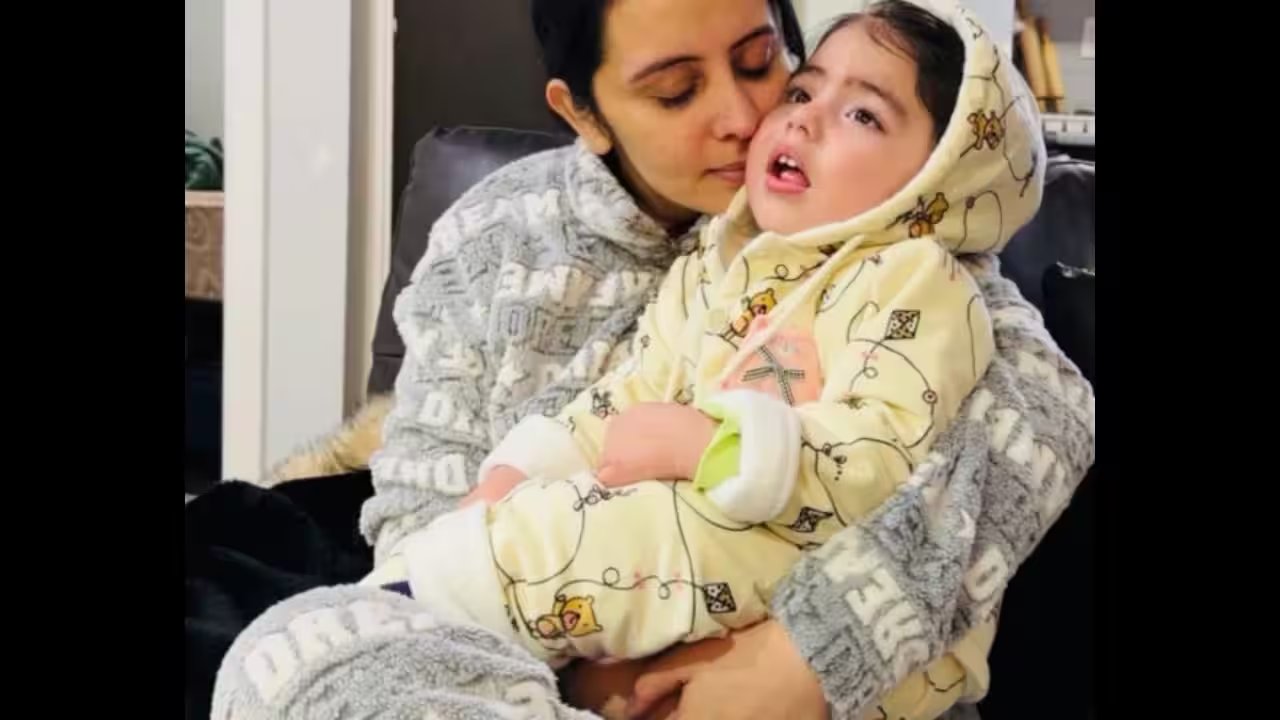
BRAMPTON — Mandeep Chandi and his wife, Ramandeep Kaur, are racing against biological time to raise 5.5 million Canadian dollars to fly their two-and-a-half-year-old son to Boston for an experimental direct-to-brain gene therapy after provincial health authorities slammed the door on public funding.
Their son, Zorawar, suffers from Aromatic L-amino Acid Decarboxylase (AADC) deficiency. The rare genetic disorder halts the brain's ability to produce an enzyme vital for synthesizing dopamine and serotonin. Without these chemical messengers, the central nervous system falters. Zorawar cannot sit, crawl, walk, or speak. He cannot chew solid food.
He survives entirely on liquids.
Several times every week, the toddler's eyes involuntarily roll upward into his head for up to 30 agonizing minutes, leaving him locked in continuous pain.
"He's just in a newborn situation right now, his brain isn't able to get the proper function," said Chandi, who migrated to Canada from India in 2015. "He's not able to walk, talk or sit. He can't do anything, he just sits in his mom's lap 24/7."
His mother described the daily toll of watching her child endure unpredictable bouts of distress without any way to communicate his agony.
Sometimes he is very irritated, cry all the day, and he is not able to — like he can't say anything about what is going on with him.
Ramandeep Kaur, Mother
The family's sole clinical lifeline sits across the southern border at Boston Children's Hospital. There, surgeons administer KEBILIDI — the first gene therapy approved by the United States Food and Drug Administration for AADC deficiency. The eight-hour surgical procedure infuses functional genetic material directly into the child's brain to address the underlying enzymatic defect, offering patients a window to acquire motor and communication milestones over subsequent months.
Canada has not approved the treatment.
Desperate for institutional backing, the Chandis petitioned Ontario's Ministry of Health for out-of-country medical coverage to finance the surgery in Boston. The provincial government formally rejected the application, leaving the household with zero domestic alternatives.
| Clinical & Campaign Parameter | Official Detail |
|---|---|
| Patient | Zorawar Chandi (Age: 2.5 years) |
| Diagnosis | Aromatic L-amino Acid Decarboxylase (AADC) Deficiency |
| Target Therapy | KEBILIDI (Direct-to-brain gene therapy) |
| Regulatory Status | FDA-approved in US; unapproved in Canada |
| Procedure Duration | Approximately 8 hours (Boston Children's Hospital) |
| Fund Target | 5.5 million Canadian dollars |
Faced with bureaucratic refusal, the couple turned directly to the public through a dedicated GoFundMe campaign to meet the staggering $5.5 million CAD requirement.
By November 14, the grassroots effort had amassed more than $1.5 million CAD, crossing roughly 29 percent of the total threshold. The funds cover the projected clinical assessment, intracranial surgical deployment, and months of specialized follow-up care required to gauge neurological response.
Medical teams in Boston caution that the therapy requires rigorous individual pre-assessment and offers no guaranteed medical outcome. Yet for Zorawar's parents, securing the remaining $4 million CAD remains the only path toward giving their toddler a chance at independent movement and relief from chronic suffering.
| Amount Raised |
| Exceeding $1.5 million CAD (approx. 29% as of Nov. 14) |