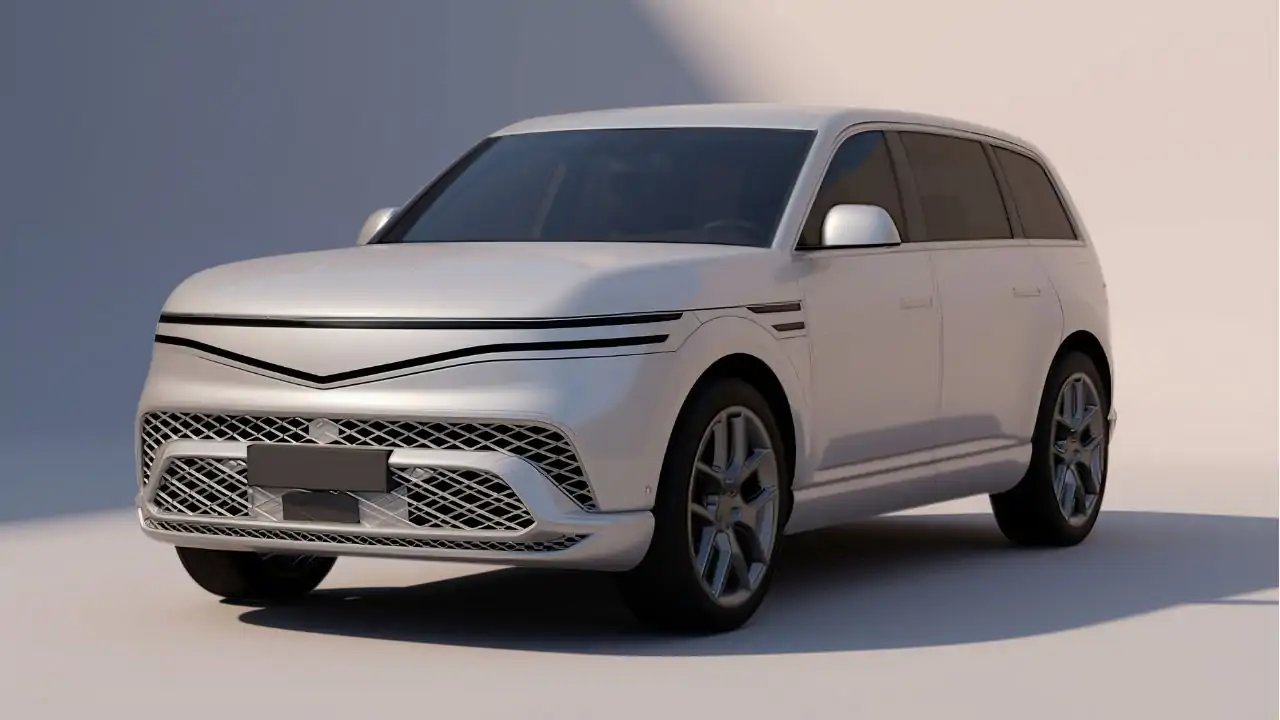
If you are planning to spend north of a crore on a full-size luxury electric SUV over the next three years, Hyundai just laid its cards on the table.
Hyundai Motor Company has patented the design of the Genesis GV90 in India. The move comes ahead of the Genesis luxury sub-brand's scheduled 2027 rollout in the country. A patent filing protects intellectual property rather than guaranteeing an Indian showroom arrival date. Yet the design paperwork submitted in New Delhi shows the standard, production-spec body with conventional doors and three rows of seats, signaling an unmistakable focus on large luxury haulers for the Indian market.
The vehicle first broke cover in August 2026 in two distinct iterations: a standard version and an ultra-exclusive Neolun concept featuring coach doors labeled the Neolun Arch Gate. India gets the design patent for the road-ready standard variant.
Big luxury sells on road presence. The GV90 delivers exactly that.
Check the tape measure: the SUV stretches 5,285mm in length, spans 2,030mm in width, and stands 1,825mm high. It rides on a massive 3,245mm wheelbase with 224mm of ground clearance to clear broken tarmac. Up front, full-width LED daytime running lamps run in Genesis' trademark V-shaped signature, while the tailgate integrates a flush, edge-to-edge light bar. Wheel sizes run up to 22 inches on standard variants, with the flagship Neolun trim pushing wheel diameter to 24 inches.
Step inside, and the equipment list aims straight at upper-tier German rivals. The cabin integrates a 24.6-inch rolling OLED infotainment display matched to an enormous 25-inch head-up display. Hyundai has bundled its Pleos Connect interface alongside a 25-speaker Bang & Olufsen audio system. Every seating position benefits from heating, ventilation, and massage functions, while low-speed agility in tight hotel porticos comes courtesy of rear-wheel steering. Remote Parking Assist 3 handles hands-off maneuvers, backed by a safety system that includes the world's first roof-deployed airbag.
Performance hardware relies on Hyundai's dedicated high-voltage eMP skateboard architecture. It houses a colossal 123.5kWh battery pack engineered to return approximately 500km on a full charge. Ultra-fast charging infrastructure will also matter for cross-country runs; the platform accepts DC fast charging speeds up to 350kW.
Power delivery is immediate. A twin-motor all-wheel-drive assembly pushes out a combined 657bhp and 800Nm of peak torque, putting this multi-ton hauler squarely in super-SUV acceleration territory.
| Specification Parameter | Genesis GV90 Standard | Genesis GV90 Neolun |
|---|---|---|
| Overall Length | 5,285 mm | 5,285 mm |
| Overall Width | 2,030 mm | 2,030 mm |
| Overall Height | 1,825 mm | 1,825 mm |
| Wheelbase | 3,245 mm | 3,245 mm |
| Ground Clearance | 224 mm |
Market Context: In South Korea, the entry GV90 retails at 139.5 million KRW—converting straight to approximately ₹97.97 lakh. The ultra-luxurious Neolun commands 189.9 million KRW, or roughly ₹1.33 crore. Indian buyers must remember that straight currency conversions ignore the heavy customs duties slapped on imported fully built units (CBUs), along with registration fees and state levies. When the GV90 lands on Indian asphalt, its final on-road invoice will sit substantially higher.
So where does it fit?
The standard GV90 takes direct aim at established three-row flagships: the Mercedes-Benz GLS, the BMW X7, and Audi's upcoming Q9. Meanwhile, the coach-door Neolun targets the ultra-luxury bracket populated by the Mercedes-Maybach GLS, Range Rover, Bentley Bentayga, and Rolls-Royce Cullinan.
But caution remains sensible. Genesis has not yet confirmed the Indian variant roster, local battery capacities, or launch pricing. A design patent establishes legal protection—it is not an invitation to visit a dealership tomorrow. Buyers eyeing this tier should track certified local range numbers, public 350kW DC charger installations along trunk highways, and the setup of dedicated Genesis experience centers before crossing off the German mainstays.
| 224 mm |
| Battery Pack | 123.5 kWh | 123.5 kWh |
| Peak Output | 657 bhp / 800 Nm | 657 bhp / 800 Nm |
| Driving Range | ~500 km (single charge) | ~500 km (single charge) |
| DC Fast Charging | Up to 350 kW | Up to 350 kW |
| Korean Base Price | 139.5m KRW (~₹97.97 lakh) | 189.9m KRW (~₹1.33 crore) |