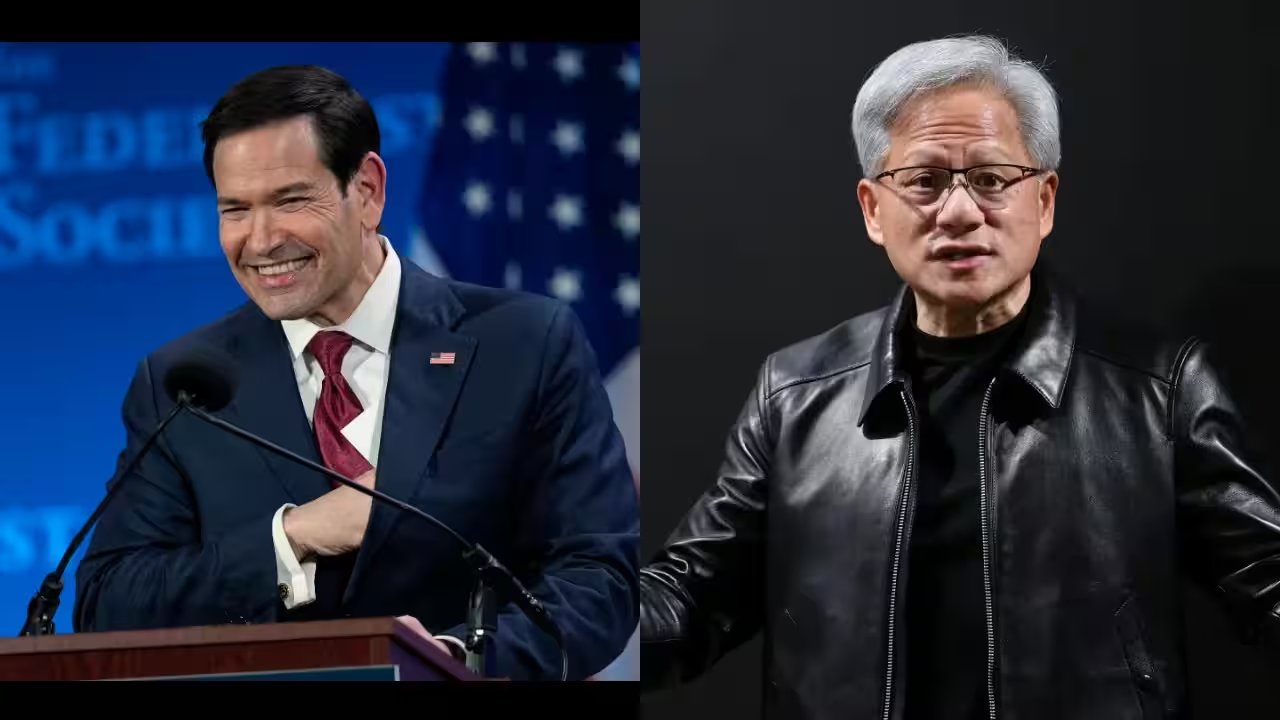
WASHINGTON — Marco Rubio rewrote a classified Central Intelligence Agency assessment to aggressively portray Nvidia chief Jensen Huang as entangled with a suspected Chinese spy, manufacturing the political crisis that ousted Silicon Valley's most powerful executive.
Huang quit on Thursday. The resignation decapitated the world's dominant artificial intelligence hardware maker in a single blow. It also handed Washington's national security hardliners total victory in their shadow war over advanced semiconductor exports to Beijing.
Rubio, executing dual mandates as US Secretary of State and President Donald Trump's national security adviser, took direct aim at Huang using intercepted intelligence. Agency analysts had reviewed the intercepts and hesitated. CIA officials remained unconvinced that the woman—identified in intelligence files as Alice Huang—knowingly transferred trade secrets or proprietary data to Beijing, even as counterintelligence units flagged her as a foreign risk.
Rubio brushed those institutional reservations aside.
Preparing a West Wing briefing memo for Trump, Rubio took the agency's nuanced findings and recast them in his own unyielding, prosecutorial prose. He framed the relationship not as an ambiguous counterintelligence concern, but as an active national security liability right at the president's elbow.
Then the classified memo leaked.
The resulting political uproar stripped Huang of his standing overnight. Former administration officials confirmed that the maneuver was designed from the outset to eliminate Huang’s unique backchannel to the Oval Office.
"They wanted to destroy the influence Jensen had over the president," one former administration official confirmed, detailing the bitter factional divide inside the White House.
Huang had spent months cultivating an unusually intimate bond with Trump. He pushed hard. He convinced the president to carve out key exemptions allowing Nvidia to continue shipping tailored artificial intelligence processors to Chinese commercial clients. That single concession infuriated the administration's China hawks, who argued that every high-end chip exported across the Pacific directly upgraded Beijing's military and supercomputing architecture.
Rubio struck back through the national security apparatus.
| Executive & Intelligence Profile | Case Assessment Details |
|---|---|
| Targeted Executive | Jensen Huang, Chief Executive Officer, Nvidia |
| National Security Official | Marco Rubio, US Secretary of State & National Security Adviser |
| Primary Intelligence Assessment | CIA counterintelligence review of communications intercepts |
| Original Agency Finding | Unconvinced subject knowingly passed intelligence to Beijing |
| Executive Action Taken | Intelligence recast into assertive threat memo; delivered to Oval Office |
| Commercial Outcome | Resignation of Jensen Huang as Nvidia CEO on Thursday |
Rubio refused to address the intelligence rewrite directly when cornered at a Group of Seven foreign ministers meeting in Paris this week. Questioned repeatedly on whether he orchestrated the memo to scuttle technology talks with Beijing, Rubio gave no ground.
The Chinese system is always going to act in the best interest of the Chinese system, and the United States will always act in the best interest of the United States. I work for the American people.
Marco Rubio, US Secretary of State
Nvidia now faces an immediate leadership vacuum. Finding a replacement capable of navigating both the explosive computational demands of the artificial intelligence boom and the hostile geopolitical crosswinds in Washington represents a daunting task for the chipmaker's board of directors.
Federal export control panels are scheduled to review revised artificial intelligence hardware trade limits next month, with the White House expected to lock down the remaining export loopholes Huang fought to preserve.