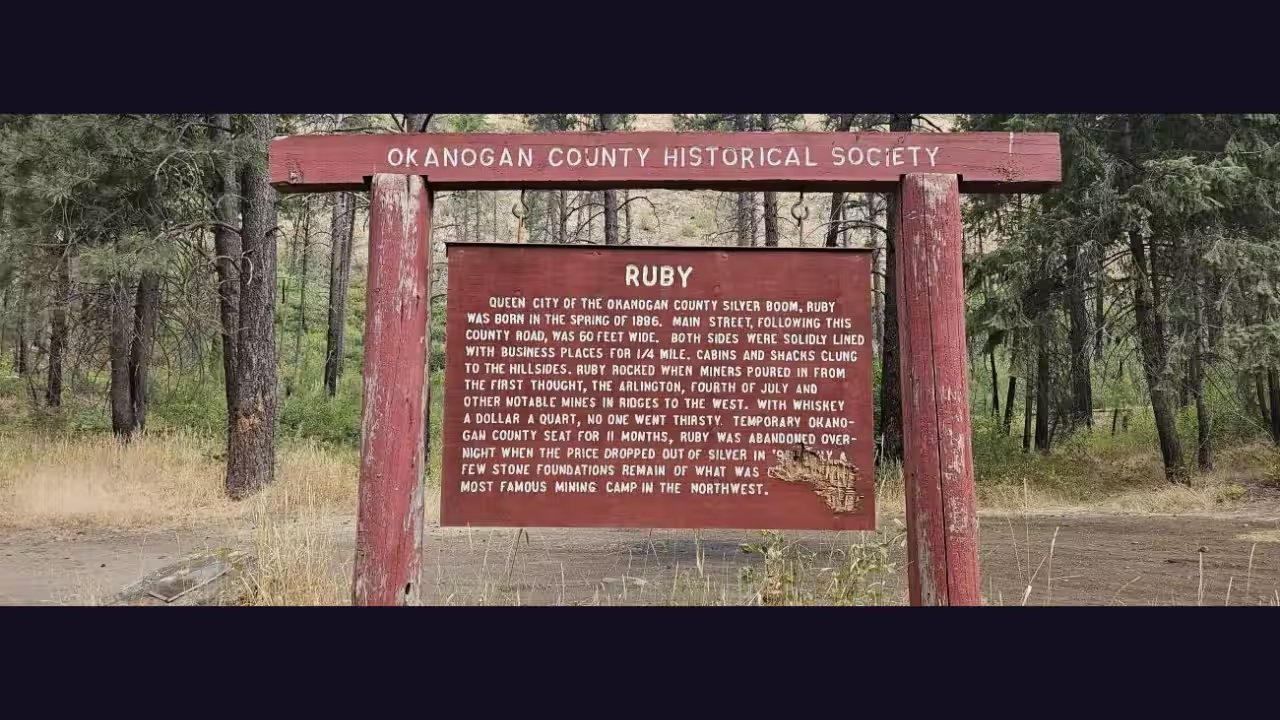
The opening of reservation lands for mineral claims on 1 May 1886 set the stage for a fevered rush; Wendt’s discovery of the Nevada vein north of what would become Ruby City drew investors who formed the War Eagle Mining and Milling Company, leading to a network of claims that produced more than $2.5 million in 2025 terms.
Ruby City was laid out on 6 January 1887 by Singleton and Fuller along Salmon Creek, with Main Street parallel to the waterway and numbered streets running from First to Tenth. The land they sold was not yet legally theirs, sparking a title dispute that would drag on until 17 March 1892, when the courts finally recognized the developers’ ownership.
The town’s economy surpassed the mines: Sam Lichtenstadter’s Bank of Ruby issued pink checks that circulated for nearly $300,000, while saloons like the Mother Lode and the Snug attracted miners and entrepreneurs. In 1888 Ruby became the first seat of newly formed Okanogan County before voters moved the seat to Conconully, a move that stung local pride.
By the early 1890s the silver veins ran thin and transportation costs ballooned—ore had to be hauled 45 miles to Brewster, shipped 80 miles downriver to Wenatchee, then by rail to Tacoma or Montana. The Sherman Silver Purchase Act of 14 July 1890 temporarily buoyed prices, but the subsequent Panic of 1893, coupled with falling silver, forced most mines to shut down. Austin Mires, mayor of Ellensburg, noted in August 1899 that the town was “entirely deserted.”
By 1904 only a handful of crumbling buildings remained, and the settlement was officially abandoned. Today the Washington State Parks and Recreation Commission preserves the site as Old Ruby State Park, where ponderosa pines stand over the ghost of Main Street, offering hikers a glimpse of a once‑thriving silver boomtown.