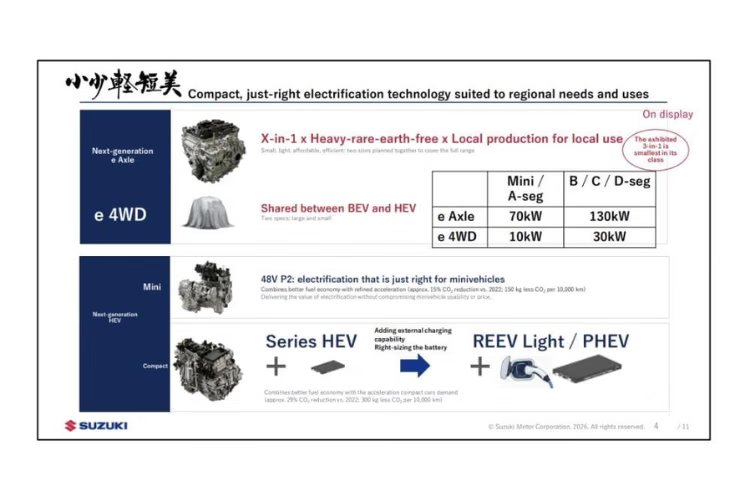
If you’re stuck between a petrol car and a full EV, Suzuki just handed you a third option. The company has confirmed it is building a 'REEV Light' system for its compact lineup. This isn’t a new car model yet, but a powertrain evolution that lets you plug in at home like an EV, but never worry about running out of charge on a highway trip. The wheels are driven entirely by an electric motor. The petrol engine’s only job is to act as a generator, topping up the battery when it dips low. It’s a clever workaround for the current charging infrastructure gap in India.
This builds directly on the series hybrid tech Suzuki started developing for the Fronx and Baleno. Back in February 2024, reports suggested the 1.2-litre Z12E engine would serve as the generator. Now, Suzuki is expanding that concept. Instead of just generating power from fuel, the system will include a charging port and a 'right-sized' battery. The goal is simple: keep the battery small enough to keep the car light and cheap, but big enough to handle daily city commutes on electricity alone. When you go further, the engine kicks in. You don’t need a 400 kg battery pack to drive 50 km in the city.
Why does this matter for your wallet? Because adding a full EV battery to a sub-₹10 lakh car kills its value proposition. Suzuki’s strategy is to share core platforms between the standard series hybrid and this new plug-in variant. By keeping the hardware minimal, they aim to lower production costs. This stands in contrast to Toyota-supplied series-parallel hybrids found in higher-end Maruti models. The REEV Light is specifically targeted at the lower and mid-level segments where price sensitivity is highest. It’s a pragmatic approach to electrification that doesn’t ask the buyer to compromise on affordability.
Suzuki estimates this setup could cut CO₂ emissions by roughly 29% compared to its 2022 baseline. That translates to about 300 kg of carbon saved over 10,000 km. However, the company hasn’t revealed the specific battery capacity or the exact electric-only range for the REEV Light variant yet. It also hasn’t confirmed if the Z12E engine will be the sole generator for this new system. What we do know is that both the standard series hybrid and the REEV Light will be developed together, sharing basic designs. This shared development path is crucial for keeping the final price competitive in a crowded market.
The real question is which car gets it first. The Fronx and Baleno are the likely candidates, given their position in the lineup. Both models are popular and have the space for a modest battery pack. Whether this technology debuts in India or elsewhere first remains unclear. Suzuki has not released a specific launch date or a country-wise rollout plan. For now, it’s a confirmed technology, not a bookable car. Keep an eye on upcoming Maruti Suzuki launches, as this powertrain could quietly appear as a new variant on existing models rather than as a standalone nameplate.