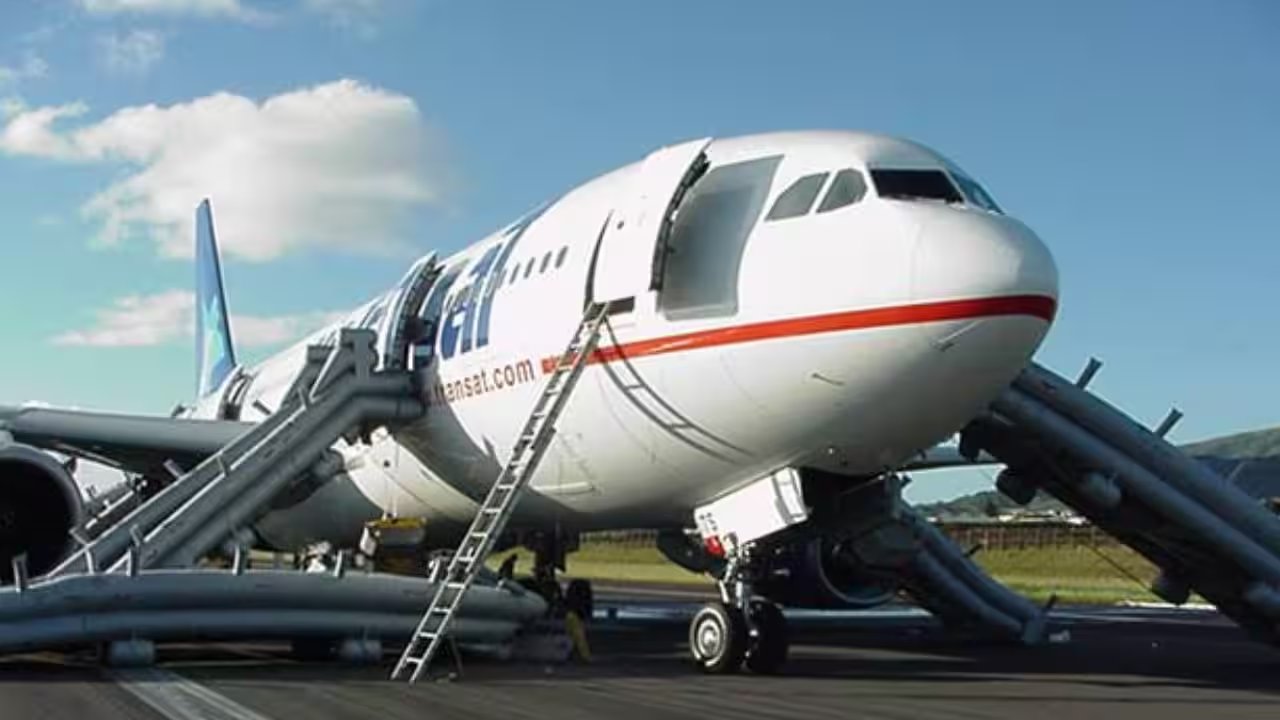
Both engines died over open ocean. Running entirely on momentum and gravity, Captain Robert Piché and First Officer Dirk DeJager steered Air Transat Flight 236 through a desperate 65-nautical-mile glide across the Atlantic, touching down at Portugal's Lajes Air Base on Terceira Island to save all 306 passengers and crew aboard.
The unpowered twin-engine widebody slammed onto Runway 33 at roughly 200 knots—well above typical touchdown speeds. With hydraulic systems severed and anti-skid controls down, the locked wheels shredded rubber against the tarmac, blowing tires before the airframe ground to a halt using nearly the entire runway. Emergency crews evacuated the cabin immediately. Eighteen people sustained injuries during the evacuation, including two passengers with serious fractures, while the Airbus A330-243 suffered structural damage to its lower fuselage and landing gear.
The flight had departed Toronto Pearson International Airport bound for Lisbon carrying 293 passengers and 13 crew members. Four hours into the transatlantic crossing, disaster struck quietly in the dark. A fracture split an engine fuel line, bleeding aviation kerosene out into the night sky at an accelerating rate. The cockpit crew, observing abnormal oil readings and a developing fuel imbalance, initiated fuel transfers between wing tanks—a standard operational procedure that unwittingly funnelled tons of remaining fuel directly into the ruptured line.
Right engine combustion halted at 6:13 UTC, approximately 150 nautical miles out from the Azores. The aircraft sank toward the ocean. Thirteen minutes later, at 6:26 UTC, the left engine flamed out.
Silence filled the cabin. The widebody jet had transformed into a 100-ton glider. The aircraft's emergency ram air turbine dropped into the slipstream automatically, producing just enough electrical and hydraulic pressure to power basic cockpit displays and flight control surfaces. Flaps, slats, and power braking were gone. With military radar operators at Lajes guiding their approach, Piché—a seasoned captain with over 16,000 flight hours—executed a succession of sweeping S-turns to scrub off excess altitude, fighting to align the falling jet with the runway threshold.
The deadstick descent lasted 19 minutes. It remains the longest unpowered glide of a commercial passenger jetliner in modern aviation history.
| Flight Parameter | Recorded Incident Metric |
|---|---|
| Aircraft Model | Airbus A330-243 |
| Total Occupants | 306 (293 passengers, 13 crew members) |
| Gliding Distance Without Power | 65 nautical miles (approx. 120 km) |
| Duration of Unpowered Flight | 19 minutes |
| Touchdown Velocity | Approximately 200 knots |
| Emergency Landing Site | Runway 33, Lajes Air Base, Azores |
An inquiry completed by Portugal's Aviation Accidents Prevention and Investigation Department, working alongside the Transportation Safety Board of Canada, fixed the direct cause on maintenance mistakes made prior to the flight. Technicians had installed an incorrect replacement hydraulic line adjacent to a fuel tube inside the right engine housing. The clearance proved too narrow. Engine vibrations caused the lines to violently chafe against one another until the metal wall fractured, triggering the uncontrolled leak. Regulators subsequently issued strict airworthiness directives mandating revised engine line clearances and overhauled flight manual procedures for in-flight fuel leak detection.
| Survival Rate |
| 100% (All 306 survived; 18 injured) |