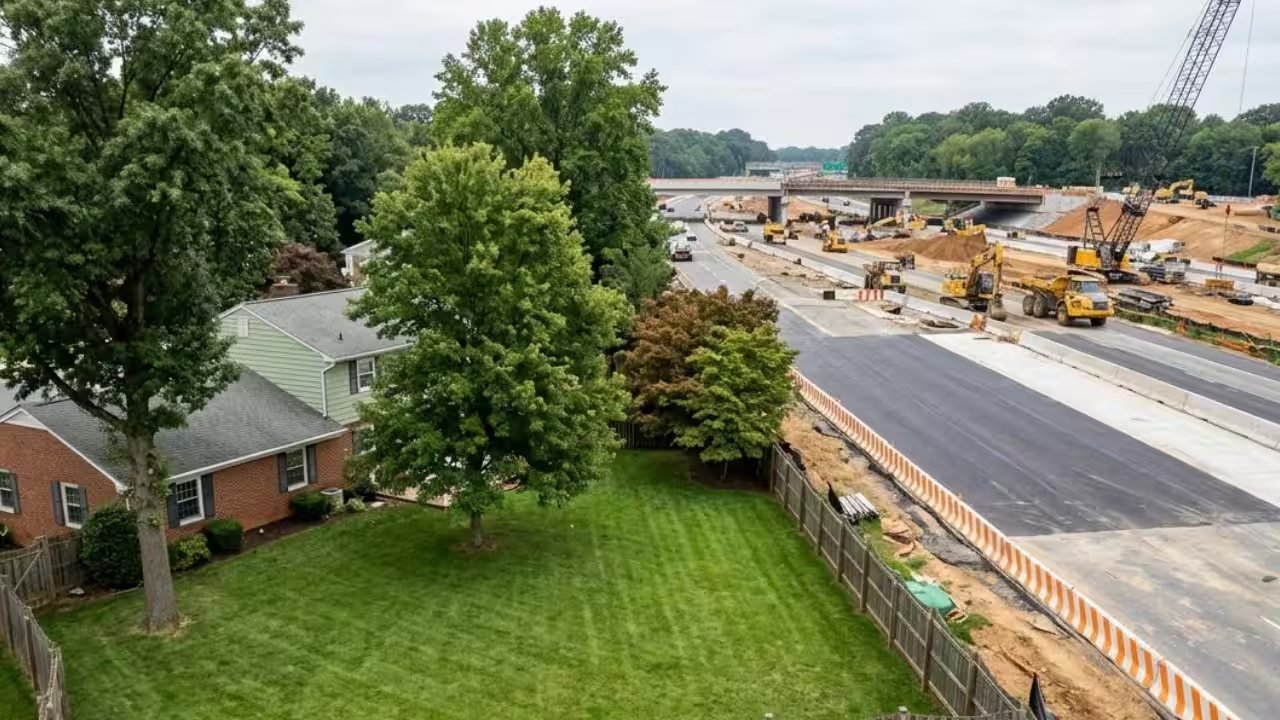
The Court of Appeals of Virginia threw out an attempt by McLean homeowners Omar Mohammad El-Rashed and Eliana Eyad Albelbaisi to secure nearly $500,000 in damages over the state's widening of Interstate 495.
The ruling sets an unyielding boundary on condemnation payouts. The appellate bench held that property owners cannot recover broad financial losses triggered by a massive public road project when the state acquires only a minor, temporary patch of their private yard. The court also denied the couple's petition for legal fees and litigation costs.
Trouble started in March 2023. The Virginia Department of Transportation initiated condemnation proceedings to secure temporary rights over a narrow strip behind the couple's home near I-495. It measured under 10 feet wide and spanned 1,458 square feet. The state required the slope area for construction equipment to expand the highway, which previously ran across eight lanes shielded by a wooded buffer and a sound wall.
VDOT calculated the temporary easement's worth at $29,700—allocating $28,200 for five years of land use and $1,500 for destroyed trees and vines.
The homeowners refused to settle for that.
Calculating a five-year rental value of $50,495 alongside $3,000 for lost landscaping, the couple initially demanded $53,495. But their private appraiser, Dennis Gruelle, took a far more aggressive line. Gruelle calculated that the wider interstate widening would wipe out almost $500,000 in residential market value, citing clear-cut trees, traffic lanes creeping closer, and a replacement sound barrier pushed toward the residence.
Litigation escalated quickly. The Commissioner of Highways moved in circuit court to muzzle the appraiser, arguing that Gruelle's half-million-dollar estimate had nothing to do with the sliver of land the state temporarily rented.
| Claim Parameter | Valuation / Figure | Legal Status |
|---|---|---|
| VDOT Official Easement Offer | $29,700 | Final settlement amount ($28,200 easement, $1,500 foliage) |
| Homeowner Initial Counterclaim | $53,495 | $50,495 rental value over 5 years plus $3,000 landscaping |
| Dennis Gruelle Initial Impact Appraisal | ~$500,000 | Struck down by Circuit Court and Court of Appeals |
| Dennis Gruelle Revised Damage Claim | $124,850 | 5% property reduction for direct easement work |
| Easement Footprint |
Circuit judges agreed with the state and struck Gruelle's comprehensive assessment from the record. The court barred the couple from claiming compensation for project-wide disruptions—including construction noise, dust, vibration, and tree removal on land already owned by VDOT.
Gruelle responded with a fallback calculation. He estimated that disruption tied strictly to the easement parcel itself dropped the property's remaining value by 5 percent, or $124,850.
VDOT challenged that figure as well.
To break the trial deadlock, both parties entered an agreement: the state paid $29,700 for the temporary easement, while the homeowners reserved their right to appeal the judge's order striking down their larger damages claim.
Yet the appellate judges shut that door completely. Virginia law permits compensation for damage to remaining property only when the harm stems directly from the specific land acquired. Because the broader interstate expansion—not the temporary construction strip—generated the disruption, the homeowners had no statutory claim to state funds.
| 1,458 sq ft |
| Under 10-foot-wide rear yard strip |