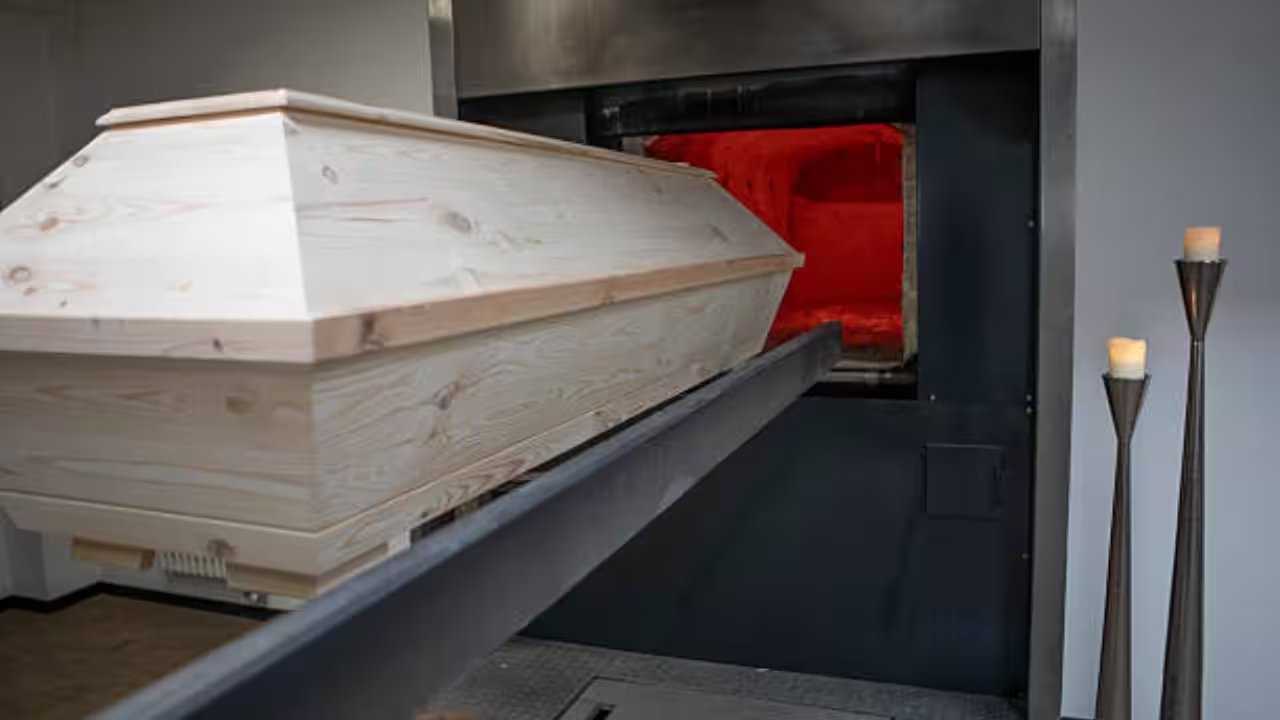
Municipal engineers across northern Europe are channeling heat recovered from crematorium flues directly into urban infrastructure, expanding a once-taboo thermal recycling model to warm thousands of residences and civic institutions.
No longer an isolated British novelty, the process captures thermal exhaust that once escaped into the sky. In Scotland, municipal planners have approved piping crematorium exhaust heat directly into an Aberdeen school currently under construction. In Kangasala, Finland, engineers are preparing to tie an all-electric crematory into a municipal network warming thousands of sub-zero households.
The strategy is straightforward. Incineration chambers generate immense heat—typically wasted through rooftop flues—that heat exchangers can divert into civic water loops before releasing scrubbed gas.
Aberdeen Heat & Power secured full municipal planning consent to route excess thermal energy from the city's crematorium into a brand-new educational campus. The crematorium already warms its own administrative buildings using waste energy, but the municipal project will redirect its larger industrial surplus.
The math makes sense. The city's facility will deliver just under 1 gigawatt-hour of heat each year—meeting roughly half the school campus's total baseline thermal demand. An auxiliary commercial heat pump will bridge the remaining load.
Ian Davidson, chief executive of Aberdeen Heat & Power, confirmed that the municipal pipeline will reach full operational status by February 2027.
They were only utilising a tiny amount of the heat available; the rest was going to the atmosphere.
Ian Davidson, Chief Executive, Aberdeen Heat & Power
Further east, in Kangasala, Finnish municipal engineers are linking an upcoming facility directly to an extensive urban district heating grid. The Finnish crematorium, scheduled to fire its chambers in 2028, will feed hot water into a 200-kilometer municipal distribution loop supplying more than 6,500 residential homes.
Winter temperatures in Kangasala stay locked below freezing for weeks. The town relies heavily on centralized thermal piping, and Finnish planners want off fossil fuels entirely. Unlike older gas-fired models across Western Europe, the Kangasala installation runs entirely on electricity, backed by arrays of rooftop solar panels.
Timo Heikkilä, an energy and building systems consultant at Thenco Oy advising the Finnish project, stressed that modern district integration turns high-temperature waste into essential public safety infrastructure during Nordic freezes.
It’s a special thing. I’m really glad I get to be a part of this... I have thought about it, and once my time is up, I would like to be cremated, and I would like my waste heat to be recycled. It’s the sensible thing. The last favour you can do for the world.
Timo Heikkilä, Energy Systems Consultant, Thenco Oy
The engineering pathway began in central England. Back in 2011, Redditch Borough Council faced severe public backlash when officials disclosed a plan to warm the local Abbey Stadium municipal swimming pool using exhaust flues from the borough crematorium. Opponents blasted the idea. Tabloids balked.
Yet the council persevered. The installation won a national green municipal award and has pumped steady heat through the town's pool since 2013 without disruption.
Redditch conducts approximately 1,200 cremations annually across two gas-fired ovens. Before venting remaining gas into the open atmosphere, primary heat exchangers capture thermal energy while industrial scrubbers remove vaporized dental mercury from the flue stream. That harvested heat transfers into a water circuit that travels 200 meters underground directly into the leisure center's secondary heat exchangers.
Guy Revans, speaking for Redditch and Bromsgrove Councils, pointed out that thousands of liters of leisure pool water serve as an ideal thermal buffer. The water absorbs heat during operating hours and stores it through cold nights, backed by auxiliary gas boilers when peak demand requires extra margin. That closed circuit saves the local council tens of thousands of pounds every single year in utility bills.
| Project Parameter | Redditch, England | Aberdeen, Scotland | Kangasala, Finland |
|---|---|---|---|
| Operational Launch | 2013 | February 2027 | 2028 |
| Facility Heat Source | Two gas-fired ovens (~1,200 rites/year) | City crematorium flue capture | Fully electric chambers with solar panels |
| End User | Municipal leisure pool (200m line) | New school campus (~1 GWh/yr; 50% load) | District network (6,500+ homes) |
Managers across the funeral sector are tightening operational schedules to preserve thermal efficiency. Ian Rudkin, a board member of the Cremation Society of Great Britain who has managed multiple crematoria, noted that facilities increasingly hold caskets up to 72 hours to fire chambers in continuous sequence rather than allowing equipment to cool between individual services.
Families initially expressed hesitation over batch schedules, Rudkin noted, before public sentiment shifted toward carbon reduction. Hannah Rumble, an academic associate at the University of Bath's Centre for Death and Society, observed that end-of-life environmental impact now guides cemetery choices for families confronting the global climate footprint of traditional burials and cremations.
The broader systemic ceiling remains modest. A comprehensive 2024 study published in the peer-reviewed academic journal Energy revealed that even if engineers tapped every operating crematorium across the United Kingdom, the recovered thermal exhaust would cover barely 1 percent of the country's total heating demand. But because heating buildings remains one of the hardest industrial sectors to decarbonize, municipal planners argue that no megawatt of captured heat can be thrown away.
Aberdeen contractors begin final mechanical fit-outs this winter ahead of the February 2027 school delivery, while Thenco Oy completes procurement for Kangasala's 2028 district grid integration.
| Backup System |
| Auxiliary gas-fired boilers |
| Commercial secondary heat pump |
| District municipal thermal network |