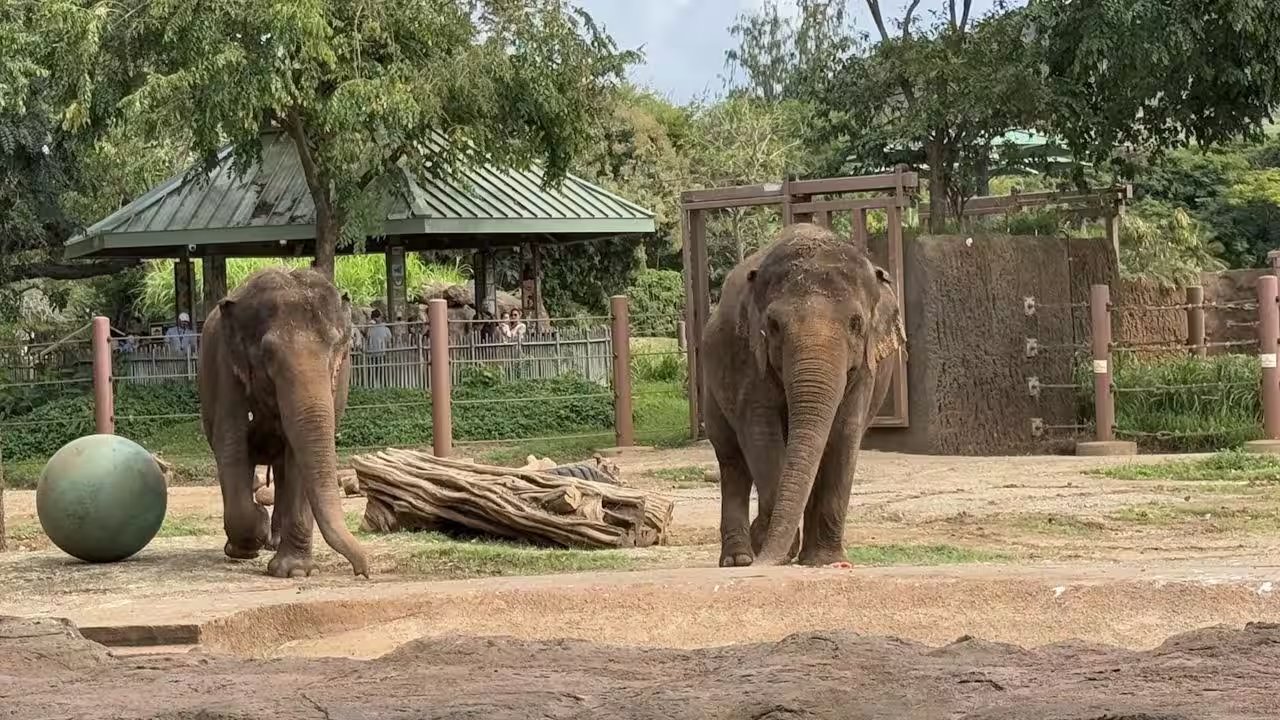
HONOLULU — The Hawaii Supreme Court has agreed to tackle one of the most contentious frontiers in modern jurisprudence: whether an animal can demand its freedom in a court of law.
State justices granted a writ of certiorari to review the prolonged captivity of Mari and Vaigai, two female Asian elephants held inside the Honolulu Zoo for decades. At stake in Nonhuman Rights Project v. City and County of Honolulu, et al. is whether the ancient common-law writ of habeas corpus—historically reserved to release arbitrarily imprisoned human beings—can strike down the cages of complex, sentient nonhumans.
The legal petition does not ask for full human status. It demands something far more specific: physical liberty.
Both animals were ripped from their native habitats as calves. Mari arrived at the municipal facility in 1982; Vaigai was brought into the same facility ten years later in 1992. Together, they share an enclosure spanning roughly 68,244 square feet—less than two acres of artificial landscape.
Yet biology dictates an entirely different existence. Wild Asian elephants regularly trek up to 10 miles each day, navigating expansive home territories that can stretch across 500 square miles. In briefs submitted to the court, the Nonhuman Rights Project (NhRP) argued that lifelong confinement in a municipal pen directly suffocates the animals' profound emotional, social, and physical needs. Scientific declarations lodged in the case record describe elephants as sophisticated beings that solve complex problems, build lifelong familial attachments, display grief over dead companions, and possess acute self-awareness.
The legal remedy sought is not cosmetic enclosure upgrades. NhRP is demanding their immediate relocation to an accredited, expansive elephant sanctuary.
| Case Metric | Official Court & Facility Parameter |
|---|---|
| Captive Animals | Mari (arrived 1982) & Vaigai (arrived 1992) |
| Species | Asian Elephant (Elephas maximus) |
| Current Habitat Size | Approximately 68,244 square feet |
| Natural Wild Home Range | Up to 500 square miles (10 miles daily movement) |
| Lead Legal Vehicle | Writ of Habeas Corpus (Bodily Liberty Protection) |
| Initial Lawsuit Filed | 2023 |
| Appeals Court Dismissal |
The case arrived at Hawaii's highest bench after a bruising lower-court gauntlet. Originally filed in 2023, the petition was thrown out by a state trial judge. In January 2026, the Hawaii Intermediate Court of Appeals upheld that dismissal, adhering to the traditional boundary that nonhuman animals lack procedural standing to petition for release.
NhRP refused to concede. The group filed an application for Supreme Court review in April 2026, persuading the five-member bench to step in.
Counsel for the elephants pushed back against claims that granting habeas corpus would upend the state's legal code. They pointed to established commercial doctrine: American courts routinely grant constitutional speech and property protections to corporations—inanimate legal fictions created on paper—while denying the basic safeguard of bodily liberty to living, breathing, emotionally complex creatures.
The battle has triggered fierce philosophical divisions across legal and commercial spheres. In a supporting amicus brief, the Hawaii Animal Law Section urged the court to evaluate the elephants' confinement through Hawaii's codified "Aloha Spirit" statute—a unique legal framework that mandates state courts to integrate kindness, humility, unity, and deep reverence for nature into judicial determinations. Counsel argued that continuing to trap highly intelligent wild animals within a restrictive display cage directly violates the ethical foundations of Hawaiian law.
Opposition coalitions, including the National Shooting Sports Foundation (NSSF), counter that the petition poses an existential danger to statutory property laws. In formal filings, critics warned that piercing the human-animal divide through habeas corpus would trigger uncontrollable legal exposure, threatening traditional animal ownership, veterinary research, agricultural operations, and wildlife management programs across the islands. They maintain that legislative animal-welfare statutes—not judicial declarations of personhood—are the only appropriate framework for regulating zoological exhibits.
The writ of habeas corpus exists to safeguard the fundamental, sacred interest in bodily liberty from unlawful detention.
Petition for Writ of Certiorari, Nonhuman Rights Project
The Hawaii Supreme Court will convene to hear oral arguments in Honolulu on November 9, 2026, where the justices will decide whether two aging elephants can finally step outside the zoo gates.
| January 2026 |
| Certiorari Granted | June 2026 |
| Oral Argument Date | November 9, 2026 |