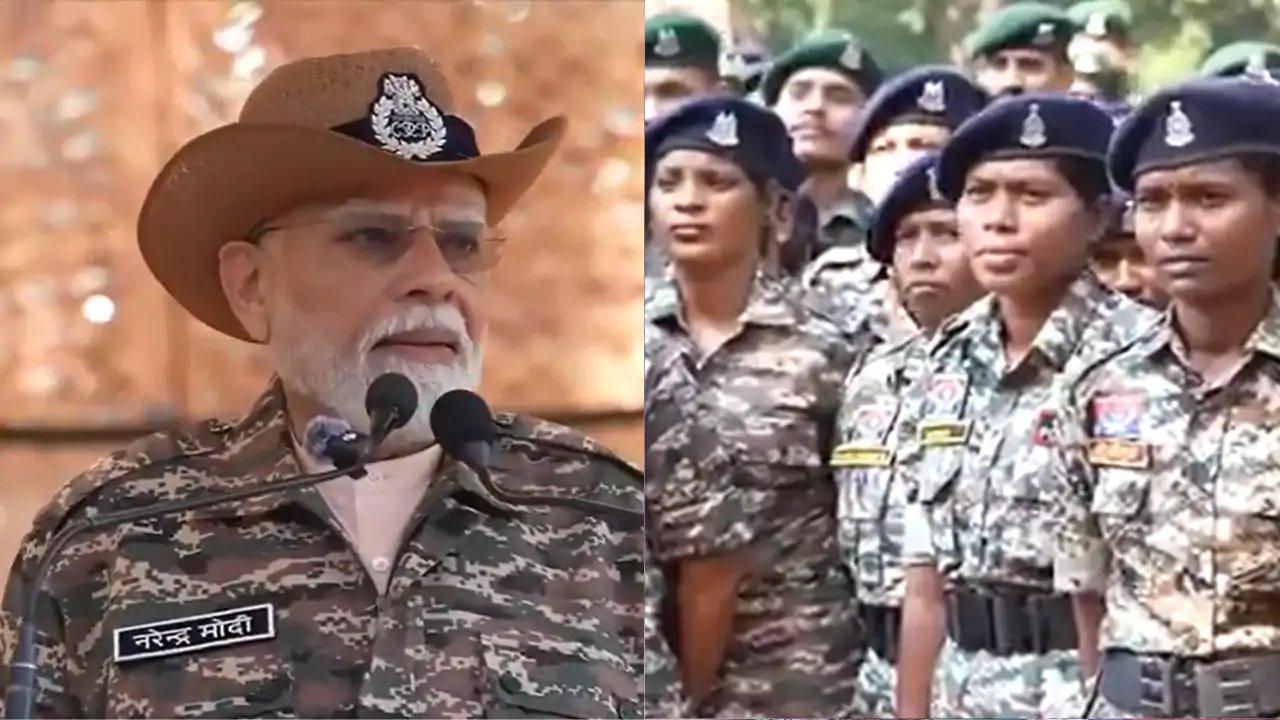
KARANPUR, BASTAR — Standing inside the forested tactical hub that long orchestrated deep-jungle strikes into Abujhmad, Prime Minister Narendra Modi declared Sunday that India has eliminated Naxalism from every district nationwide.
The insurgent war is over. Modi delivered the proclamation to deployed commandos at the Commando Battalion for Resolute Action (CoBRA) Operations Base in Karanpur, using his annual Diwali address to mark what the government frames as a decisive turning point in internal security. Addressing personnel in Chhattisgarh's southern belt, Modi stated that after four to five decades of armed conflict, 2026 marks the first year where Maoist violence no longer holds territorial sway over any administrative district in India.
The breakthrough coincided with an unprecedented casualty benchmark for federal paramilitaries. For the first time in 47 years, not a single Central Reserve Police Force (CRPF) trooper was killed in action in the line of duty.
Credit belonged entirely to the boots on the ground, Modi said, telling troops that their persistence dismantled armed networks that once dictated life across central India. The Centre reshaped its counter-insurgency doctrine through two aggressive levers: strangling illicit extortion funding and stripping away bureaucratic restraints that previously hobbled field commanders during ambushes. "Funding to Naxalites was cut off, helping curb their activities," Modi said. "Earlier, even when Naxalite attacks took place, security forces did not have the freedom to respond decisively. We gave our security forces that freedom to act and respond firmly."
A new chapter of infrastructure and administrative reach has pushed into the interior of Bastar, replacing fortified camps and guerrilla supply lines with permanent civic outposts. The Karanpur facility itself operated for years as the primary springboard for high-risk counter-guerrilla sweeps across the dense tree canopies of southern Chhattisgarh. Yet Modi insisted the battlefield has finally given way to civil governance.
The Bastar stop continues Modi's unbroken 12-year tradition of spending Diwali alongside frontline security personnel rather than in New Delhi. That protocol began in 2014 at the Siachen Base Camp and moved systematically across high-threat frontiers: the Punjab border near Amritsar in 2015, Himachal Pradesh's Sumdoh outpost in 2016, northern Kashmir's Gurez sector in 2017, and Uttarakhand's Harsil in 2018.
Subsequent festival visits placed him along the Line of Control at Rajouri in 2019, the desert outpost of Longewala in 2020, Nowshera in 2021, and Kargil in 2022. He spent Diwali 2023 at Lepcha near the northern boundary, 2024 amid the tidal marshes of Sir Creek in Kutch, and 2025 aboard the aircraft carrier INS Vikrant off the Karwar coast.
Sunday's deployment to Bastar signaled a deliberate pivot from external border defense to domestic pacification. Security deployments across the region will now transition toward area stabilization, civil policing, and accelerated road construction deep into formerly contested jungle corridors.