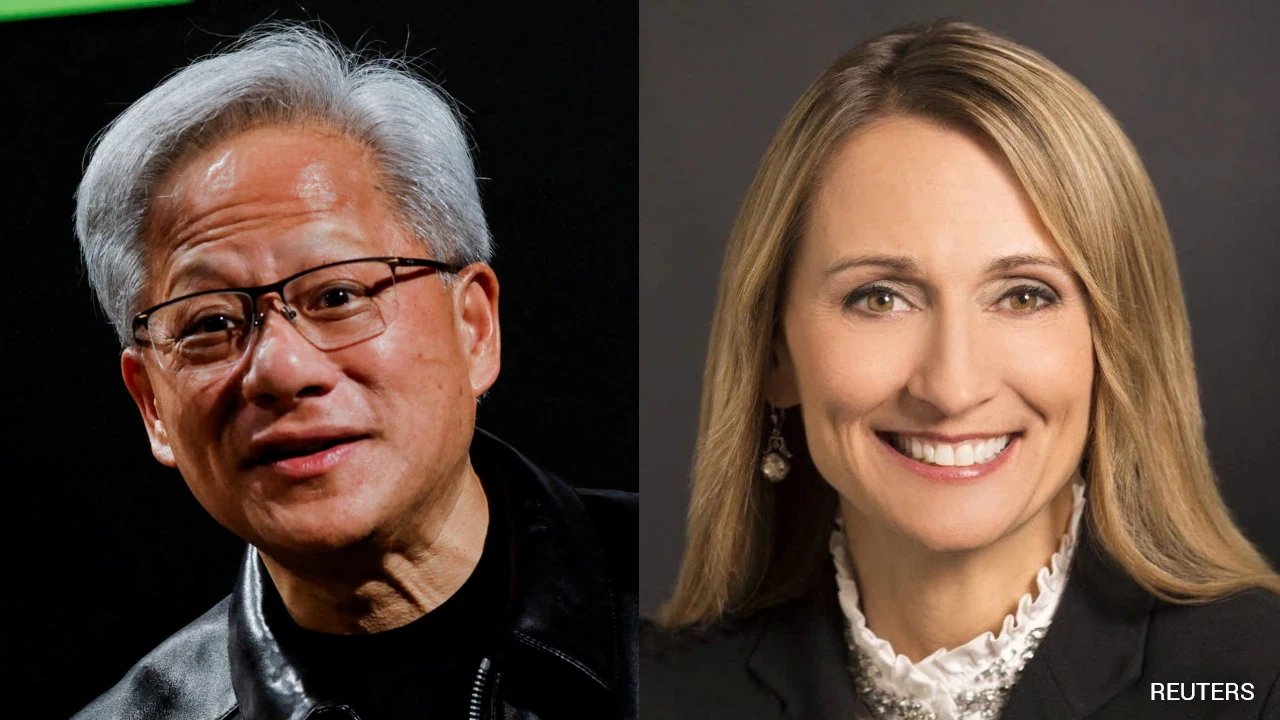
Wall Street absorbed a direct hit on Thursday. Nvidia shares plunged more than 14% in volatile intraday trading following the abrupt resignation of co-founder and Chief Executive Officer Jensen Huang, whose departure stems from disclosures of three extramarital affairs—including one involving an individual suspected of ties to Chinese intelligence. The selloff wiped billions off the world's preeminent artificial intelligence chipmaker before retail dip-buyers staged an afternoon rescue.
Shares opened 13% lower in New York, recovered late-day ground to close down 4.3%, and edged up another 1% in after-hours trade. The leadership shock sent tremors across the broader technology complex, dragging major US stock indices into the red. Huang's exit immediately upends the leadership of an enterprise controlling roughly 90% of the global market for advanced AI accelerators.
| Metric / Milestone | Detail / Figure |
|---|---|
| Intraday Low | Down >14% |
| Closing Price Action | -4.3% (Rebounded +1% after-hours) |
| Advanced AI Chip Market Share | ~90% |
| Peak Market Capitalization | Nearly $6 trillion (7x surge through early October) |
| Interim Chief Executive | Colette Kress (CFO) |
| Newly Appointed Board Chair | Harvey Jones (Director since 1993) |
| Founding Year | 1993 (Jensen Huang, Chris Malachowsky, Curtis Priem) |
The board named Chief Financial Officer Colette Kress as interim CEO while initiating a formal search across internal and external slates. Kress, an executive closely trusted by institutional asset managers, anchored initial market stabilization. Yet the sudden removal of Huang—who co-founded Nvidia in 1993 alongside Chris Malachowsky and Curtis Priem—leaves an unprecedented strategic void. A ferocious AI infrastructure spending cycle had powered a sevenfold run in Nvidia stock through early October, briefly lifting its valuation to nearly $6 trillion as Huang channeled operating cash flow back into cloud providers, silicon suppliers, and venture research labs.
That liquidity machine now faces intense scrutiny.
If Nvidia stabilizes quickly under new leadership, the AI infrastructure boom will have demonstrated resilience. If its stock, financing relationships, or ecosystem commitments remain under sustained pressure, that would add evidence to the fragile side of the AI bubble ledger." >
Stephanie Balaouras, Group Research Director, Forrester
Market Context: Nvidia's hardware acts as the de facto foundational rail for generative computation. Any disruption to its customer capital expenditure feedback loops threatens to repricce multiples across hyperscalers, data-center real estate, and merchant foundry partners worldwide.
Political crosswinds accelerated the panic. US congressional committees launched formal national security inquiries into Huang's foreign connections, and Huang agreed to appear before lawmakers for sworn testimony regarding his ties to a woman suspected of links to Chinese intelligence.
Yet the fallout extends straight into Washington policy circles. Huang maintained deep ties with US President Donald Trump and worked in parallel with Commerce Secretary Howard Lutnick to push for loosened export controls on silicon shipments to Beijing. Both officials now face bipartisan pushback from congressional China hawks over trade oversight. Trump floated former Apple chief executive Tim Cook as a potential candidate to take the helm at Nvidia.
Nvidia's board appointed long-time director Harvey Jones as its first-ever independent board chair following Huang's exit. Jones, who has served on the board since 1993, is also under evaluation for the permanent leadership post alongside Kress.
Two engineering heavyweights have also entered active consideration. Ian Buck, Nvidia's vice president of hyperscale and high-performance computing, represents the leading internal technologist candidate. Buck joined the semiconductor designer in 2004 and engineered the software and hardware stack that shifted the business from consumer gaming graphics into AI supercomputing. From outside the firm, Arm Chief Executive Rene Haas stands as a prime candidate—bringing executive pedigree from his seven years at Nvidia, where he previously served as vice president and general manager.
With congressional deposition dates pending and the board evaluating both internal division chiefs and outside candidates, market participants are watching whether Kress can protect forward order books before full-year guidance comes due.