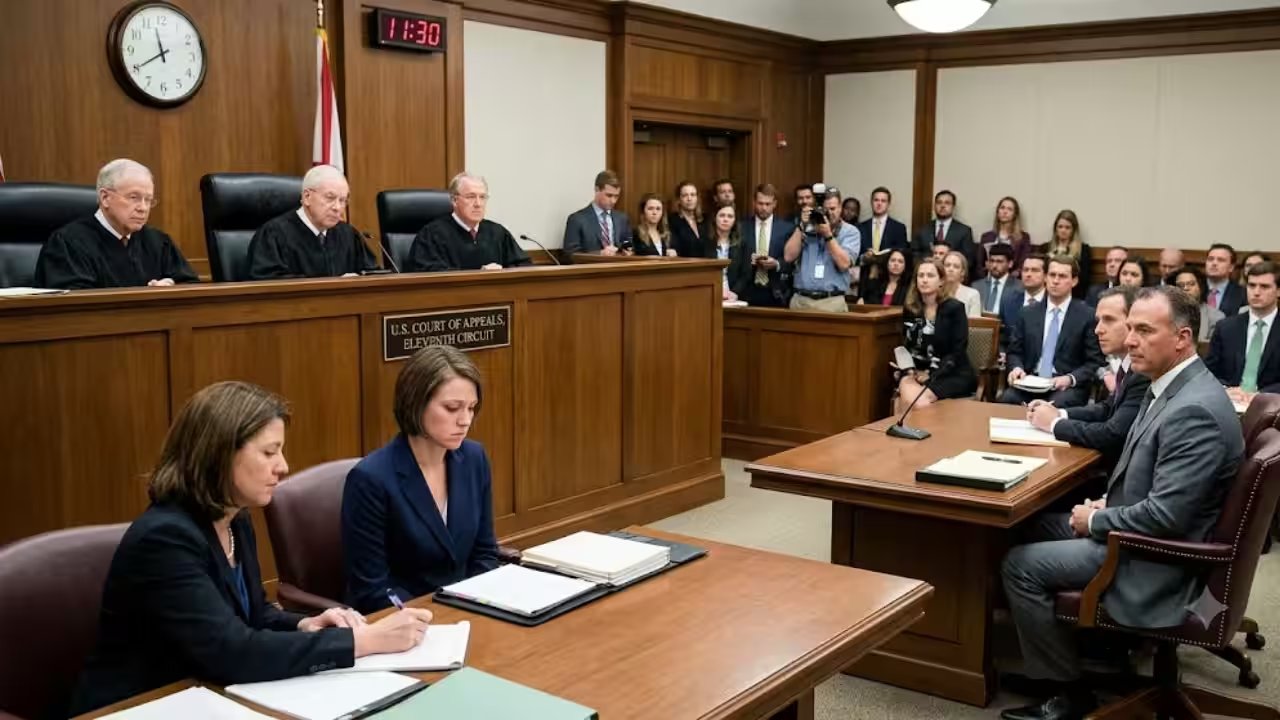
A federal appellate court has affirmed a $2,746,703.27 damages judgment against a woman who breached a confidential settlement agreement by leveling public assault accusations against a senior technology executive.
But the penalty was absolute. In a binding decision issued on November 10, 2026, the United States Court of Appeals for the Eleventh Circuit upheld the ruling against Ronda McNae, concluding she deliberately sabotaged the professional standing of technology executive Michael Fitzgerald after pocketing a $97,000 settlement to resolve earlier disputes. The appellate panel affirmed that private non-disclosure pacts carry severe financial liabilities when deliberately shredded in public forums.
Fitzgerald and co-plaintiff Yelany de Varona initiated the lawsuit in the US District Court for the Southern District of Florida after McNae launched an aggressive disclosure campaign. Despite signing a binding agreement mandating total confidentiality, McNae directly approached Fitzgerald’s corporate employers and professional associates. She accused him of rape and sexual assault, broadcasting identical claims across social media platforms and public websites.
Fitzgerald fought back in federal court. He argued that McNae’s public disclosures were calculated to annihilate his executive career and strip him of his livelihood. The federal district judge agreed, granting summary judgment in Fitzgerald's favor on the breach-of-contract claim after determining that a valid contract existed and that McNae had willfully violated its terms. Claims alleging defamation and intentional infliction of emotional distress were dismissed before trial, leaving the financial penalty tethered entirely to contract law.
A subsequent trial established the exact cost of that broken contract. The court rejected punitive penalties, anchoring the entire $2,746,703.27 sum strictly to compensatory damages. The presiding judge awarded Fitzgerald $2 million in non-economic damages to address the destruction of his executive standing. Evidence presented at trial established that Fitzgerald had built an unimpeachable track record at SoftwareONE prior to McNae's actions, with the court estimating he would require five to six years to rebuild his reputation while forfeiting $2 million in compensation.
Economic losses absorbed the remaining $746,703.27 of the judgment. Trial records showed Fitzgerald earned £550,000 annually and stood in line to become chief executive officer of an emerging enterprise. Following McNae's outreach, his employer placed him on paid administrative leave, barring him from speaking with colleagues, clients, or industry partners. The court ordered McNae to repay the original $97,000 settlement sum alongside accrued commercial losses.
| Award Parameter | Amount (USD) | Legal Basis |
|---|---|---|
| Reputational Non-Economic Loss | $2,000,000.00 | Multi-year executive earnings impairment |
| Settlement Clawback | $97,000.00 | Restitution of breached agreement funds |
| Forfeited Long-Term Incentives | $274,453.27 | Contractual corporate equity losses |
| Lost Performance Bonuses | $219,300.00 | Verified incentive target losses |
| Forfeited Performance Share Units |
OOn appeal, McNae's defense team petitioned the Eleventh Circuit panel to overturn or drastically reduce the award, arguing the lower court miscalculated the financial damages and imposed an excessive burden. The three-judge panel dismissed the challenge outright. Writing for the court, the panel stated the district judge properly calculated both categories of damages from documented financial audits, including analysis from damages expert Sheri Fiske, who confirmed $472,250 in direct economic impact alongside corresponding SoftwareONE payroll filings.
Fitzgerald v. McNae now stands as final law in the Eleventh Circuit, with the complete $2,746,703.27 judgment remaining executable in the Southern District of Florida.
| $155,950.00 |
| Documented executive equity forfeiture |
| Total Enforceable Judgment | $2,746,703.27 | Upheld in full by Eleventh Circuit |