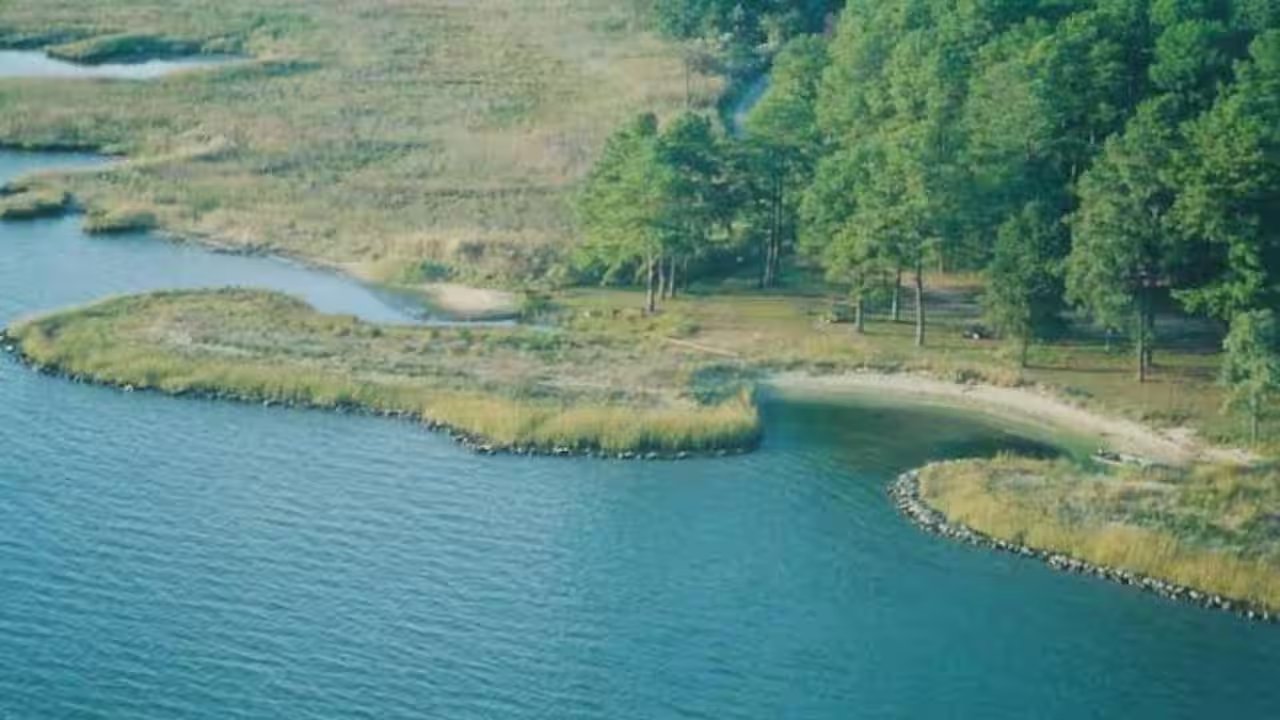
The concrete that once held the roar of Baltimore Orioles fans is now holding back the Chesapeake Bay. In 2002, engineers hauled thousands of cubic yards of clean, rebar-free rubble from the site of the former Memorial Stadium to Queen Anne’s County. The goal was simple but radical: stop wave erosion without building a wall. Today, data from the Maryland Department of Natural Resources confirms the experiment worked. The recycled material has anchored more than 400 linear feet of shoreline and fostered two acres of thriving intertidal wetlands.
Unlike the stiff, reflective bulkheads that line much of the bay, these low-lying 'sills' let water, sediment, and crabs pass through. Smooth cordgrass (Spartina alterniflora) and saltmeadow cordgrass took root behind the concrete barriers. Their root systems trap sediment, slowly raising the marsh surface. This natural elevation allows the wetlands to keep pace with sea-level rise, a feat traditional seawalls simply cannot achieve.
The proof came during the worst weather the region has seen in decades. While nearby hard structures cracked and failed under the assault of Hurricane Sandy and Tropical Storm Lee, the Grasonville site held steady. The Chesapeake Bay Environmental Centre (CBEC) in Grasonville has maintained the location as a living laboratory. Their monitoring shows the site now filters nitrogen and phosphorus from runoff while providing nursery habitat for young blue crabs and striped bass.
The stadium’s story doesn’t end on the shore. The Maryland Artificial Reef Coalition reports that additional crushed concrete was barged to deep-water locations to form artificial reefs. These structures have attracted eastern oysters, barnacles, and sportfish like tautog and summer flounder. It is a connected ecosystem, born from sports history, now sustaining marine life at every stage.
Maryland lawmakers passed the Living Shorelines Protection Act in 2008, making nature-based designs the standard for new permits. The Memorial Stadium project was the early proof that soft engineering beats hard concrete. As the state’s Watershed and Climate Service continues to track sediment buildup and plant growth at the Grasonville site, the data provides a clear blueprint. Other Mid-Atlantic communities are watching closely, waiting to see if this 20-year-old experiment can be scaled up to save their own coasts.