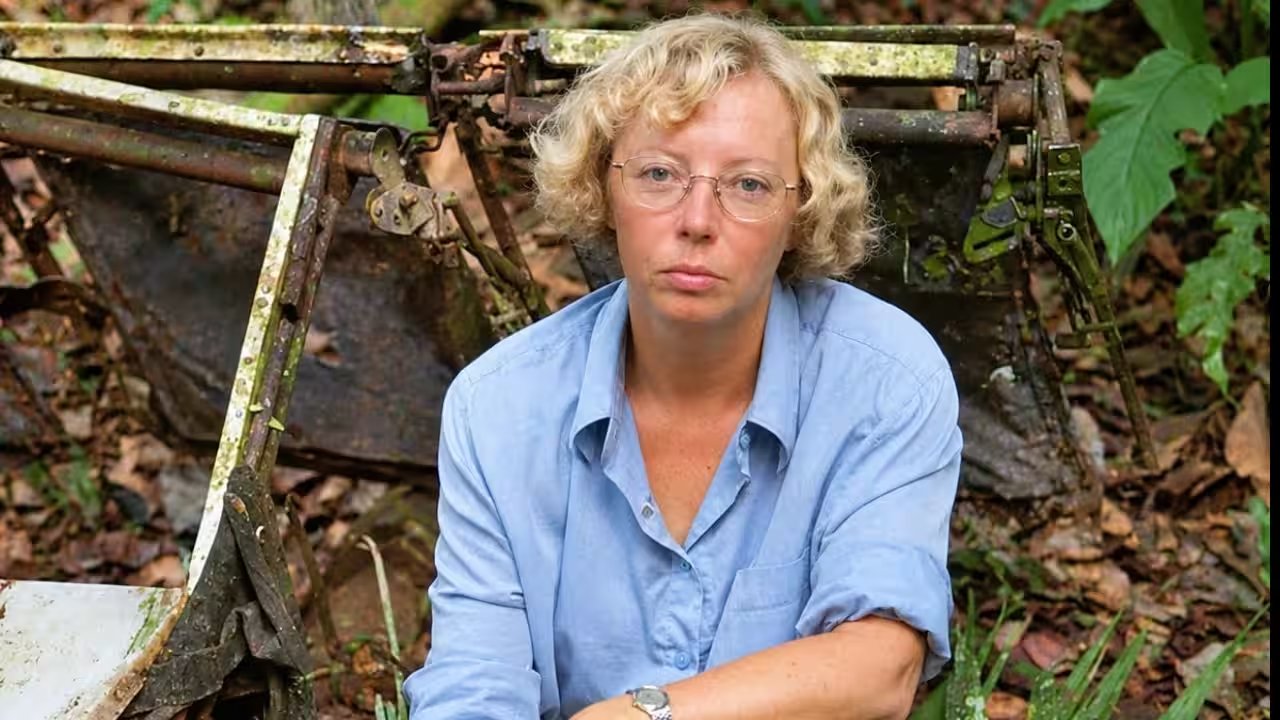
Juliane Koepcke plummeted nearly 10,000 feet through pitch-black storm clouds strapped to a three-seat airplane bench, crashing into the dense canopy of the Peruvian Amazon as LANSA Flight 508 broke apart in mid-air. She survived.
Of the 92 people aboard the Lockheed L-188A Electra turboprop on Christmas Eve 1971—86 passengers and six crew members—91 perished. Koepcke, then just 17 years old, was the sole person to walk out alive. For 11 days, nursing a broken collarbone, a ruptured knee ligament, and an arm wound festering with maggots, she navigated treacherous primary jungle using survival principles taught by her zoologist parents.
Flight 508 departed Lima bound for Pucallpa following a grueling seven-hour delay. Koepcke was traveling with her mother, ornithologist Maria Koepcke, to spend the Christmas holiday with her father, renowned zoologist Hans-Wilhelm Koepcke, at Panguana, their remote biological research station 30 miles deep in the rainforest. Lightning flashed violently as the turboprop entered severe turbulence over the Ucayali Region. Screams tore through the cabin.
Koepcke gripped her mother’s hand. Neither could speak. Then, a blinding flash of light struck the outer left engine. Maria Koepcke leaned over and whispered calmly: “That is the end, it's all over.” Those were her final words.
Whipped into a vertical nosedive, the aircraft shattered. The deafening engine roar ceased abruptly, replaced by the hiss of rushing wind. Koepcke found herself spinning in free fall thousands of metres above the unbroken forest canopy, pinned to her seat before losing consciousness.
She awoke the next morning on the rainforest floor. She called out for her mother into the dense foliage, but silence answered. Her glasses were gone. One sandal had vanished. Clad only in a sleeveless mini-dress, she took stock of her body. She had sustained a broken collarbone, deep leg lacerations, and a torn knee ligament. “My injuries weren't serious, so I could still walk,” Koepcke later recalled. Her primary weapon was an intimate familiarity with the jungle, gained from living at Panguana since her birth in 1954.
She located a small trickling stream and began tracking the current downstream, knowing all creeks eventually flow into larger rivers where human settlements cluster. Her sole nourishment consisted of a small bag of candy recovered near the crash perimeter. She carefully stepped around camouflaged pit vipers and listened to search planes droning above the canopy, invisible behind the impenetrable ceiling of trees.
On the fourth day, Koepcke heard the heavy wingbeats of a king vulture descending nearby—a bird that lands only for carrion. Tracing the sound around a river bend, she encountered an inverted aircraft bench jammed into the mud with three deceased passengers. Terrified that one might be her mother, she inspected the corpse with a stick and noticed painted toenails; Maria Koepcke had never polished hers.
| Flight 508 Incident Parameter | Documented Historical Metric |
|---|---|
| Aircraft Type | Lockheed L-188A Electra (LANSA Flight 508) |
| Crash Date | December 24, 1971 |
| Free-Fall Altitude | Approximately 3,000 metres (nearly 10,000 feet) |
| Total Occupants | 92 (86 passengers, 6 crew members) |
| Total Fatalities | 91 confirmed deceased |
| Sole Survivor | Juliane Koepcke (17 years old) |
Banked by swollen rivers, her physical reserves deteriorated sharply by day ten. Koepcke drifted through the water until she spotted a wooden boat moored near a small shelter with a palm-leaf roof. Inside, she discovered an outboard motor and a small can of gasoline. Fly larvae had burrowed deep into a one-centimetre wound on her right arm. Drawing on childhood memories of treating a pet dog with kerosene at Panguana, she siphoned fuel from the can and poured it straight into the wound, pulling out roughly 30 maggots.
She collapsed on the wooden floor for the night. The following morning, three local timber workers discovered her in the shelter. Stunned by her presence, they initially mistook her for a mythical water goddess from local folklore. Koepcke addressed them in fluent Spanish, recounted the plane crash, and received basic first aid before the crew boated her downstream to Tournavista, where medical teams evacuated her to safety and reunited her with her father. Her survival stands as one of the most astonishing endurance feats in modern human history.
| Days in Jungle |
| 11 days (Rescued January 3, 1972) |