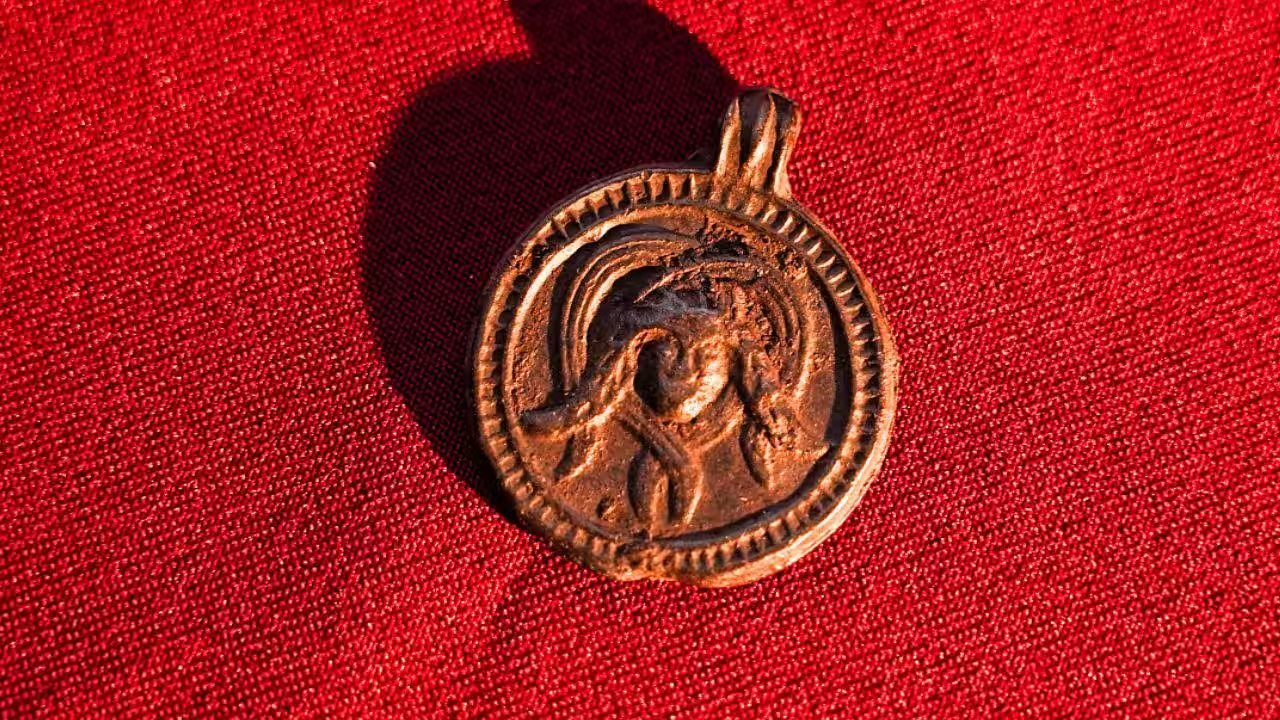
Novgorod State University archaeologists pulled an 11th-century copper-alloy pendant from the Pyatnitsky site in Staraya Russa. The object is a "serpentine" amulet—two-sided, with a warrior saint holding a spear and shield on one face, and a woman’s head with snake-like hair on the other. This isn't just jewelry. It's a cultural artifact that rewires our understanding of early medieval Russian material culture.
The saint is identified as Theodore Stratelates, while the serpentine figure echoes the Gorgon Medusa from Greek mythology. But researchers caution that this wasn't necessarily a specific mythological creature. It was likely a general representation of dark forces. The pendant was found in an ancient urban household that was still under development during the 11th century. This placement suggests the owner was part of the broad middle social group—too wealthy for simple bone charms, but not rich enough for the gold and silver worn by the elite.
Sergei Toropov, director of the NovSU Center for Archaeological Research, noted that the pendant may have been produced locally. A workshop capable of such detailed work might have operated in the same household. The non-canonical tradition of wearing these protective amulets against illness came to Rus from Byzantium. Before this dig, only four such pendants had been found in Staraya Russa, and all dated to the late 12th to 14th centuries. This new find pushes the timeline back by several centuries.
The discovery underscores well-developed cultural ties with Byzantium. It proves a Christian community was already established in the settlement during the 11th century. The fusion of Christian and pagan imagery on a single object highlights the syncretic nature of early Russian spiritual life. The pendant wasn't just decorative. It was functional protection, blending the power of a saint with the apotropaic force of a serpent.