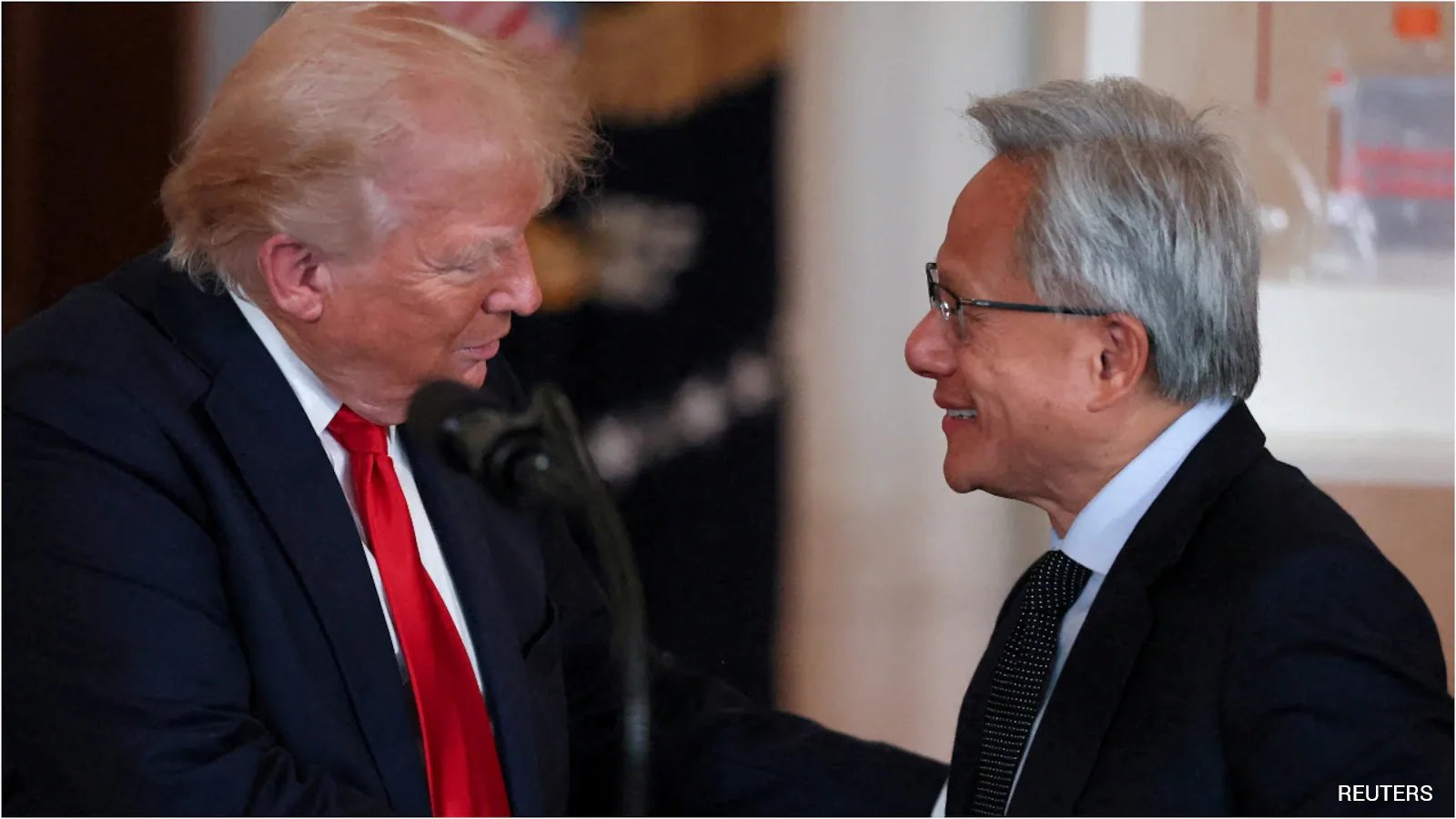
WASHINGTON — The alliance crumbled overnight.
Former Nvidia chief executive Jensen Huang resigned from his post on November 12, 2026, stepping down under the weight of an expanding Federal Bureau of Investigation inquiry and imminent congressional hearings. Federal investigators are scrutinizing Huang's personal ties, focusing on an affair with a businesswoman alleged to be an intelligence operative for China. The revelation caught the administration off guard, leaving President Donald Trump answering for two years of aggressive chip diplomacy that granted Silicon Valley’s most visible executive direct access to the Oval Office.
Trump acknowledged the shock on November 9, confirming he spoke directly with Huang once details surfaced regarding an affair with Alice Huang, an unrelated former executive. The president stated he was "amazed" by the allegations against a figure who had stood at the core of his administration's commercial artificial intelligence strategy.
Yet the bond between the two men had spent two years reshaping American technology policy.
Nvidia’s chief spent much of 2025 and 2026 lobbying the White House to loosen federal export curbs on advanced graphics processors destined for the Chinese market. Democratic and Republican lawmakers pushed back, repeatedly demanding a complete halt on shipments of high-performance computing hardware to strategic adversaries. Huang argued the opposite. He told administration officials and Capitol Hill lawmakers that maintaining American chip sales would force Chinese developers to stay dependent on US architecture.
The White House sided with Huang.
In January 2026, the Trump administration cleared case-by-case export authorizations for Nvidia's high-performance H200 AI chips to Chinese buyers. While restrictions remained in force for entities on Washington's official trade blacklist, the concession gave Nvidia a critical revenue lifeline into mainland data centers.
Jensen, will you stand up? What a job, what a job you've done. He's a great guy too.
Donald Trump, President of the United States
The political access had started early. In January 2025, during his first month back in the Oval Office, Trump hosted Huang for what he described as a "good meeting." By July 2025, Huang visited the White House again ahead of an executive trip to Beijing. Later that month, Trump singled out Huang during a White House AI summit, ordering him to stand as the president signed executive orders.
By August 2025, the pair held formal talks inside the West Wing specifically centered on advanced chip licensing. Huang then traveled alongside Trump during a state visit to Britain in September 2025, cementing his role as the administration's primary corporate tech envoy.
| Chronology | Diplomatic & Corporate Milestone | Policy & Regulatory Outcome |
|---|---|---|
| January 2025 | Oval Office bilateral meeting | Initial coordination on administration AI agenda |
| July–August 2025 | White House strategy sessions | Talks begin over easing China AI processor restrictions |
| January 2026 | Commerce Department licensing update | H200 AI chip exports cleared to China on case-by-case basis |
| March 2026 | Presidential appointment | Huang appointed to 13-member Science & Technology Council |
Huang's influence widened steadily through 2026. In late March, the White House formally named him to the 13-member President's Council of Advisors on Science and Technology, seating him at the highest table of federal policy formulation.
Two months later, access turned physical.
During a May 2026 presidential trip to Beijing aimed at pushing Chinese President Xi Jinping to open markets to American corporations, Trump issued a last-minute directive summoning Huang. Ground crews spotted the Nvidia boss walking up the stairs to board Air Force One during a scheduled refueling stop in Alaska. Huang landed in Beijing as an official part of the presidential delegation.
He returned to Washington in September 2026, taking a prominent seat at a formal White House state dinner honoring Xi. Days earlier, Huang had taken a live telephone call from Trump during a technology conference in Los Angeles. Putting the president on speakerphone for five minutes, attendees heard Trump publicly dismiss corporate AI safety fears as a "hoax." By September 29, Huang stood beside Trump in the Oval Office to sign a voluntary, "morally binding" safety pledge that drew sharp rebukes from regulatory watchdogs for containing zero enforcement penalties.
The relationship carried financial entanglements. In early October 2026, Trump presented Huang with the National Medal of Science, the highest scientific honor in the United States. On the exact day of the medal ceremony, federal ethics disclosures showed Trump had actively traded Nvidia stock during the summer of 2026, buying up to $1.6 million and shedding up to $1 million in company shares. By mid-October, Nvidia pledged a $25 million corporate gift to finance Trump's planned White House ballroom.
Federal investigators have refused public comment on the timeline of the counterintelligence probe. Bipartisan committee leaders in both chambers of Congress are now drafting subpoenas for White House visitor logs, flight manifests, and Commerce Department licensing files, scheduling the first public testimony on the Nvidia security breach for the coming weeks.
| May 2026 | Presidential trade delegation to China | Huang boards Air Force One during Alaska refueling stop |
| September 2026 | Los Angeles AI Summit & White House pact | Trump dismisses safety concerns; Huang signs voluntary pact |
| October 2026 | Oval Office honors & financial filings | Trump awards Science Medal; discloses Nvidia stock trades |
| November 2026 | Executive resignation & federal inquiry | Huang steps down; FBI probe and congressional hearings open |