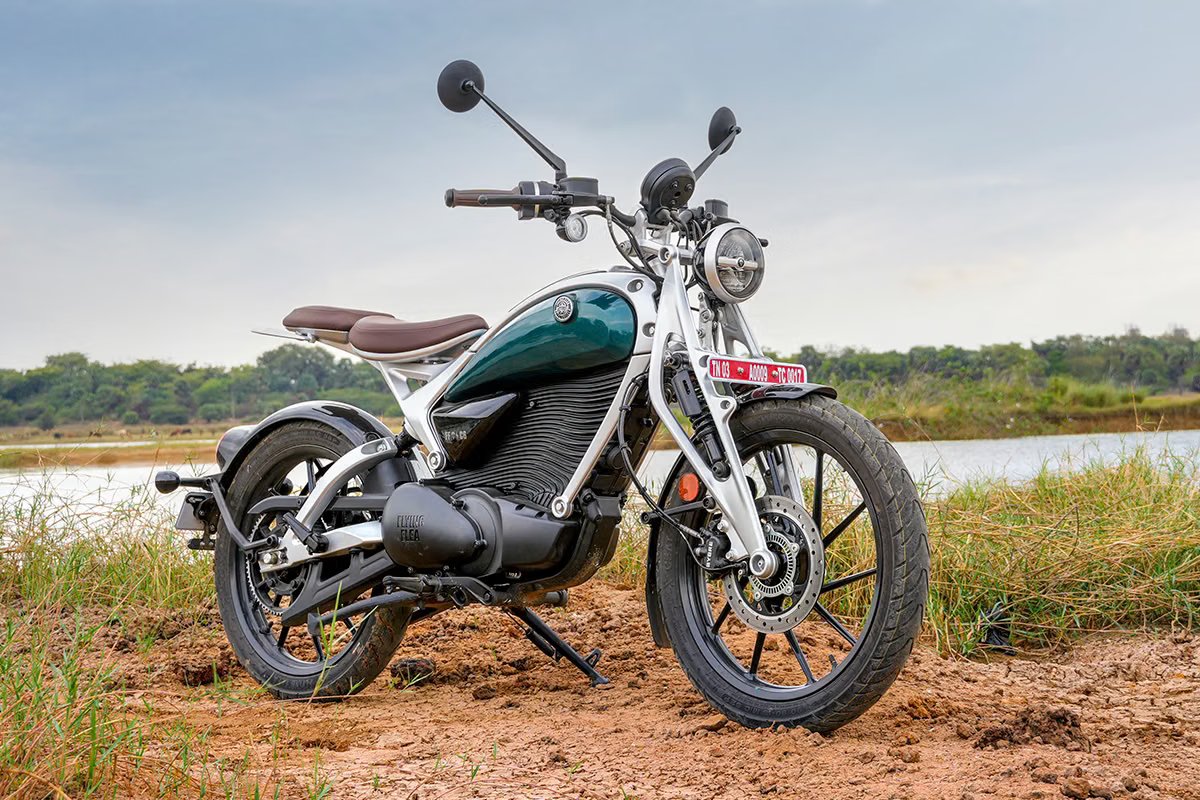
For motorcyclists sizing up the transition to battery power, the calculus looks entirely different from buying a runabout scooter. Royal Enfield knows it. The brand has built its storied legacy on thumping long-distance tourers, and it is refusing to sprint blindly into an unproven electric motorcycle market.
Speaking to investors during Eicher Motors' Q2 FY27 earnings conference call on Friday, Royal Enfield Chief Executive Officer B. Govindarajan delivered a blunt reality check on customer behavior. Enquiries for the brand's maiden electric motorcycle, the Flying Flea C6, are pouring in across Indian and international showrooms. But conversions into firm bookings remain deliberate. Riders want seat time, long test rides, and proof of endurance before committing their money.
Govindarajan laid out the company's measured philosophy directly:
We are not in any rush. We wanted to build that properly, one by one. The enquiries are very good. Bookings are slower because we have to give more experience to them.
Royal Enfield has handed over around 200 Flying Flea C6 motorcycles in India since launching the model in April 2026. Early owners have already logged more than 1.25 lakh cumulative kilometres on the road. The machine is not built for cross-country highway hauls. Instead, it is aimed at discerning city riders seeking lightweight agility.
Consumers navigating showroom price tags face two distinct acquisition paths. Straight off the showroom floor, the C6 retails at ₹2.79 lakh (ex-showroom). For that sum, buyers get a 3.91kWh battery pack delivering a claimed city range of 154 kilometres. Alternatively, Royal Enfield offers a Battery-as-a-Service (BaaS) plan. That drops the upfront vehicle purchase price down to ₹1.99 lakh, while riders pay separate recurring subscription charges for battery usage.
To support early adopters, Royal Enfield established 40 retail and service touchpoints. The network started in Bengaluru before pushing into Hyderabad, Pune, and Chennai, blending dedicated boutique stores with display spaces inside established Royal Enfield dealerships. Delhi stands next in line for distribution. Across the sea, the rollout reached Paris, Barcelona, Rome, Berlin, and London in September 2026, where order books recently opened under a phased ownership-first framework.
| Flying Flea C6 Parameter | Specification / Retail Detail |
|---|---|
| Upfront Ex-Showroom Price | ₹2.79 Lakh |
| Battery-as-a-Service (BaaS) Upfront Cost | ₹1.99 Lakh (Battery subscription paid separately) |
| Battery Capacity | 3.91 kWh |
| Claimed Riding Range | 154 km |
| Indian Deliveries Since April 2026 | ~200 units |
| Cumulative Distance Ridden | >1.25 lakh km |
The deliberate trickle of electric motorcycle deliveries contrasts sharply with the broader two-wheeler landscape. India's electric mobility transition is booming, but it runs almost entirely on step-through floorboards. Commuters looking to dodge fuel prices for short grocery runs and office sprints have embraced electric scooters in droves.
Official VAHAN vehicle registry data underscores this divide. Retail registrations for electric two-wheelers jumped roughly 70% year-on-year in FY27, climbing to 13.48 lakh units during the April-October 2026 period. That compares to 7.91 lakh units registered during the same seven-month stretch in FY26. Yet that massive sales volume belonged overwhelmingly to scooter manufacturers: TVS Motor, Bajaj Auto, Ather Energy, and Hero MotoCorp’s VIDA brand cornered the lion's share of the market.
Market Context: Electric scooters thrive because daily urban utility requires simple twist-and-go convenience over predictable 20-to-30 kilometre daily commutes. Motorcycles serve an entirely different emotional and utilitarian master. Enthusiasts expect weekend highway runs, touring flexibility, and rugged durability—areas where current battery weights and charging turnaround times still force trade-offs.
Govindarajan pointed directly to that functional divergence when explaining why forecasters cannot simply superimpose scooter sales trajectories onto geared motorbikes.
So, the adoption, in my personal view, will take more time. There is no clear basis for predicting whether adoption will accelerate within three or five years.
Financial markets have weighed this methodical rollout against broader balance-sheet fundamentals. Nomura assigned Eicher Motors a Neutral rating with a target price of ₹7,827 per share following the initial Flying Flea C6 market introduction, tracking the capital allocation into electric vehicle development alongside traditional internal combustion earnings.
Yet Royal Enfield is not sitting still. At the EICMA motorcycle show in Milan earlier this month, the manufacturer unveiled its second zero-emission machine: the Flying Flea S6.
Built on the same core platform as the C6, the upcoming S6 adopts a scrambler stance. It pairs urban packaging with light off-road capability, featuring dual-purpose tires, raised clearances, and revised ergonomics designed to handle broken pavement and unpaved trails. Royal Enfield scheduled the S6 for commercial market launch in the summer of 2027.
Further electric concepts and architectures remain in active development behind closed doors. But Govindarajan reiterated that showroom volumes will not be forced through deep discounting or premature factory ramp-ups. Availability will track consumer readiness and infrastructure depth, market by market.
We are in for a long haul. We want to build the category.
For now, prospective buyers in Delhi can expect C6 display units and test rides to arrive at capital dealerships in the coming months, while riders across Bengaluru, Hyderabad, Chennai, and Pune continue testing whether a 154-kilometre urban battery roadster fits their daily garage routines.
| Initial Operational Indian Cities |
| Bengaluru, Hyderabad, Pune, Chennai (Delhi next) |
| European Launch Cities (Sept 2026) | Paris, Barcelona, Rome, Berlin, London |