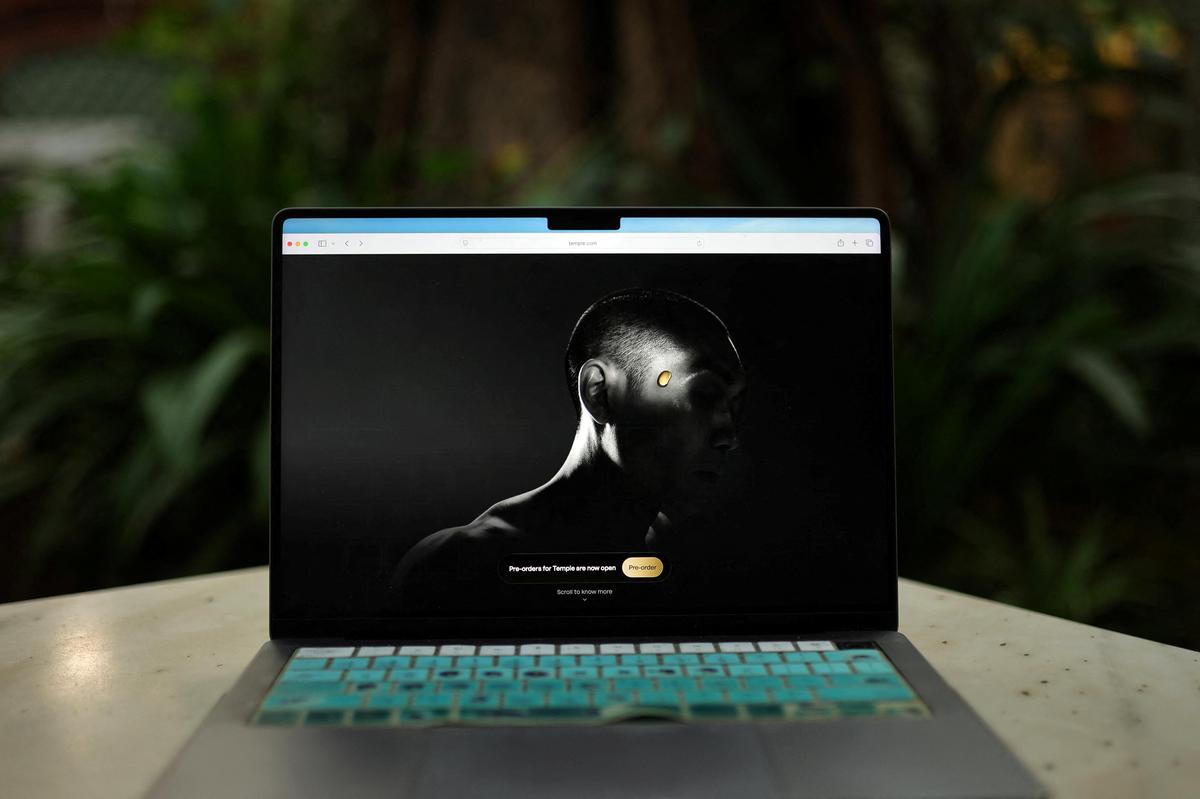
A thumb-sized patch stuck beside the eyebrow has triggered a fierce battle between India's medical fraternity and Silicon Valley-style wellness engineering.
Billionaire entrepreneur Deepinder Goyal, the 43-year-old founder of Eternal, has staked ₹282.55 crore of personal capital and stepped down as chief executive of Zomato's parent firm to back Temple—a 2-gram wearable device designed to sit on the side of the head. Priced at ₹85,000 ($907) and offered in six shades, the miniature gadget promises to transform personal health monitoring. Yet, senior clinicians are pushing back aggressively, warning that the hardware makes sweeping physiological claims without published clinical validation.
The core dispute zeroes in on what the sensor claims to read versus what basic human anatomy allows.
Promotional materials for the device tout two flagship metrics: "BrainFlow", which claims to track how effectively blood enters the brain in real time, and "Entropy", which monitors how hard the body works to dissipate heat. Beyond these, the firm asserts that the patch captures thermal, immune, digestive, cognitive, and emotional fluctuations, with upcoming updates aimed at tracking snoring and nocturnal jaw clenching. High-profile athletes, including national cricket captain Shubman Gill and double Olympic medallist P.V. Sindhu, have publicly sported the sensor.
Doctors remain unconvinced.
Leading physicians argue that measuring cerebral perfusion through unbroken skin is technically complex—if not biologically implausible with an over-the-counter optical sensor.
Dr. Jason Philip took to social media to break down the anatomical limits of temple-mounted sensors, noting that optical light signals positioned over the side of the forehead cannot penetrate the skull to gauge intracranial circulation. Instead, such optics merely register pulse waves from the superficial temporal artery, a blood vessel that feeds the external scalp and facial tissue rather than the brain parenchyma.
People must be aware of wellness hacks such as wearables also, even though they are not marketed as health devices.
That assessment was echoed by Dr. Cyriac Philips, a prominent hepatologist known online as "TheLiverDoc" with an audience of over 328,000 followers, who publicly branded the claims misleading and termed the venture an unverified wellness gimmick. In televised medical debates, paediatrician and nephrologist Dr. Sanjeev Bagai similarly criticized the product, pointing out that it operates without therapeutic validation or statutory health clearances.
| Specification / Parameter | Temple Wearable Data Point |
|---|---|
| Retail Price | ₹85,000 ($907) |
| Device Weight | Under 2 grams (0.07 oz) |
| Form Factor Dimensions | Under 1 inch wide (2.54 cm) |
| Target Placement | Lateral temple (between forehead and ear) |
| Core Features | BrainFlow (blood tracking), Entropy (heat shedding) |
| Additional Metrics Claimed | Immune, digestive, thermal, cognitive, emotional |
Goyal has firmly rejected accusations of scientific deception, emphasizing that Temple operates purely as a lifestyle companion.
"Not a scam; have spent over ₹188 crore to build the device," Goyal declared, underscoring that Temple is configured specifically as a fitness tracker and proactive wellness tool rather than an interventionist medical instrument. In an official communication, Temple acknowledged that features like BrainFlow and Entropy rely on "emerging science," confirming that peer-reviewed clinical studies are underway and that select analytical tools will ultimately seek statutory certification.
The venture carries heavyweight academic backing, listing faculty researchers from the University of Ottawa and Harvard University on its scientific advisory board. Commercial demand has moved rapidly; following an intake cycle launched on November 1, Temple recorded paid orders across 62 countries after securing $54 million in venture equity at a $190 million valuation earlier this year.
The controversy arrives alongside major executive transitions at Goyal's core corporate vehicle. To spearhead Temple full-time, Goyal relinquished his post as chief executive of Eternal—the $35 billion consumer internet conglomerate housing Zomato—passing the executive reins to Blinkit founder Albinder Dhindsa.
While overseas authorities strictly police the boundary between leisure telemetry and clinical diagnosis, India's Union Health Ministry has maintained silence on the matter, leaving the domestic regulatory category for high-end head wearables undefined.
For consumers, fitness enthusiasts, and biohackers eyeing temple-mounted sensors, practical discernment remains essential. While heart rate, skin temperature, and sleep hygiene data provide useful lifestyle benchmarks, users experiencing neurological symptoms, chronic headaches, or vascular issues should consult accredited neurologists rather than rely on uncertified consumer wearables.
| Development Expenditure | Over ₹188 crore (₹282.55 crore total commitment) |
| Ventures Capital Raised | $54 million (February round at $190M valuation) |
| Global Order Footprint | Shipments logged across 62+ countries |