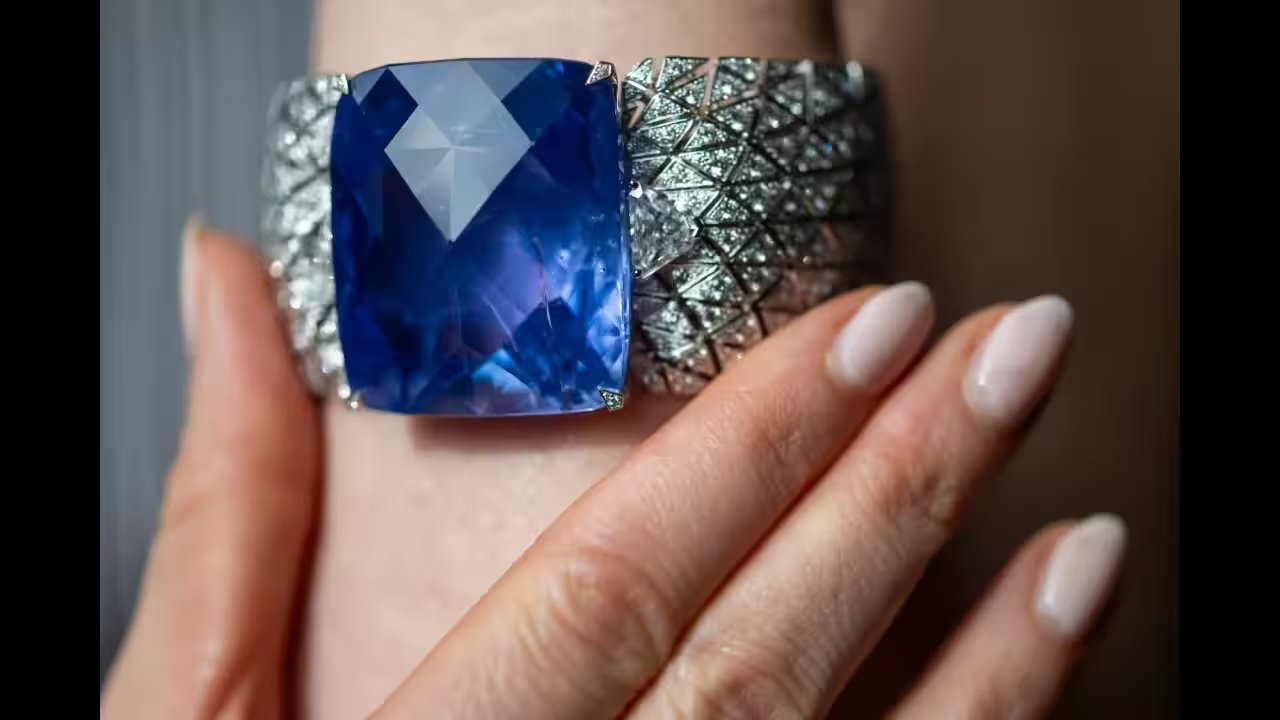
A colossal 197.80-carat royal sapphire tied directly to the fallen Romanov dynasty fetched $4.9 million in Geneva, demolishing pre-sale expectations under relentless bidding. The hammer price more than doubled its high estimate of 1.7 million Swiss francs, or roughly $2 million.
Royal provenance commands an ironclad premium. Certified as a natural, unheated Ceylon stone by both the Swiss Gemmological Institute (SSEF) and the Gübelin Gem Lab, the gem emerged as the headline lot of the Geneva auction room. Its unusual cut traces back centuries before the Russian empire's collapse, bearing Mughal-style faceting that indicates it entered the imperial vaults long before the Romanov dynasty reached its peak.
Before the Bolsheviks seized the throne, the sapphire held pride of place in St. Petersburg. Imperial jewelers had long hoarded the stone within an elite assemblage expanded by Empresses Elizabeth and Catherine the Great during the 18th century. Master craftsman Fabergé originally framed the jewel inside a dense diamond border, pairing it with an even larger 249.25-carat companion sapphire to serve as matching imperial clasps.
Dowager Empress Maria Feodorovna brought the gem into global lore. At the lavish 1903 Winter Palace Ball—the Romanov court's final theatrical display of supreme wealth—she pinned the stone directly onto the front panel of her heavy Moscovite costume. The imperial court had staged a recreation of 17th-century Russia, sewing raw gemstones directly into velvet and brocade. Feodorovna, born Princess Dagmar of Denmark, wore the jewel alongside its massive twin. The image endured. The empire did not.
Revolution dismantled the collection. Following the 1917 overthrow of Tsar Nicholas II, Soviet authorities catalogued the confiscated crown jewels under mineralogist Aleksandr Fersman. The resulting Fersman catalogue split the royal treasures into three utilitarian tiers. Pieces deemed to possess irreplaceable artistic value remained under state lock.
The Romanov Sapphire did not make the cut. Soviet appraisers relegated the stone to Category Three, judging it primarily on intrinsic commodity value rather than historical merit. Cash-strapped Bolshevik officials offloaded the jewel anonymously on foreign markets during the 1920s liquidation campaign.
Polish-American opera singer and high-society collector Ganna Walska acquired the sapphire from Cartier in 1927. Walska treated the stone as personal armor. In 1929, she ordered Cartier to mount it onto an elaborate sautoir alongside a monumental 256.60-carat carved Mughal emerald. She reworked the stone repeatedly across five decades, eventually placing it onto a strand of tumbled sapphire beads before her estate offloaded the piece at auction in 1971. It surfaced again in Geneva in 1992 on a twisted torsade of emerald and sapphire beads.
In 2015, Cartier reclaimed the narrative. The French maison mounted the 197.80-carat gem into a geometric Art Deco bracelet lined with brilliant-cut and shield step-cut diamonds, anchored by an interchangeable rock-crystal center. The signed piece crossed the block complete with original Cartier design documentation and archival presentation boxes.
| Gem Parameter | Official Specification | Pre-Sale Status | Auction Outcome |
|---|---|---|---|
| Carat Weight | 197.80 carats | Unheated Ceylon | Certified by SSEF & Gübelin |
| Imperial Provenance | Dowager Empress Maria Feodorovna | 1903 Winter Palace Ball | Fabergé historical setting |
| Current Mounting | Signed Cartier Bracelet (2015) | Rock crystal & step-cut diamonds | Provenance dossiers included |
| Valuation & Sale |
Following the settlement of the Geneva sale, the Cartier-mounted Romanov sapphire transfers into private custody, closing another public chapter in a 300-year transcontinental migration.
| 850,000–1,700,000 CHF ($2M) |
| Sotheby's Geneva |
| Sold for $4.9 Million |