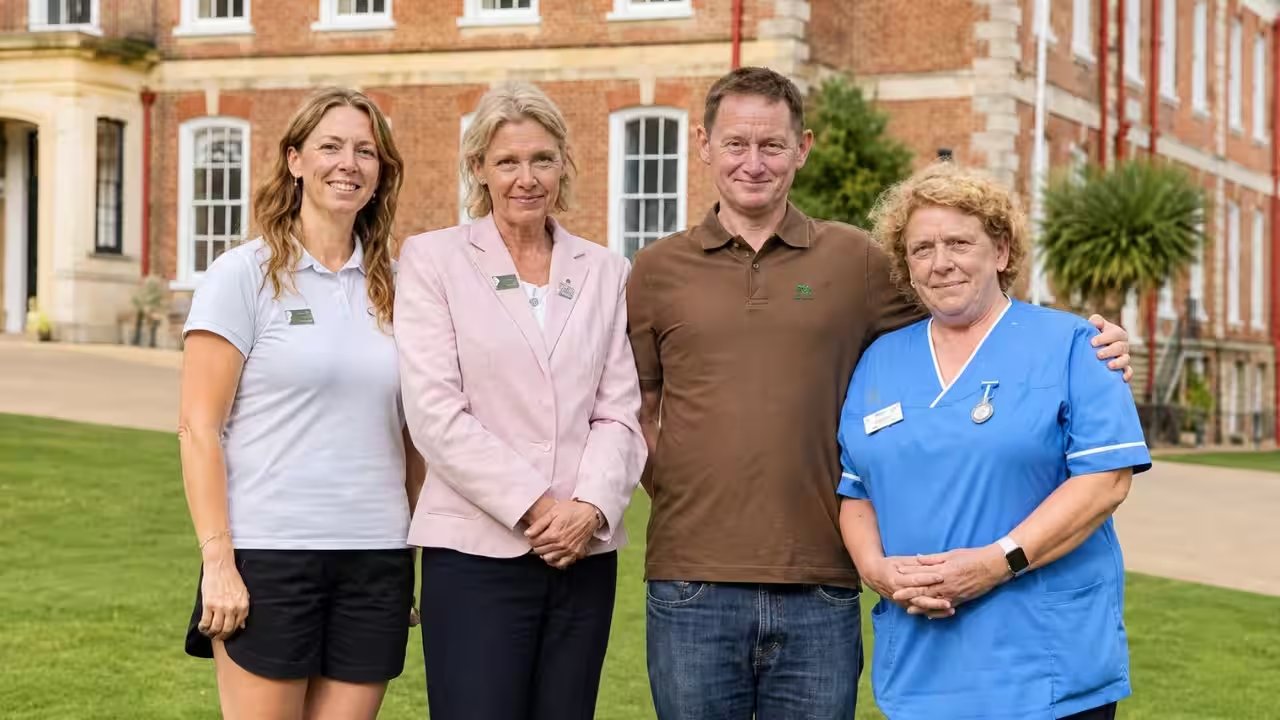
LONDON — Three staff members from Windlesham House School received national honours at Chapter Hall in St John’s Gate after reviving a lone cyclist who suffered cardiac arrest on the South Downs.
Physical education teacher Stacey Charman, cookery teacher Chellie Messenger, and school nurse Claire Agnew performed cardiopulmonary resuscitation for roughly 25 minutes and administered two electrical shocks from a defibrillator to restart the heart of 58-year-old Kip Knowles. Exactly one year after his heart stopped on an isolated country road, Knowles stood beside the trio as St John Ambulance presented them with the Lifesavers at Work Award.
Had their routine held, Knowles would have died on the asphalt.
Cy那时 Charman and Messenger were walking during their post-lunch break when Messenger’s dog, Waffle, pulled them along an unusual path. Moments later, they spotted Knowles, then 57, collapsing off his bicycle into the road. He had ridden unaccompanied for miles without encountering another person.
Having lost his pulse, Knowles slipped between brief bouts of consciousness and total respiratory arrest. Charman dropped to the ground and initiated chest compressions without hesitation. “Everything was a complete blur apart from Kip,” Charman said. “I was in the zone, the training kicked in, and nothing around me could stop me from carrying on.”
Messenger dialed 999 and simultaneously used a handheld school radio to summon Agnew with the campus automated external defibrillator. Then Messenger stepped in to rotate chest compressions—her first time performing chest compressions on a living person rather than a plastic training manikin. “It was horrible to see, but we didn’t stop,” Messenger said. “It wasn’t a case of ‘that’s it, he’s gone’. I was thinking—this man is the age of my husband.”
Agnew sprinted to the scene carrying the emergency defibrillator. With 42 years of clinical nursing behind her, she initially feared the worst. “I thought he was dead,” Agnew said. “I know what a dead body looks like; I’ve done this for 42 years.” Agnew attached the pads and discharged two shocks. After 25 relentless minutes of mechanical compressions and electric countershocks, Knowles drew breath and sat up.
I was on my bike in the middle of nowhere; I hadn’t seen anyone for hours. The ladies did CPR on me for around 25 minutes. I was going in and out of consciousness, and by the time Claire arrived with the defib, I’d stopped breathing, and they thought it was too late. But they didn’t give up on me, and I wouldn’t be here today without them.
Kip Knowles, Cardiac Arrest Survivor
| Emergency Parameter | Case Detail |
|---|---|
| Patient | Kip Knowles (Age 57 at collapse, 58 at award) |
| Location | South Downs, United Kingdom |
| First Responders | Stacey Charman, Chellie Messenger, Claire Agnew |
| Institutional Affiliation | Windlesham House School |
| Duration of CPR | Approximately 25 minutes continuous |
| Defibrillator Intervention | 2 automated external shocks administered |
Knowles’ wife, Lucy Knowles, submitted the formal nomination to St John Ambulance after emergency medical staff confirmed that the immediate roadside intervention prevented fatal brain damage and organ failure. “Our lives, and the lives of so many family and friends, would have crumbled had these angels not been there that day,” she said.
Presenting the awards, general practitioner and medical broadcaster Dr Nighat Arif emphasized that physician intervention rarely arrives in time for out-of-hospital cardiac arrests. “As a GP, I know the minutes before an ambulance arrives can decide whether someone lives or dies, and the most important person then isn’t a doctor; it’s whoever is nearby,” Dr Arif said. “What these winners did with their own hands is the most powerful message of all.”
St John Ambulance operates a national network of nearly 20,000 community volunteers, yet organizational leadership warned that systemic training gaps in commercial and educational facilities leave workers vulnerable. Internal charity assessments reveal that two in five British workers do not know how to carry out basic CPR during sudden cardiac collapse.
“Every one of the winners was an ordinary person who refused to give up on someone whose life was slipping away,” said St John Ambulance Chief Executive Officer Shona Dunn. “Cardiac arrest is the emergency that workers fear the most, yet two in five say they wouldn’t know how to perform CPR. That’s a gap we can close, and the workplace is where we can close it the fastest.”
Following the London ceremony, St John Ambulance announced plans to expand its workplace first-aider accreditation modules across private businesses and public schools through the remainder of the 2026 calendar year.
| Award Distinction |
| St John Ambulance Lifesavers at Work Award |