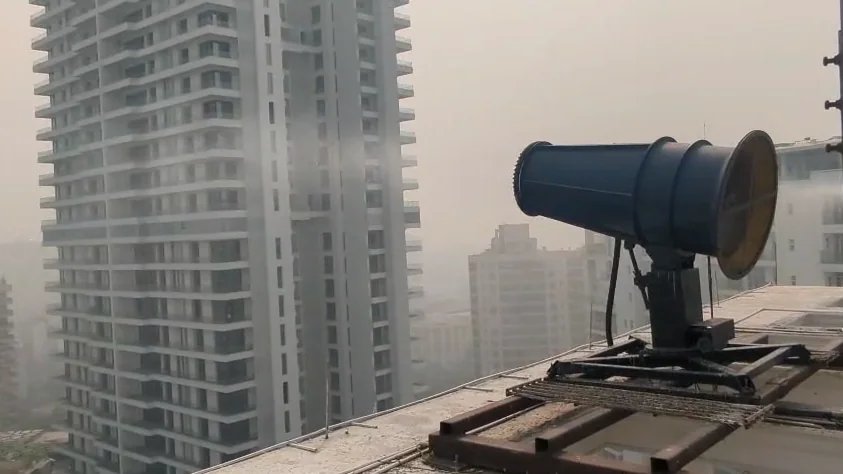
GURUGRAM — Wealthy apartment enclaves across Gurugram are deploying rooftop anti-smog guns, automated water sprinklers, and dedicated tanker fleets, footing bills running into lakhs of rupees to clear toxic winter haze hanging over their private compounds.
Households already run commercial air purifiers inside their apartments around the clock. But soaring particulate levels outdoors have forced housing societies along Sohna Road and Golf Course Extension Road to treat the surrounding atmosphere itself.
Resident welfare associations maintain that municipal intervention remains chronically inadequate.
"Even after spending crores of rupees on a flat, we are not getting good roads or clean air," said Shailja Bhatia, a resident of Central Park Resorts. "A person puts their entire life's earnings into buying a good home. If they still cannot breathe clean air after moving in, it is extremely disappointing."
Bhatia noted that Gurugram generates immense tax revenue as one of India's pre-eminent corporate hubs, yet municipal authorities have functioned as "mute spectators" while air quality collapsed. "If society residents can make such arrangements on their own, why can't the administration take concrete steps for the whole city?" she asked.
At Rising Homes in Sector 92, where high-rise apartments command prices between ₹5 crore and ₹7 crore, private anti-pollution measures began four years ago. The society refused to wait for municipal relief.
Resident Welfare Association president Praveen Malik said the society invested approximately ₹2.5 lakh to link its on-site sewage treatment plant directly to an automated sprinkler network. The system pipes treated wastewater straight to green belts and surrounding open plots to knock down airborne dust.
The society acted on its own because the government was not doing enough to curb pollution throughout the year.
Praveen Malik, RWA President, Rising Homes
Dedicated maintenance crews operate the sprinklers in continuous shifts from 10 am to 8 pm. When toxic smoke choked the National Capital Region following Diwali, the association tacked two additional hours onto the daily spraying schedule.
Malik pointed out systemic municipal waste, arguing that the Manesar Municipal Corporation routinely allows lakhs of litres of monsoon runoff to drain away unused. Stored runoff could dampen summer heat and suppress dust storms during peak winter inversions.
| Society & Regulatory Metrics | Operational Details |
|---|---|
| Sector 92 Property Valuations | ₹5 crore to ₹7 crore per unit |
| STP-Sprinkler Infrastructure Outlay | ₹2.5 lakh (Rising Homes) |
| Daily Water Suppression Window | 10:00 AM to 8:00 PM (extended by 2 hours post-Diwali) |
| Enforcement Action by HSPCB | 5 construction sites sealed |
| Primary Enforcement Hub | Udyog Vihar (3 sites shut down) |
Yet regulatory enforcement is tightening across industrial corridors. The Haryana State Pollution Control Board sealed five construction sites in Gurugram for flouting statutory dust-containment rules.
Pollution inspection squads targeted Udyog Vihar, shutting down three non-compliant projects in that industrial hub alone. State inspectors are scrutinizing peripheral construction sites for mandatory dust screens, perimeter barricades, and covered transport of loose building aggregates.
State monitoring teams are also auditing construction sites shut down under the Graded Response Action Plan. Security patrols have explicit orders to penalize uncovered transit of building debris, open garbage dumping, and biomass burning on road corridors.
HSPCB inspection teams will widen dust-containment audits across commercial corridors through the coming week, targeting unpaved transit yards and unshielded building sites.