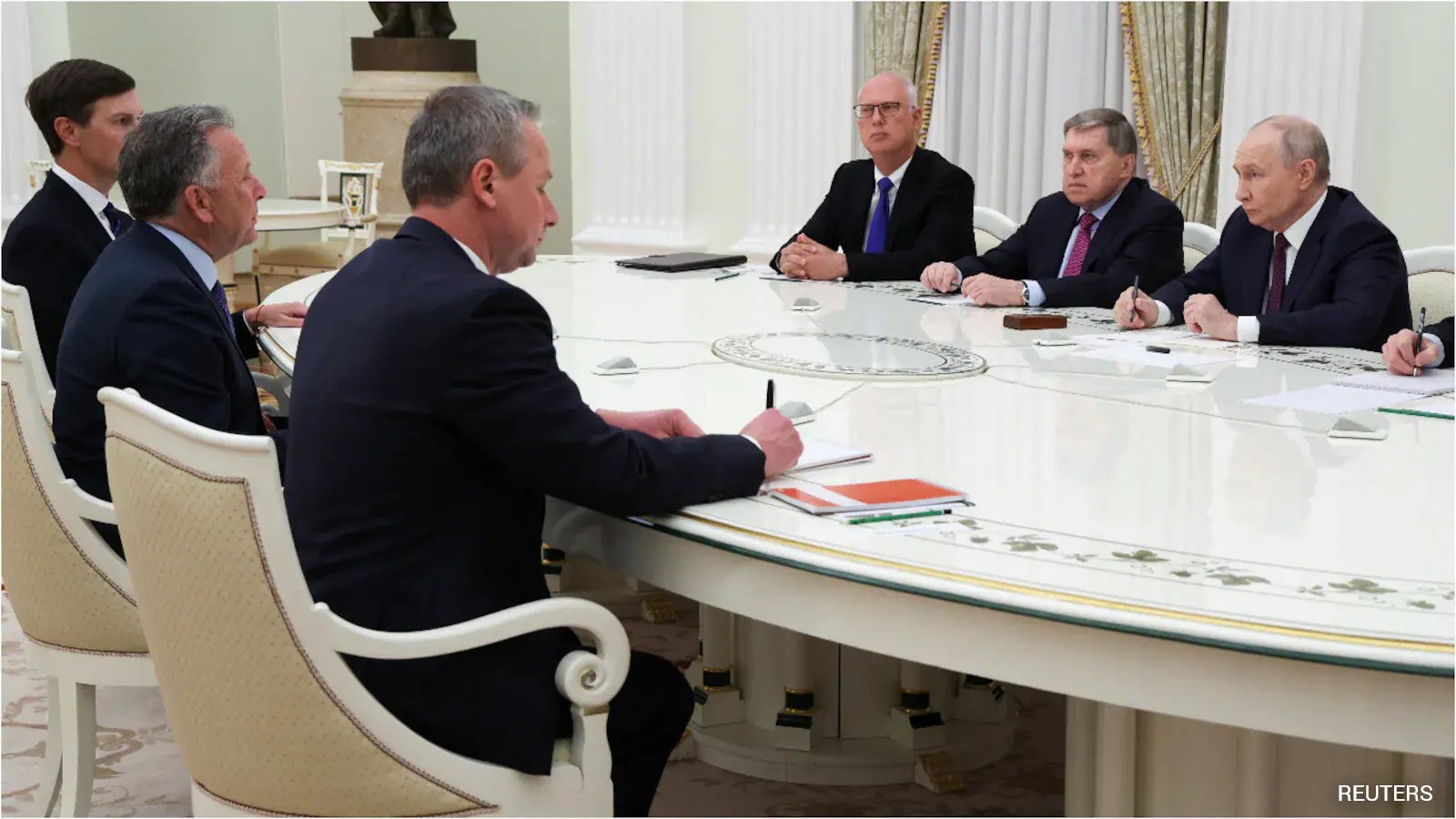
Russian President Vladimir Putin agreed Thursday to let European representatives join the next round of Ukraine peace negotiations, opening the door to a broader multilateral table after direct Kremlin talks with United States envoys Steve Witkoff and Jared Kushner.
The breakthrough expands diplomatic architecture that had stalled for nearly a year. Yet the concession came wrapped in an unyielding ultimatum: Washington must force its European partners to decide whether they seek a settlement or an expanded conflict.
"The Europeans will join at the next meeting, which we consider to be a very important moment because they are our partners and it's important to us that they take part," Witkoff stated on Russian state television following the Moscow session.
Kushner assured Putin that Washington had detected "a big change" across European capitals, insisting that pulling European officials into the room would accelerate rather than derail negotiations. Putin pushed back against that optimism. He rejected Western claims that Moscow had isolated itself, arguing European capitals had severed ties unilaterally.
He also drew a non-negotiable red line on postwar deployments.
We would very much like you, gentlemen, and the US administration as a whole, to work with your European allies so that they can finally make up their minds as to what they want: peace or war in Ukraine.
Vladimir Putin, President of Russia
Putin warned that any deployment of European expeditionary troops to police a future ceasefire would instantly reignite direct hostilities. Moscow, he argued, views foreign military boots on Ukrainian soil as an unacceptable national security threat.
Hundreds of miles to the west, Kyiv reacted with cold suspicion.
Speaking ahead of a Dublin summit with Witkoff and Kushner, Ukrainian President Volodymyr Zelensky criticized Washington for attempting to negotiate a continental security architecture over Ukraine’s head, calling the US diplomatic posture "a bit strange." He tied that unease directly to critical battlefield outages.
Zelensky disclosed that SpaceX's military-grade Starshield satellite network—the digital backbone of Ukraine’s frontline fire coordination—has suffered widespread, systemic operational throttling. The bandwidth choke spans the entire active line of contact and Russian-controlled zones. The slowdown has severely degraded Ukrainian interceptors, leaving them unable to gather sufficient speed to target incoming Russian jet-powered strike drones.
"So far we know very little," Zelensky said on Telegram regarding the communications blackout. "But some things are already clear: if someone in America is making decisions that basically treat Ukrainian territory as if it is not Ukrainian, then it tells us where things are going."
| Diplomatic Parameter | Official Status | Details Recorded | :--- | :--- | :--- | European Delegation | Cleared by Moscow | Slated for upcoming negotiation round | Abu Dhabi Milestone | Finalized | Major prisoner-of-war exchange due within weeks | Territorial Division | Contested | Moscow occupies ~20% of Ukraine; Kyiv holds Donbas lines | Starshield Communications | Throttled | Frontline speed caps impair Ukrainian drone interceptors | Kostiantynivka Corridor | Proposed by Kremlin | 5-day demining truce targeting 400–500 civilians |
The diplomatic pivot comes directly out of two days of trilateral negotiations in Abu Dhabi—the first direct US-mediated talks between Russian and Ukrainian delegations in nine months. While negotiators secured an agreement for a major exchange of prisoners of war in the coming weeks, territorial claims remain entirely deadlocked. Russia occupies roughly one-fifth of Ukraine, while Kyiv flatly refuses to abandon its remaining positions in the eastern Donbas.
Inside the Kremlin, Putin pitched a separate five-day local ceasefire around Kostiantynivka in eastern Ukraine. He claimed Russian troops control the contested city, insisting a temporary truce would allow engineering units to clear mines and extract 400 to 500 stranded residents. He cited a similar evacuation model deployed in Oleshky late last month.
Kyiv dismissed the claim of control. Ukrainian military planners suspect the Kremlin routinely leverages humanitarian windows to resupply forward units, pause relentless drone attacks on Russian refineries, and regroup stalled mechanized assaults.
Witkoff and Kushner land in Dublin for urgent talks with Zelensky, where the Ukrainian leadership is expected to demand immediate answers on Starshield connectivity and establish non-negotiable parameters for Europe’s incoming negotiators.