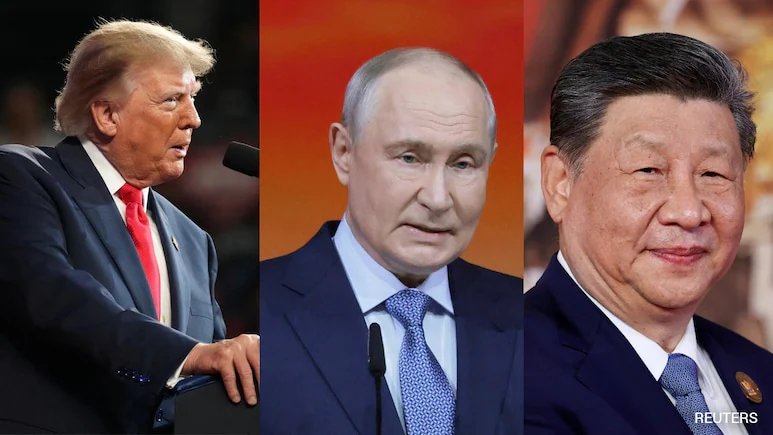
United States President Donald Trump, Chinese President Xi Jinping, and Russian President Vladimir Putin will meet Thursday on the sidelines of the Asia-Pacific Economic Cooperation summit in Shenzhen, China, bringing the leaders of the world's three preeminent nuclear powers into unprecedented trilateral talks.
Plans for the high-stakes summit were confirmed Friday by the White House. The rendezvous places the heads of state in the same room amid acute geopolitical friction over Ukraine, Iran, and expiring arms control architecture.
Expectations of immediate diplomatic breakthroughs remain low. Analysts characterize the session as heavy on symbolism. Yet the optics alone will dominate the regional gathering in China's southern technology hub.
Trump pushed for the three-way sit-down to tackle two immediate priorities: the ongoing US war with Iran and a stalled push to construct a trilateral nuclear arms control framework.
Legal caps on the world's two largest nuclear arsenals vanished in February when the New START treaty between Moscow and Washington formally expired. Trump had rejected Russian proposals for a simple one-year extension. Instead, he demanded a modernized agreement that forces Beijing to the negotiating table.
Beijing holds little enthusiasm for such an arrangement. Pentagon estimates indicate China commands an arsenal of more than 600 warheads—a lethal stockpile, yet a fraction of the arsenals deployed by Washington and Moscow, who each command more than 5,000 warheads.
I would be shocked if there were a joint statement that came out of this meeting that said anything about denuclearization.
Edgard Kagan, Senior Fellow at the Center for Strategic and International Studies
Foreign policy analysts argue each leader approaches the Shenzhen trilateral with divergent domestic and diplomatic calculations:
| :--- | :--- | :--- | :--- | :--- | :--- | :--- |
|---|---|---|---|---|---|---|
| Head of State | Donald Trump | Xi Jinping | Vladimir Putin | |||
| Estimated Nuclear Warheads | 5,000+ | 600+ (Pentagon est.) | 5,000+ | |||
| Key Strategic Demand | Trilateral arms treaty & Iran resolution | Showcase global clout & trade defense |
For Putin, the trilateral format grants Moscow coveted billing alongside Washington and Beijing as an indispensable power broker. Russia's grinding war in Ukraine approaches its fifth year. Moscow has simultaneously deepened military, intelligence, and diplomatic coordination with Tehran while remaining economically tethered to Beijing.
"I think the key for Putin was that this was very much about signaling a desire to talk to the president and talk to Chairman Xi in a way that suggests that they're making decisions on Ukraine, which obviously the Ukrainians and the Europeans don't like," said Kagan, who previously served as US ambassador to Malaysia.
Xi faces a delicate balancing act. Hosting 21 economies in Shenzhen offers China a premier stage to showcase its transformation from a fishing village into an economic powerhouse.
But presiding over a closed-door great-power summit risks clouding Beijing's messaging. Hoo Tiang Boon, a professor of Chinese foreign policy at Nanyang Technological University, noted that monopolizing summit oxygen runs counter to Beijing's stated defense of broad multilateralism.
Ties between Moscow and Beijing have hardened since 2022 under an affirmed "no-limits friendship." Beijing remains Russia's primary trading partner, purchasing discounted energy while exporting vital components for Russian manufacturing despite Western sanctions. Simultaneously, Trump has maintained personal ties with both autocrats, holding talks with Putin in Alaska in August 2025 and hosting Xi in Washington in September.
Diplomatic delegations will arrive in Shenzhen early next week, with the trilateral session scheduled for Thursday ahead of the broader ministerial and economic communiqués closing the APEC calendar.
| Superpower parity & Ukraine settlement |
| Direct Bilateral Record | 7 meetings with Putin; 8 with Xi | 40+ meetings with Putin since 2013 | Met Trump in Alaska in August 2025 |