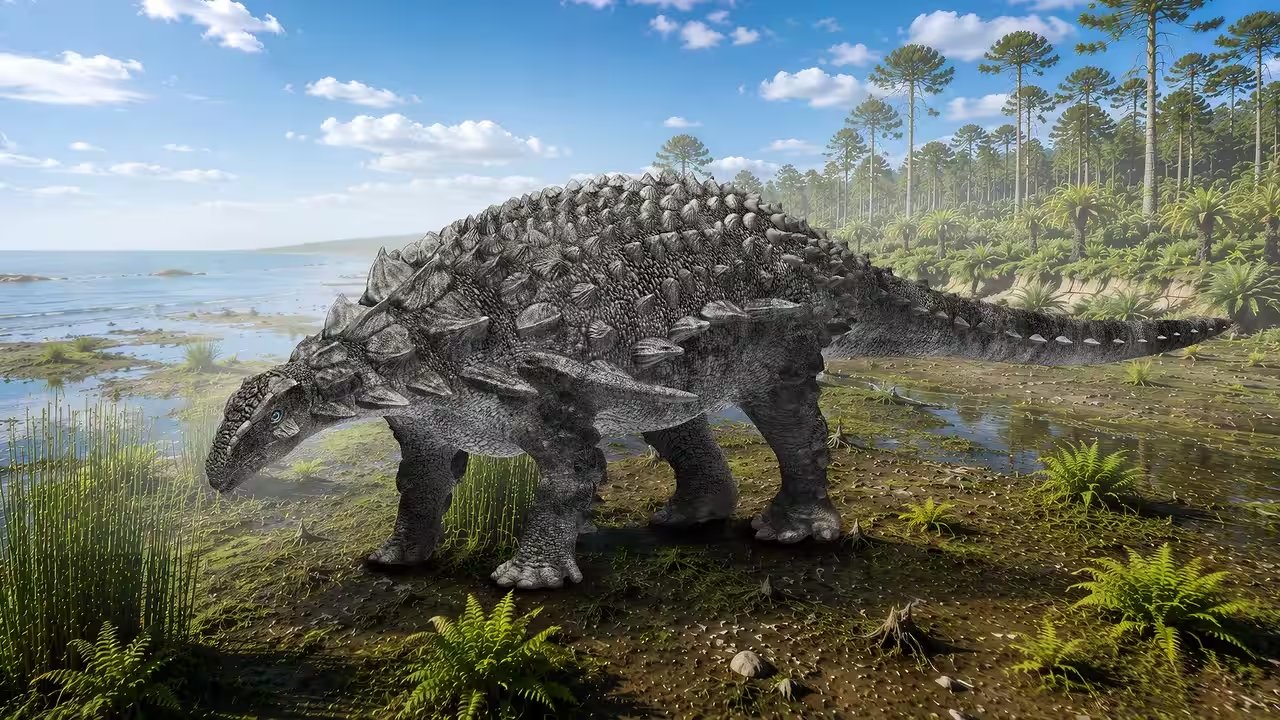
Shumpei Oyabu of Hokkaido University and an international team announced on Tuesday that the fossil, catalogued as MCM A522, has been formally named Nipponopelta yezoensis, the first ankylosaur officially described from Japan. The specimen, a partial skull and atlas discovered in a concretion along the Omakizawa River in Yubari, was first unearthed in 1994 and had lingered in the Mikasa City Museum’s storage for three decades before modern imaging clarified its identity.
Using high‑resolution CT scans, the researchers digitally reconstructed previously hidden portions of the skull, exposing a section of the lower jaw, two intact teeth and the dinosaur’s left inner ear. The scans also revealed a distinctive combination of features in the rear of the skull that justified erecting a new taxon.
Phylogenetic analysis placed Nipponopelta squarely among derived North American and European nodosaurids, clustering it with Pawpawsaurus, Panoplosaurus, Nodosaurus, Edmontonia, Denversaurus and Dracopelta. The result was unexpected because the only other Asian nodosaurids are known only from postcranial material, making this cranial material a key reference point.
Ancestral geographic reconstruction suggests that Nipponopelta’s lineage once spanned Laramidia, Appalachia and Asia, and that the species favored marine‑influenced coastal or estuarine habitats. The coastal preference may have facilitated its long‑distance dispersal across the ancient seaways that divided the supercontinent.
Eijiro Goto, who donated the fossil to the museum in 1994, recalled the moment he found the concretion in the riverbank: "I was digging along the Omakizawa and the stone gave way, revealing a strange skull." His discovery now serves as a tangible link between local communities and the deep past.
The team plans to present the findings at the upcoming International Conference on Paleontology in Kyoto next month, where they will also discuss targeted fieldwork in the Hikagenosawa Formation to uncover more cranial material that could further illuminate the migratory routes of nodosaurids.