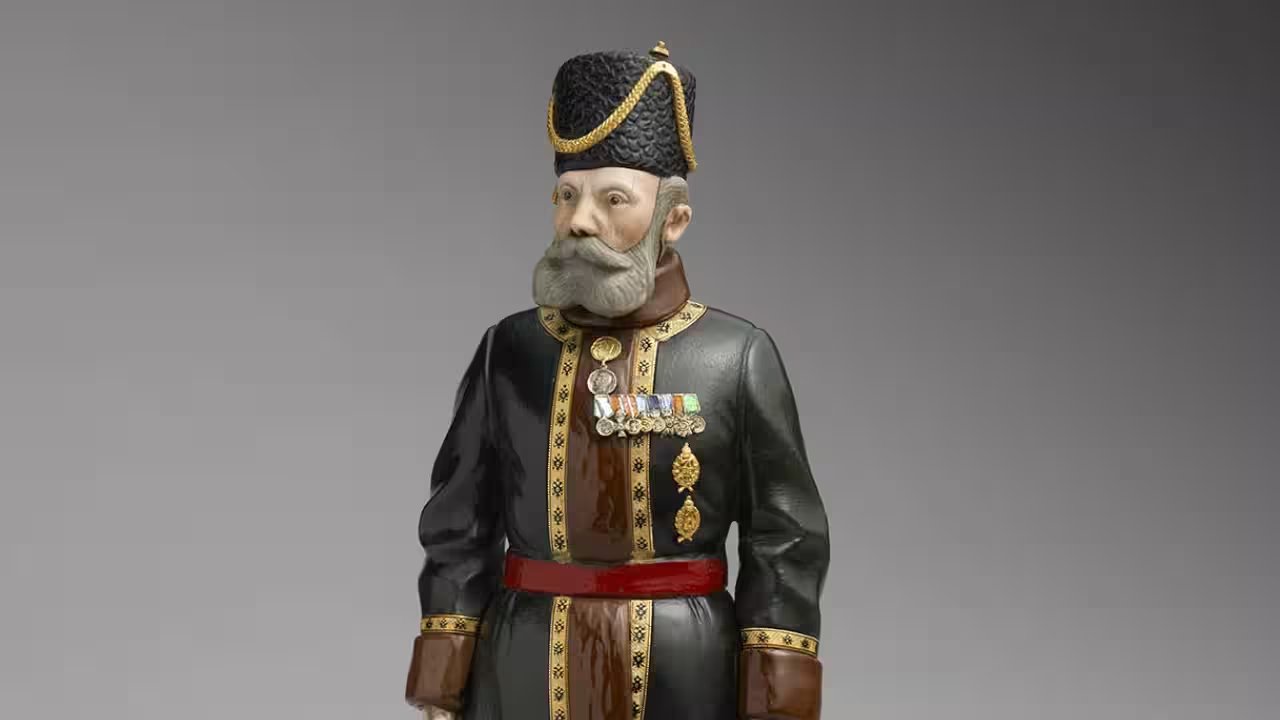
The seven-inch statuette of Nikolai N. Pustynnikov, a personal Cossack bodyguard to Empress Alexandra Feodorovna, hammered down for $5.2 million at Stair Galleries in Hudson, New York, on October 26, 2013. The final price, which included a buyer’s commission bringing the total to approximately $5.98 million, obliterated the previous auction record for a Fabergé hardstone figure, which stood at $1.8 million set by Sotheby’s in New York in 2005.
The object’s journey from the Russian imperial court to a dusty attic was as turbulent as the era that produced it. Commissioned by Emperor Nicholas II in 1912 for his mother, Dowager Empress Maria Feodorovna, the figure was one of a rare group of lifelike portraits created by the Fabergé workshop. According to Fabergé records, the design was dated January 31, 1912, and the carving was likely executed by master lapidaries Derbyshev or Kremlev from a wax model by sculptor Boris Frödman-Cluzel. The statue’s coat is crafted from nephrite and jasper, adorned with gold and enamelled orders, while Cyrillic inscriptions on the boots identify the maker, the year, and Pustynnikov’s rank as a Kamer-Kazak dating back to 1894.
Pustynnikov himself was a highly esteemed servant, born in Novocherkassk and serving the Empress from her marriage to Nicholas II in 1894 until the 1917 Revolution. Being appointed to attend a member of the Imperial family was a tremendous honor, granting him privileges that placed him in close proximity to the royal family. Henry Bainbridge, Fabergé’s London agent and biographer, noted that the Tsar insisted on portraits from life, with the Cossacks attending the studios to be modeled in wax.
When the Bolsheviks seized power, Imperial possessions were confiscated, and the figures ended up at Pavlovsk Palace. By 1925, the Pustynnikov figure had been sold to American industrialist and art dealer Armand Hammer, who brought it to the United States. Hammer later sold it to New York Fabergé collector George H. Davis in 1934. That was the last time the world saw it.
The trail went cold for nearly eight decades. The figurine was finally discovered in 2013 in the attic of a deceased descendant of the collector in Rhinebeck, New York. Crucially, the find was accompanied by receipts and documentation linking it to the 1934 purchase, a provenance that transformed a hidden object into a verified piece of imperial history. The auction estimate had been a modest $500,000 to $800,000, but intense bidding pushed the price over five times the high end of that range.
Experts note that portrait figures showing identifiable historical people are rarer than the famous Imperial Easter Eggs. Tatiana Fabergé, in her reference book, estimated that fewer than 80 such hardstone figures were ever produced, making the Pustynnikov piece a singular artifact of a vanished empire. The sale underscores the enduring market premium for works that combine extreme rarity with impeccable documentation, a lesson for collectors of imperial Russian art.