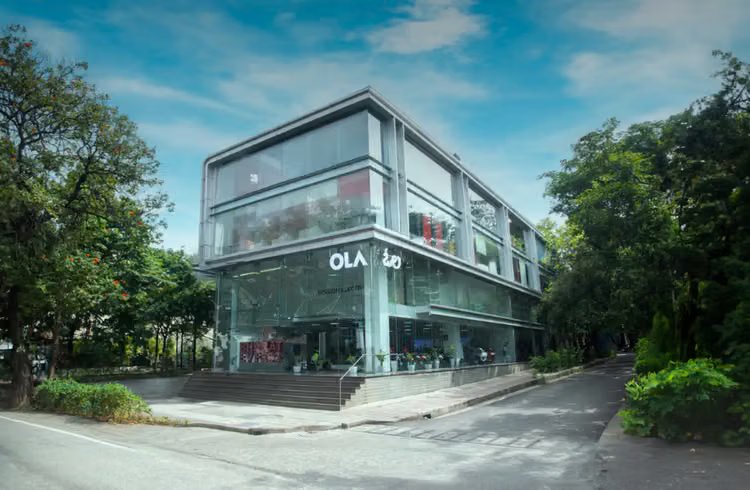
Ola Electric is burning cash while showroom receipts shrink.
For two-wheeler buyers and ecosystem watchers tracking India's electric mobility transition, the manufacturer's latest balance sheet offers an unvarnished reality check. Topline momentum has slowed down sharply. Ola Electric Mobility posted a consolidated net loss of ₹362 crore for the second quarter of FY2027—widening from ₹336 crore in the preceding June quarter, even as it narrowed against the ₹418 crore deficit recorded during the same period last year.
The revenue curve took a heavy hit. Revenue from operations slid 39% year-on-year to ₹421 crore during the July-September stretch, down from ₹690 crore in Q2 FY2026. Squeezed volumes in the automotive division—which generates the bulk of group earnings alongside the nascent cell manufacturing arm—dragged consolidated income down to ₹448 crore from ₹756 crore a year ago.
Management trimmed overall operational expenses to ₹639 crore from ₹893 crore a year prior. But that belt-tightening failed to offset the top-line contraction. Operating costs actually ticked up sequentially from ₹620 crore in Q1 FY2027, leaving operating losses before interest, tax, depreciation, and amortisation at ₹191 crore compared with ₹137 crore in Q2 FY2026. Finance costs absorbed ₹63 crore, while depreciation and amortisation ate another ₹108 crore.
| Financial Metric | Q2 FY2027 | Q2 FY2026 | H1 FY2027 | H1 FY2026 |
|---|---|---|---|---|
| Revenue from Operations | ₹421 crore | ₹690 crore | ₹876 crore | ₹1,518 crore |
| Consolidated Net Loss | ₹362 crore | ₹418 crore | ₹698 crore | ₹846 crore |
| Total Income (Inc. Other) | ₹448 crore | ₹756 crore | — | — |
| Total Expenses | ₹639 crore | ₹893 crore | — | — |
For the full first half of FY2027, operating revenue crashed 42% to ₹876 crore against ₹1,518 crore in H1 FY2026. Consolidated net losses for the six-month period stood at ₹698 crore, showing modest recovery from the ₹846 crore hole logged across the first half of FY2026.
A contentious accounting manoeuvre brought scrutiny to the books. Statutory auditor B S R & Co. LLP issued a qualified conclusion on the financial statements, zeroing in on the treatment of liquidated damages tied to the Ministry of Heavy Industries' Advanced Chemistry Cell (ACC) battery production-linked incentive scheme.
Ola Cell Technologies, a wholly owned subsidiary, had originally booked a ₹57 crore provision for liquidated damages after missing scheduled investment milestones under the central battery scheme. But during the first quarter of FY2027, the company reversed that entire ₹57 crore liability, crediting other expenses on the argument that it had applied for a project extension and a waiver.
The auditor pushed back.
B S R & Co. LLP concluded that the ₹57 crore provision should have stayed on the balance sheet until the central government formally granted the waiver. It also determined that Ola Cell Technologies failed to recognise an additional ₹11 crore provision due for Q1 FY2027. While the Ministry of Heavy Industries later issued a conditional waiver on August 11, 2026—pegging relief to the subsidiary meeting revised investment targets—the auditor maintained its qualified review for both the June and September quarters. The auditor did not, however, modify its stance on the group's going-concern status.
Market Context: A manufacturer's ability to maintain after-sales service, software updates, and warranty commitments depends entirely on balance-sheet endurance. When factory revenues tumble and core cash generation stalls, aggressive capital expenditure faces immediate friction.
To plug ongoing liquidity drains, Ola Electric tapped equity markets for immediate runway.
The company secured ₹780 crore through a qualified institutional placement (QIP) during the first half of the financial year, earmarking capital for debt repayment, corporate purposes, and operational expansion. Following the close of the September quarter, the board allotted 37.03 crore partly paid-up equity shares at ₹27 apiece through a ₹1,000 crore rights issue, pulling in roughly ₹600 crore in initial application money.
Yet cash flow stress at the standalone entity remains acute. Standalone operating cash flows flipped to a negative ₹24.61 lakh for the half-year ended September 30, 2026, reversing from positive operating cash generation of ₹203.49 lakh in the corresponding period of FY2026. Group leadership affirmed that its ongoing operational viability relies directly on current cash reserves, subsidiary cash generation forecasts, available bank credit lines, and proceeds from the fresh rights issue.
All eyes now turn to factory ramp-ups and milestone deadlines under the Heavy Industries Ministry's conditional waiver, where the company must demonstrate compliance across both vehicle deliveries and domestic cell manufacturing timelines.
| EBITDA Loss | ₹191 crore | ₹137 crore | — | — |
| Finance Costs | ₹63 crore | — | — | — |
| Depreciation & Amortisation | ₹108 crore | — | — | — |