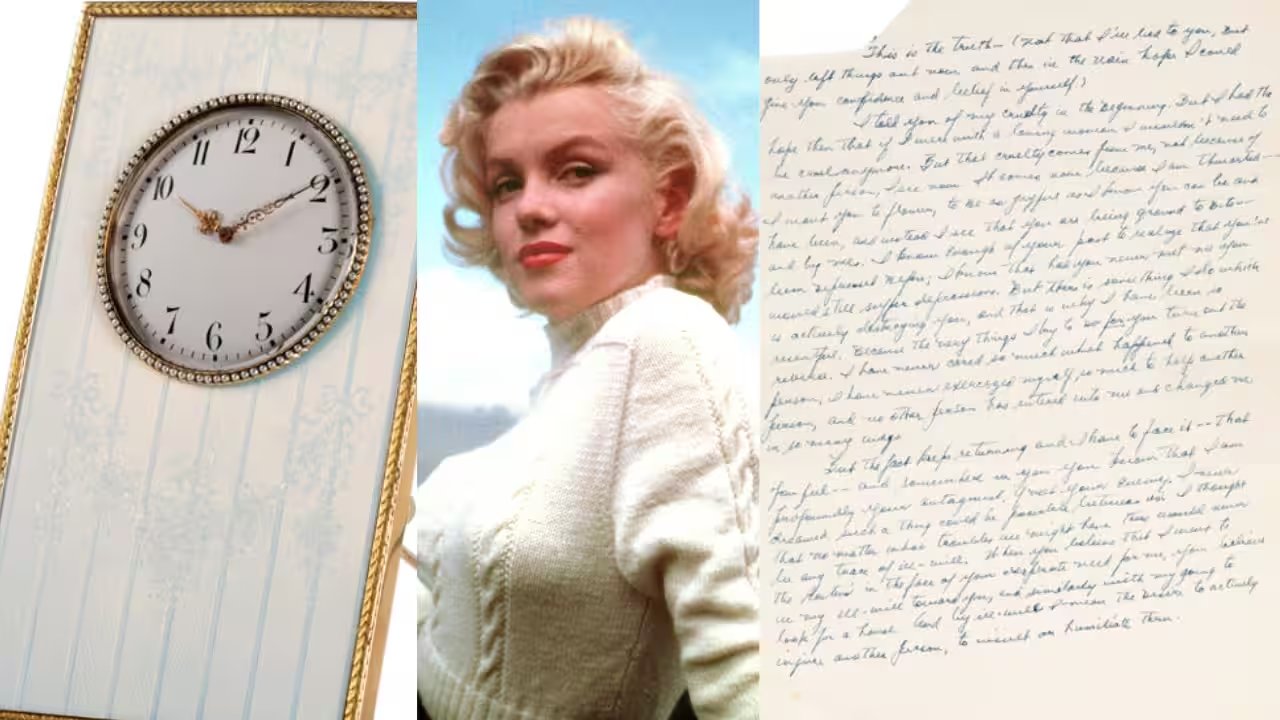
The myth swallowed her whole. For six decades, Marilyn Monroe remained frozen in cultural memory as a curated celluloid pin-up, dissected almost exclusively through glamorous studio stills, tabloid marriages, and an untimely death.
That flat portrait just splintered.
A trove of handwritten letters, personal notes, unpublished poems, art, garments, and domestic effects held out of public sight for more than 60 years has surfaced. Preserved intact by two of her closest confidants, the cache maps Monroe's inner life from 1955 to her death in August 1962. Heritage Auctions officially presented the archive in May 2026, registering it as one of the most comprehensive personal Monroe paper trails ever brought to light.
She kept the receipts. Instead of polished studio PR, the pages capture a woman grappling with marital decay, artistic hunger, and private grief.
The entire paper trail survived because Monroe trusted a single couple.
Photographer Sam Shaw introduced Monroe to poet Norman Rosten and his wife, Hedda, in 1955. It blossomed into an enduring refuge. Far from the flashbulbs of Hollywood backlots, Monroe slipped away with the couple to quiet retreats in New York, Connecticut, and London.
Norman shared her quiet appetite for literature and verse. With him, Monroe did not have to play dumb. She talked craft, read widely, and scribbled stanzas with a peer who took her mind seriously. Hedda entered the fold in a practical capacity, working as Monroe's personal assistant and escorting her across grueling movie sets. Because the Rostens guarded her memory rather than flogging it off piecemeal, the correspondence, wardrobe, and keepsakes stayed unified under single-family care for generations.
| Archive Component | Time Period Covered | Key Artifacts & Documented Records |
|---|---|---|
| Marital Correspondence | 1955–1961 | Raw notes on Arthur Miller marriage; letter from Miller; DiMaggio pain logs |
| Literary Works | 1955–1962 | Handwritten poems, including two verses composed on Arthur Miller letterhead |
| Medical & Death Records | August 1962 | Letters signed by Dr. Ralph Greenson, including August 15, 1962 narrative |
| Personal Wardrobe & Art | Late 1950s–1962 | Worn garments, original sketches, and private domestic keepsakes |
The correspondence cuts straight to her turbulent relationships with two cultural giants.
Monroe married playwright Arthur Miller in 1956. The intellectual and the bombshell made relentless headlines, but the marriage curdled behind shut doors. Monroe's handwritten communications in the Rosten archive lay bare the grinding personal frictions of that union. Crucially, the collection also preserves an original handwritten letter from Miller back to Monroe—documenting escalating alienation from both sides of the domestic divide rather than relying on secondhand Hollywood gossip.
Yet the pain was not reserved for Miller alone.
Baseball legend Joe DiMaggio haunts the margins. Though their 1954 marriage folded within nine months, their mutual emotional grip never fully broke. One handwritten letter in the collection explicitly addresses the deep emotional trauma tied to their shared past.
And then the ink turns darker.
In one deeply sensitive handwritten note, Monroe discusses a possible pregnancy loss—a private physical trauma long speculated about by film historians. Other fragments capture stark meditations on isolation, fractured memories, and creeping mortality.
The final chronological chapter of the archive contains clinical documentation from Monroe's final days.
Monroe died on August 5, 1962, at age 36 inside her Brentwood home in Los Angeles. The archive features letters signed by her personal psychiatrist, Dr. Ralph Greenson. Most striking is a detailed account dated August 15, 1962—penned exactly ten days after Monroe died—recording the circumstances surrounding the day of her death and the chaotic immediate aftermath. While auction catalogers emphasize that Greenson's letters represent his personal testimony rather than a legal verdict on her contested demise, they provide primary medical documentation from the epicenter of her care.
Then there is the poetry.
Two previously unseen poems sit penned directly onto sheets of Arthur Miller's stationery. They confirm what Norman Rosten insisted upon for decades: Monroe possessed a genuine literary impulse, drafting reflective verse when the cameras ceased rolling.
Heritage Auctions plans to bring the cataloged Rosten estate materials to public exhibition and auction platforms throughout the 2026 calendar cycle.