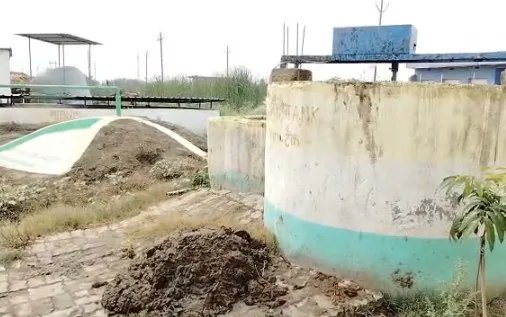
BARABANKI — Agricultural stubble across central Uttar Pradesh is no longer going up in smoke. Instead, heavy industrial balers are hauling tonnes of paddy and maize stalks straight from rural acreage into high-yield energy refineries. The commercial pivot has wiped out up to ₹3,000 per acre in field-clearing costs for local growers. Farm budgets turned positive overnight.
Forty compressed biogas (CBG) facilities now operate across Uttar Pradesh, with state planners clearing blueprints for another 78 units, according to the Agriculture Department. The initiative targets the perennial menace of crop residue burning by converting discarded biomass into industrial fuel and nutrient-dense organic manure.
For growers in Barabanki district, the operational shift eliminated an agonizing seasonal dilemma. Farmers historically had to pay private contractors steep manual clearing fees or strike a match to prepare the earth for winter sowing.
Yogesh, who cultivates wheat, paddy, and potatoes in Karamat Kheda village in Harakh block, saw the turnaround firsthand. Prompt field clearing allowed him to seed his next seasonal crop immediately without losing critical soil moisture to delay. Further west in Tikra village, farmer Balram calculated the economic windfall. Clearing one acre of stubble previously cost him between ₹2,500 and ₹3,000.
“Transporting stubble to the biogas plant saves us the cost of removing it from the field,” Balram said. “Farmers can now avoid burning residue while the processed organic material can be used as manure.”
Patrolling the rural belt required institutional redesign. The Agriculture Department structured the collection network alongside the Bill & Melinda Gates Foundation’s Technical Support Unit (TSU), anchoring local supply logistics to Farmer Producer Organizations (FPOs) and regional aggregators.
Coordination is rigorous. Aggregators deploy field-mapping teams immediately after harvest to sync mechanized extraction schedules. Fleets of tractor-mounted slashers, rakers, and hydraulic balers roll across the fields, cutting and compressing loose stalks into high-density cubes before hauling them to centralized storage hubs.
Labor demands followed the machinery into the countryside. Field operations deploy between 10 and 12 local workers per collection crew, while large industrial processing centers employ roughly 2,000 personnel.
The flagship industrial CBG facility on Deva Road in Barabanki swallows approximately 150 tonnes of bundled agricultural residue every day. In return, the plant churns out between 15,000 and 19,000 kilograms of commercial-grade biogas every 24 hours.
Livestock owners generally reject paddy and maize stalks because high silica levels make them tough and indigestible as animal fodder. But industrial digesters thrive on the high-fiber fuel. Fermentation tanks isolate the carbon while spinning off organic sludge that is returned to agrarian villages as chemical-free bio-fertilizer.
| Project Parameter | Operational Baseline | Official Target / Metric |
|---|---|---|
| Active Biogas Facilities (UP) | 40 Plants | 78 Additional Units Planned |
| Farmer Clearance Cost Savings | ₹0 (Prior Baseline) | ₹2,500 to ₹3,000 Per Acre |
| Deva Road Daily Biomass Inflow | — | 150 Tonnes of Residue Daily |
| Deva Road Daily Gas Output | — | 15,000 to 19,000 kg Biogas |
| Industrial Facility Employment |
The Deva Road facility and a sister refinery in Haidergarh have expanded commercial collection routes across Harakh, Haidergarh, Fatehpur, and Ramnagar blocks, said Barabanki Deputy Director of Agriculture Umesh Kumar Sah.
Stubble is being removed from farmers' fields on time, while the organic residue generated after processing is being made available as manure.
Umesh Kumar Sah, Deputy Director of Agriculture, Barabanki
State authorities are moving to institutionalize the economic gains. Agriculture Department Director T.M. Tripathi confirmed the administration has pivoted completely from punitive disposal measures to structured industrial conversion.
“With the establishment of CBG plants, stubble that earlier posed a problem for farmers is now becoming a source of income,” Tripathi said.
To prevent harvest supply bottlenecks, the state government is distributing direct capital subsidies to FPOs and individual rural entrepreneurs to finance additional Crop Residue Management (CRM) machinery ahead of the upcoming agricultural cycle.
| — |
| ~2,000 Workers Per Plant |