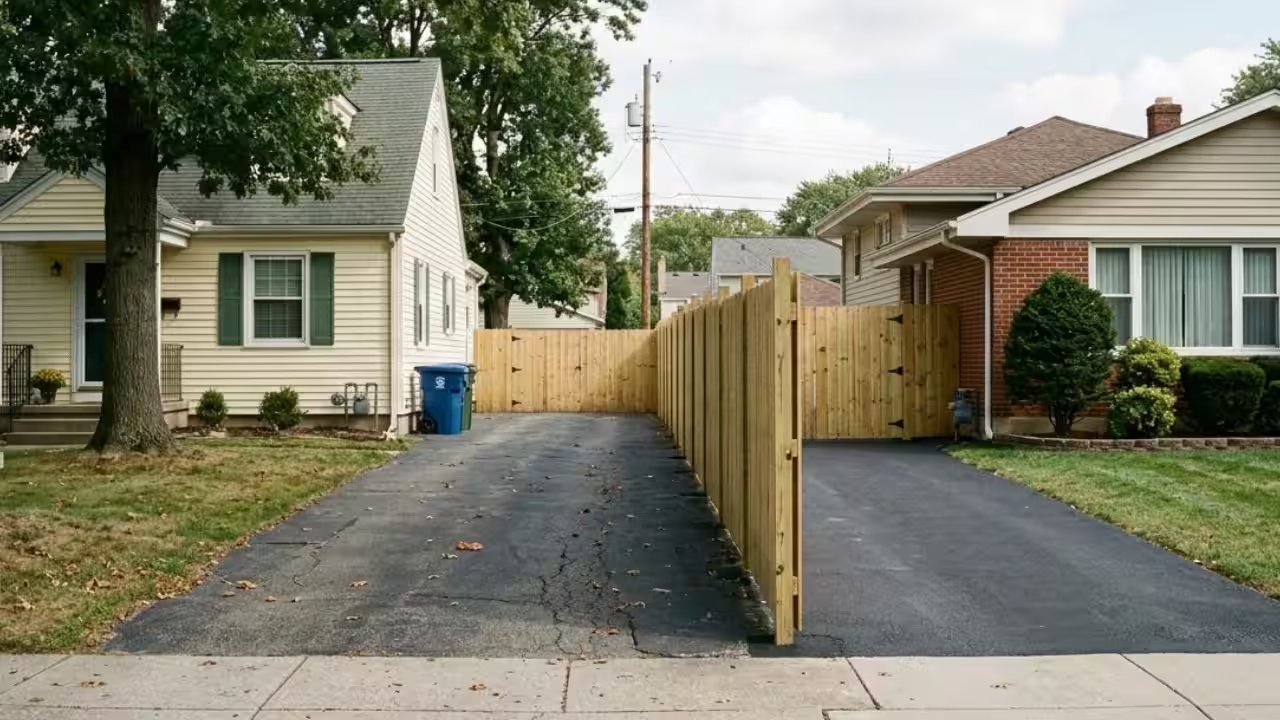
A federal judge has dismissed a constitutional civil rights lawsuit against the City of Oak Hill, ruling that municipal authorities did not execute an illegal government taking when they permitted a resident to slice a shared driveway in half with a boundary fence.
Plaintiffs Mark McDonald, Nanette McDonald, and their daughter Madeleine McDonald had sued the Davidson County municipality under the Fifth and Fourteenth Amendments after local zoning officials sanctioned the obstruction. The ruling draws a hard line between private property battles and municipal regulatory oversight, establishing that granting an erroneous or disputed building permit does not convert private encroachments into unconstitutional state seizures.
The family previously forced their neighbor to dismantle the barrier through state litigation. Yet their bid to hold city hall financially liable collapsed in federal court.
Trouble surfaced when neighbor Mary Rust prepared renovations on her parcel in Oak Hill, an incorporated city in Davidson County, Tennessee. Rust occupied a home built in the 1950s, while the McDonald family owned the adjacent 1965 property where their daughter resided. Both households had shared a single concrete driveway since construction under reciprocal easements that allowed each party to drive over the boundary line.
City zoning codes threw a wrench into Rust's expansion plans. Oak Hill calculates allowable lot improvements by excluding any land encumbered by an easement. That metric barred Rust from proceeding unless she erased the McDonald family's driveway rights.
Rust asked the McDonalds to sign an agreement extinguishing the easement. They refused.
Rust then approached municipal authorities in July 2024 to ask whether she could run a boundary fence straight down the middle of the driveway. A city code enforcement officer initially pushed back. Oak Hill zoning statutes mandated a formal building permit accompanied by a stamped survey and site plan displaying all property lines and easements, and the inspector warned Rust that no permit could clear if an easement encumbered her side of the driveway.
She changed tactics. On October 29, 2024, Rust submitted a Deed of Correction executed by her property's previous owners. The document asserted that a joint driveway agreement recorded in 1992 was never intended to run with the land or bind subsequent purchasers. Rust claimed the filing expunged the easement entirely.
The city attorney accepted Rust's paperwork. Despite explicit warnings from the McDonalds that the property right remained active and disputed, Oak Hill approved Rust's application and issued a building permit on November 21, 2024. Rust erected the fence immediately, barring the McDonald family from half the driveway.
Legal combat erupted on two fronts. The McDonalds appealed the building permit to the Oak Hill Board of Zoning Appeals, but board members deferred, declaring they lacked legal jurisdiction to adjudicate private title conflicts. On December 6, 2024, the family escalated the fight to the Davidson County Chancery Court, suing Rust for trespass, interference with an easement, and slander of title.
The state court case ended in total capitulation for Rust. In September 2025, the chancery court entered an agreed order that invalidated the October 2024 Deed of Correction, upheld the McDonald family's reciprocal easement, and commanded Rust to tear down the fence. In June 2026, both parties finalized a settlement resolving the family's financial damages claims.
Yet the McDonalds pressed forward in federal court against the City of Oak Hill. Their complaint alleged that municipal officials violated the U.S. Constitution by stripping their vested property access without just compensation. They charged the city with maintaining an unconstitutional practice of rubber-stamping permits over private property rights and failing to properly train code enforcement personnel.
The federal court threw out the case. Issuing a standard municipal permit to a private citizen does not constitute an exercise of eminent domain or a state taking, the court concluded.
| Legal Action & Parameter | Case Milestone & Judicial Status | Forum / Entity |
|---|---|---|
| Oak Hill Building Permit | Issued Nov 21, 2024; fence erected down driveway | City of Oak Hill |
| Board of Zoning Appeals | Dismissed; cited lack of authority over private titles | Oak Hill BZA |
| State Property Lawsuit | Agreed Order entered Sept 2025; fence removed | Davidson County Chancery Court |
| Private Damages Claim | Settled out of court, June 2026 | Private Settlement |
Both properties in Oak Hill now operate under the restored 1992 reciprocal easement, with the fence permanently cleared and federal claims against municipal coffers dismissed with prejudice.
| Federal Civil Rights Claim |
| Dismissed; permit issuance ruled not a taking |
| U.S. District Court |
| Governing Constitutional Law | Fifth and Fourteenth Amendments (Takings Clause) | Federal Judiciary |