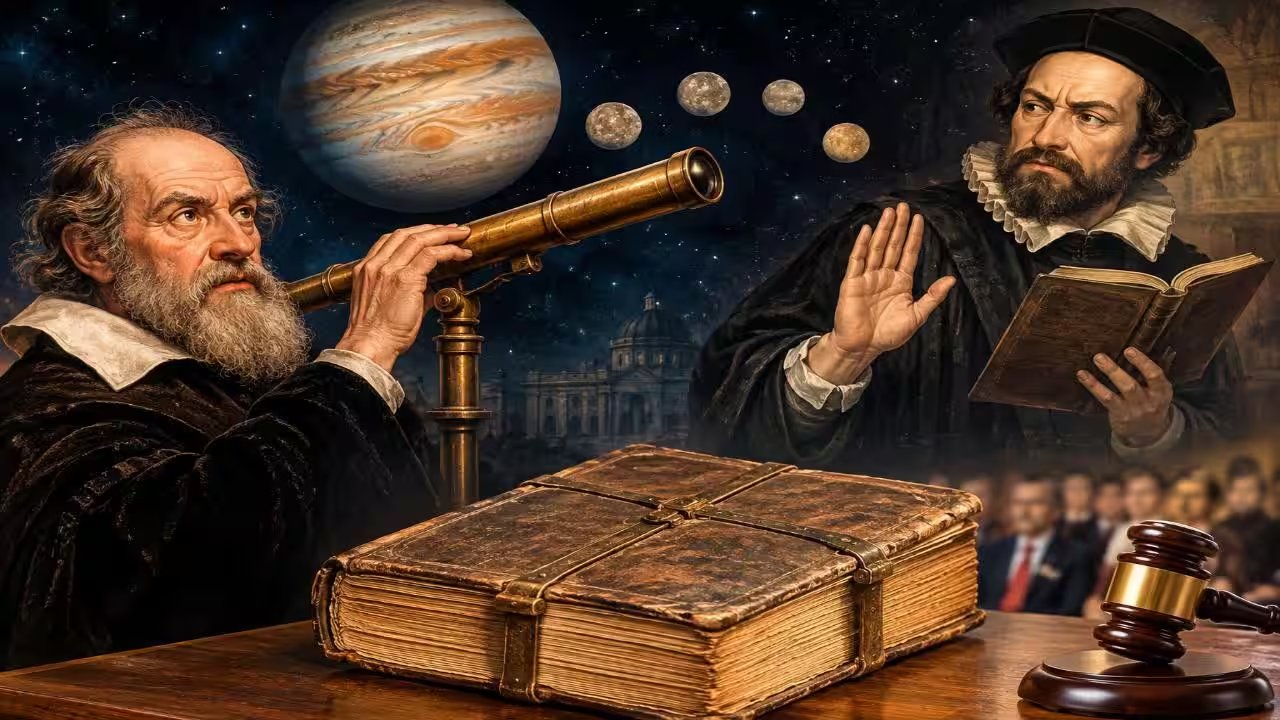
A rare physical manifestation of scientific dissent just cleared the block at Christie’s. In February 2026, the auction house sold a bound volume for US$217,600 (approximately Rs 2.07 crore). It contained Galileo Galilei’s 1610 Sidereus Nuncius alongside Francesco Sizzi’s 1611 Dianoia astronomica, optica, physica.
Sizzi didn't just disagree; he attacked the instrument. He argued the four lights orbiting Jupiter were optical illusions created by the telescope itself. Galileo, who had built his own improved scopes after learning of the technology in 1609, had observed these bodies—now known as Io, Europa, Ganymede, and Callisto—shifting positions night after night. The data was undeniable, yet the resistance was immediate.
What makes this specific copy extraordinary is that the two men’s works survived together. Bound in contemporary stiff vellum, the volume also includes texts by Marcus Antonius de Dominis and Giovanni Antonio Magini. According to Christie’s catalogue, Galileo chose not to publicly refute Sizzi, prioritizing their friendship over a public victory. The binding even features a reused sheet from a 1474 Latin translation of Herodotus, offering a glimpse into how early printed books were assembled.
The Sidereus Nuncius itself was a seismic shift. Published in Venice in March 1610, it didn't just announce new moons; it described the Moon’s mountainous surface and resolved the Milky Way into individual stars. This shattered the Aristotelian model of nested celestial spheres with Earth at the center. The book made Galileo famous across Europe almost overnight.
The auction marks the end of a journey for this specific artifact, but the scientific legacy continues. The four moons remain central to modern astronomy. For collectors, the value lies in the tangible record of that early 17th-century debate—a moment when evidence first clashed with entrenched belief, and two friends stood on opposite sides of the telescope.