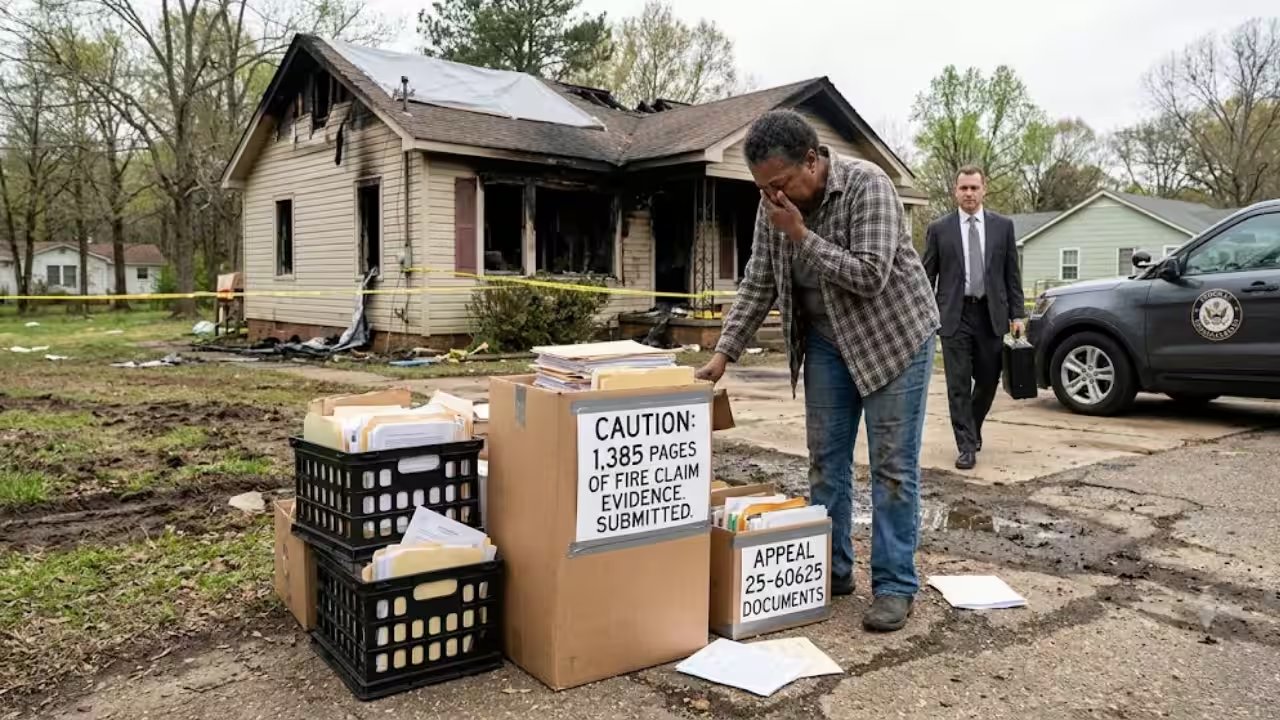
A federal appellate panel threw out a Mississippi homeowner's bid to force full policy coverage for a destructive 2023 house fire, ruling that a massive 1,385-page evidentiary submission failed to overturn an earlier court dismissal.
Even a small mountain of paperwork could not salvage the case.
Presiding over case number 25-60625, the U.S. Court of Appeals for the Fifth Circuit affirmed the lower court's decree on November 10, 2026, officially closing years of federal litigation. The dispute centered on whether the homeowner's insurer had systematically shortchanged her after an official adjuster's assessment pegged the structure's physical damage at $440,092. The policyholder insisted that figure fell far short of actual restoration costs, demanding that the carrier pay out the full limit of her policy.
The appellate judges disagreed.
Fire tore through the Mississippi residence in 2023, leaving behind charred framework and hundreds of thousands of dollars in destruction. After inspecting the wreckage, the insurance carrier delivered an official estimate of $440,092 to repair and rebuild the structural footprint.
Yet the homeowner pushed back immediately. She argued that the carrier’s assessment ignored hidden structural stress, escalating construction costs, and the true price of restoring the home to its pre-fire condition. Convinced the company breached its contractual duty to deliver full coverage, she set out to overpower the insurer's appraisal with raw paper.
She amassed 1,385 pages of documentation. Her legal filings bundled contractor price breakdowns, repair bids, damaged personal property logs, forensic photographs, and technical assessments from building experts. The dossier sought to establish that the company's $440,092 figure failed basic standards of adequacy.
But sheer volume carries little legal weight when an underlying claim fails federal evidentiary rules.
The federal district court dismissed her suit. Undeterred, she escalated the battle to the Fifth Circuit in New Orleans, asking a three-judge panel to review the record and overturn the dismissal.
Federal appeals courts do not conduct new trials, weigh witness credibility, or reconsider raw factual records from scratch. Their mandate focuses narrowly on judicial error—determining whether the presiding district judge misapplied statutory standards or committed procedural missteps.
Upon reviewing the lower court record, the Fifth Circuit found no reversible legal error in how the trial judge handled the homeowner's claims, formally rejecting her appeal and terminating her push for increased proceeds.
| Case Parameter | Legal & Factual Record |
|---|---|
| Appellate Jurisdiction | U.S. Court of Appeals for the Fifth Circuit |
| Docket Number | Case 25-60625 |
| Ruling Date | November 10, 2026 |
| Originating Incident | Residential Fire (2023) |
| Contested Structural Valuation | $440,092 |
| Evidentiary Bundle Submitted | 1,385 pages |
| Appellate Disposition |
The Legal Takeaway: The Fifth Circuit's final decree underscores a foundational reality in federal insurance litigation: courts demand rigorous adherence to procedural thresholds and contractual terms over sprawling document dumps. No matter how devastating the blaze, policyholders cannot rely on paper weight to revive claims dismissed for fundamental legal deficiencies.
With the Fifth Circuit’s mandate taking effect, the decision extinguishes the policyholder's federal options, leaving the insurer’s $440,092 assessment as the final benchmark of recovery for the 2023 blaze.
| Lower Court Dismissal Affirmed |