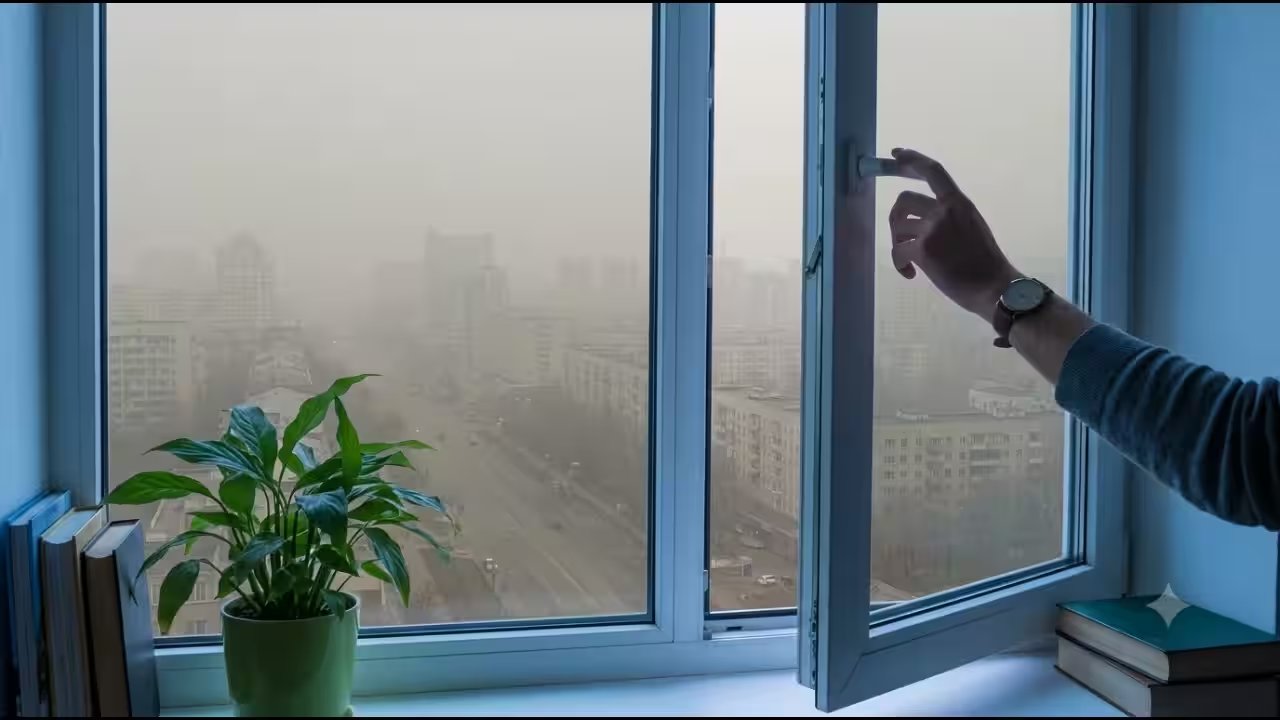
Throwing open your bedroom curtains and sliding the glass back at daybreak feels like an instinctive reset. The crisp morning breeze rushes across the floorboards. Sunlight cuts across the rug. But if you live in Delhi or across North India's winter smog belt, that gentle breeze is a trap.
Your home is not breathing fresh air. It is inhaling poison.
Cold winter air does not behave like warm spring breezes. Low temperatures, sluggish wind speeds, and atmospheric temperature inversions pin heavy vehicular fumes and industrial smoke right against the pavement. When street sweepers begin their rounds at sunrise, their heavy brooms kick up thick plumes of surface dust that linger in the chill. Opening your windows at 7 a.m. pulls that toxic slurry straight into your living room.
"When outdoor pollution levels are high, opening windows can allow harmful particles such as PM2.5 and PM10, along with vehicle emissions and other pollutants, to enter the house," said Dr Vikas Maurya, Senior Director and Head of Department for Respiratory Medicine and Respiratory Critical Care at Fortis Hospital, Shalimar Bagh.
Once those ultra-fine PM2.5 micro-particles drift past your window frame, they do not simply float out when you shut the glass. They settle into carpets, sofa upholstery, and bedsheets, suspended in stagnant indoor pockets where your lungs pull them in for hours. A bedroom may feel slightly cooler, but the air inside is materially dirtier than it was five minutes earlier.
Delhi's geography turns morning air into an enclosed chamber. The ground cools rapidly overnight, chilling the air closest to the asphalt while a warm blanket of atmosphere sits above it, preventing dirty air from rising or scattering. Every diesel exhaust pipe, factory chimney, and dust broom adds to an invisible soup hovering under six feet from the soil.
| Exposure Vector | Primary Pollutant Source | Practical Home Solution |
|---|---|---|
| Morning Ventilation | Inversion layer trapping PM2.5 and PM10 | Keep windows sealed; vent only when AQI improves |
| Street Sweep Dust | Early morning brooms and pavement traffic | Delay outdoor air intake until afternoon wind picks up |
| Kitchen Vapours | Cooking oils and gas combustion | Run dedicated exhaust fans continuously during meal prep |
| Domestic Fragrance | Incense sticks and mosquito coils | Eliminate smoldering coils; shift to physical barriers |
Yet sealing your home shut around the clock carries its own quiet danger. Indoor air builds up toxic concentrations quickly when everyday routines run unchecked. Cooking oils smoking on the burner, smoldering incense sticks at the home altar, mosquito coils burning through the night, and lingering tobacco smoke all choke tight living spaces. Harply scented chemical cleaners only compound the chemical load.
Fixing this does not require complex renovations. Flip your kitchen exhaust fan on the moment a pan touches the stove to pull oil vapors outward before they spread down the hallway. Cut out burning incense and mosquito coils entirely. Wipe down hard surfaces with damp microfiber cloths to trap settled dust without flicking it back into the breathing zone.
Stop letting the wall clock dictate your ventilation routine. A home does not magically freshen up just because the sun climbed above the horizon. Check your local AQI dashboard before unlatching a single window latch.
Run a certified HEPA air purifier in high-traffic bedrooms to scrub floating particulate load when regional pollution spikes into severe territory. While a HEPA filter cannot replace fresh ventilation or wipe away every volatile domestic fume, it strips fine particulate matter out of the breathing zone while the outside air remains hazardous. When afternoon heat breaks the inversion layer and local monitor numbers dip, open opposing windows for a brisk ten-minute cross-breeze, then seal them shut before evening traffic sets in.