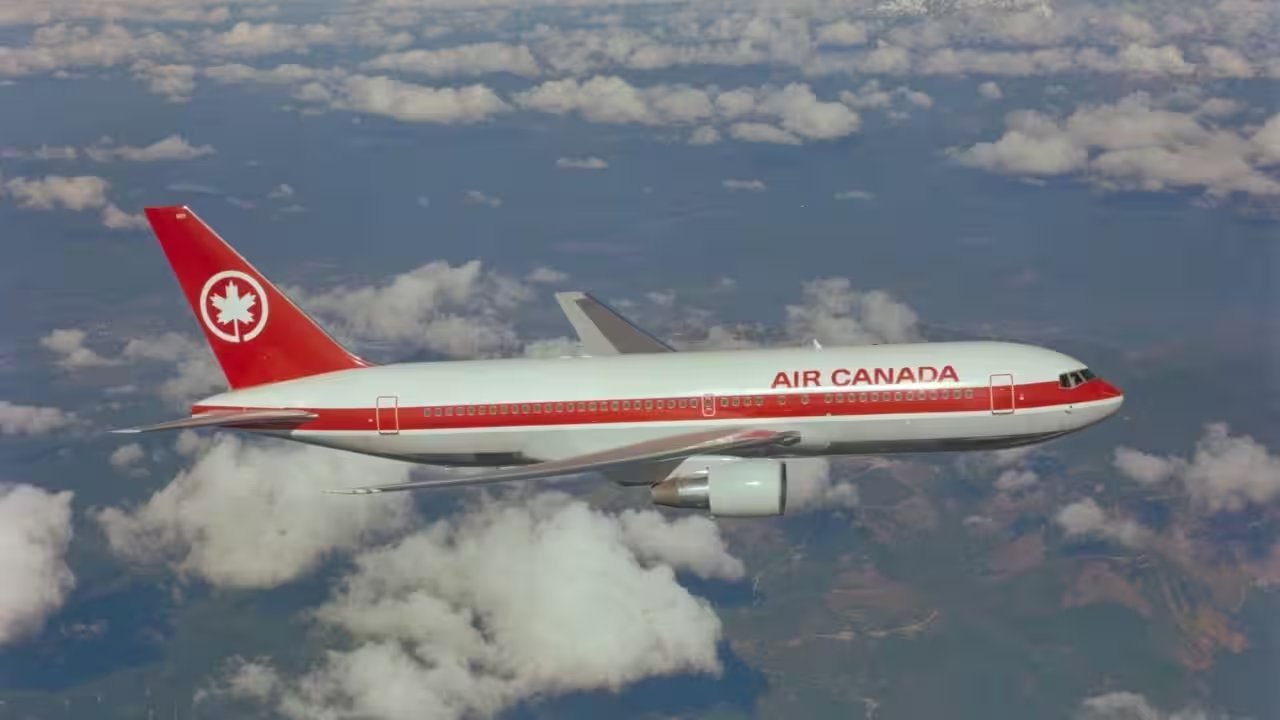
Captain Robert Pearson and First Officer Maurice Quintal brought a 132-tonne Boeing 767 to a silent stop on a dragstrip in Gimli, Manitoba, on July 23, 1983. The aircraft ran out of fuel at 41,000 feet over Red Lake, Ontario, after ground staff in Montreal calculated the load using imperial weights instead of kilograms. The plane carried 61 passengers and eight crew members, all of whom survived the emergency landing.
The error stemmed from Air Canada’s transition to the metric system. The digital Fuel Quantity Indicator System was faulty, forcing the crew to use a dripstick to measure fuel in litres. They multiplied the volume by 1.77—the conversion factor for pounds—rather than 0.8 for kilograms. This mistake loaded the jet with only 10,100 kg of fuel, roughly 45% of the 22,300 kg needed for the Montreal-to-Edmonton route.
At 41,000 feet, the Pratt & Whitney JT9D engines died, cutting power to all main electrical generators. Cockpit displays went blank, leaving Pearson and Quintal with battery-powered backup instruments that lacked a vertical speed indicator. Without hydraulic pumps, the control surfaces froze. The aircraft’s emergency ram air turbine—a small propeller powered by airflow—kicked in, providing just enough pressure for the pilots to steer.
Quintal, who had trained at the former Royal Canadian Air Force Station Gimli, suggested the diversion. The crew did not know the base had become the Gimli Motorsports Park, where spectators and race cars occupied part of the runway. Pearson, a glider pilot, executed a forward slip to bleed altitude without gaining speed. The maneuver briefly starved the ram air turbine, making controls stiff just before touchdown.
The jet touched down on the dragstrip section. Pearson applied the main wheel brakes, bursting two tyres, while two boys on bicycles narrowly escaped the silent slide. The nose gear failed to lock, causing the front of the aircraft to scrape along the concrete. The friction helped slow the plane to a halt. The Aviation Safety Board of Canada reported only minor injuries during the evacuation. The incident remains a textbook case for aviation fuel management protocols.