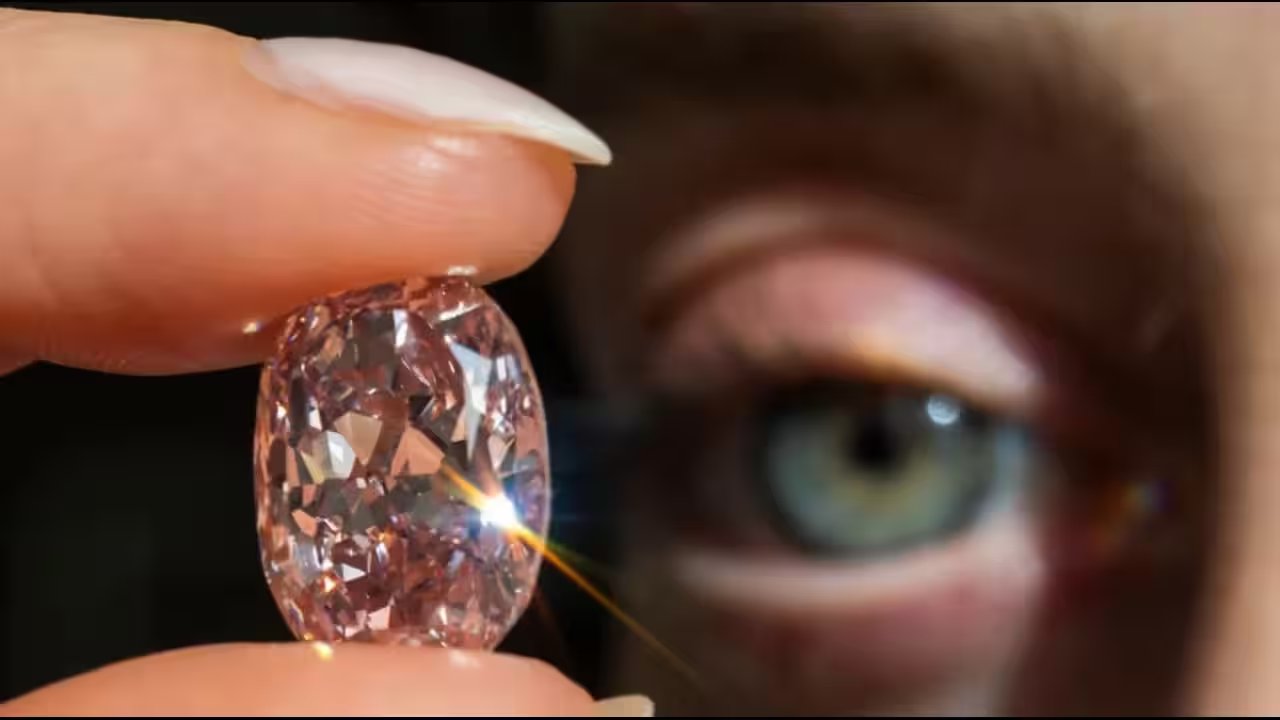
A 24-carat pink diamond rooted in southern India’s fabled Golconda mines fetched 12.086 million Swiss francs—roughly $14.8 million or ₹124 crore—at Christie’s in Geneva on November 10.
The room fell silent as the final bids landed. Held under the hammer during the Magnificent Jewels sale, the centerpiece gem, celebrated across elite jewelry salons as the "Bulgari Pink," found a buyer after spending more than 70 years tucked away inside a private family collection. Pre-sale guidance had pegged the stone between 10 million and 15 million Swiss francs, translating to roughly $12 million to $18 million, or ₹100 crore to ₹151 crore. The hammer fell squarely within that bracket.
Family provenance records released for the auction date the diamond’s modern journey to the 1950s. The seller’s great-grandparents purchased the raw crystal in India while it was still in its uncut, rough state.
Gem historians trace the stone directly to the river basins of southern India's historic Golconda kingdom. The deposit gave the world the Koh-i-Noor and the Hope Diamond. For generations, Golconda yielded gems with a watery, ethereal transparency that modern mechanized pits cannot replicate.
Soon after purchasing the rough stone, the family traveled to Rome. They commissioned the Italian luxury house Bulgari to plan the cut, polish the facets, and set the crystal into a ring. Bulgari opted for an emerald cut to showcase its natural saturation. Once finished, the piece vanished from the market. It passed quietly down through three generations of the same European household, never once surfacing on an exhibition floor or retail counter until this month.
Colored diamonds regularly force collectors to choose between physical volume and chromatic richness. Large stones tend to wash out. Intensely pigmented stones usually measure small.
This crystal defies that compromise.
Christie’s gemologists graded the stone as "Fancy Intense Pink" across its entire 24 carats. Crucially, laboratory analysis places the diamond in the ultra-rare Type IIa bracket—a designation that accounts for fewer than two percent of all gem-quality diamonds ever mined. Type IIa stones contain virtually no nitrogen impurities in their carbon lattice. That chemical purity gives the crystal an internal glass-like brilliance and immaculate clarity.
It is the Mona Lisa of pink diamonds," said Max Fawcett, Christie's global head of jewelry, describing the stone's rare marriage of size, saturation, and historic Indian pedigree ahead of the bidding.
| Attribute | Verified Auction & Gemological Metric |
|---|---|
| Carat Weight | 24 Carats |
| Diamond Color Grade | Fancy Intense Pink |
| Chemical Classification | Type IIa (<2% of all gem-quality stones) |
| Cut Style | Emerald Cut Mounted in Statement Ring |
| Provenance Origin | Golconda Mines, Southern India (Acquired 1950s) |
| Cutting House | Bulgari (Rome, Italy) |
The Bulgari Pink served as the anchor for an expansive single-owner estate sale in Geneva. The collection brought nearly 300 vintage 20th-century jewelry pieces to auction, featuring heritage designs from Cartier, Graff, and Bulgari.
Yet none rivaled the Golconda centerpiece.
Market Context: Historic Indian diamonds carry a severe structural premium among private collectors. With Golconda's mines depleted centuries ago, zero new supply enters the market; every transaction relies exclusively on family vaults opening up or royal heirlooms coming to auction.
Having emerged from private European hands for the first time since the mid-20th century, the Bulgari Pink stands among the highest-grossing gemstone sales globally this year.
| Auction Date & Location |
| November 10; Geneva, Switzerland |
| Pre-Sale Valuation | 10M – 15M CHF ($12M – $18M / ₹100 Cr – ₹151 Cr) |
| Final Realized Price | 12.086 Million Swiss Francs (~$14.8M / ₹124 Crore) |