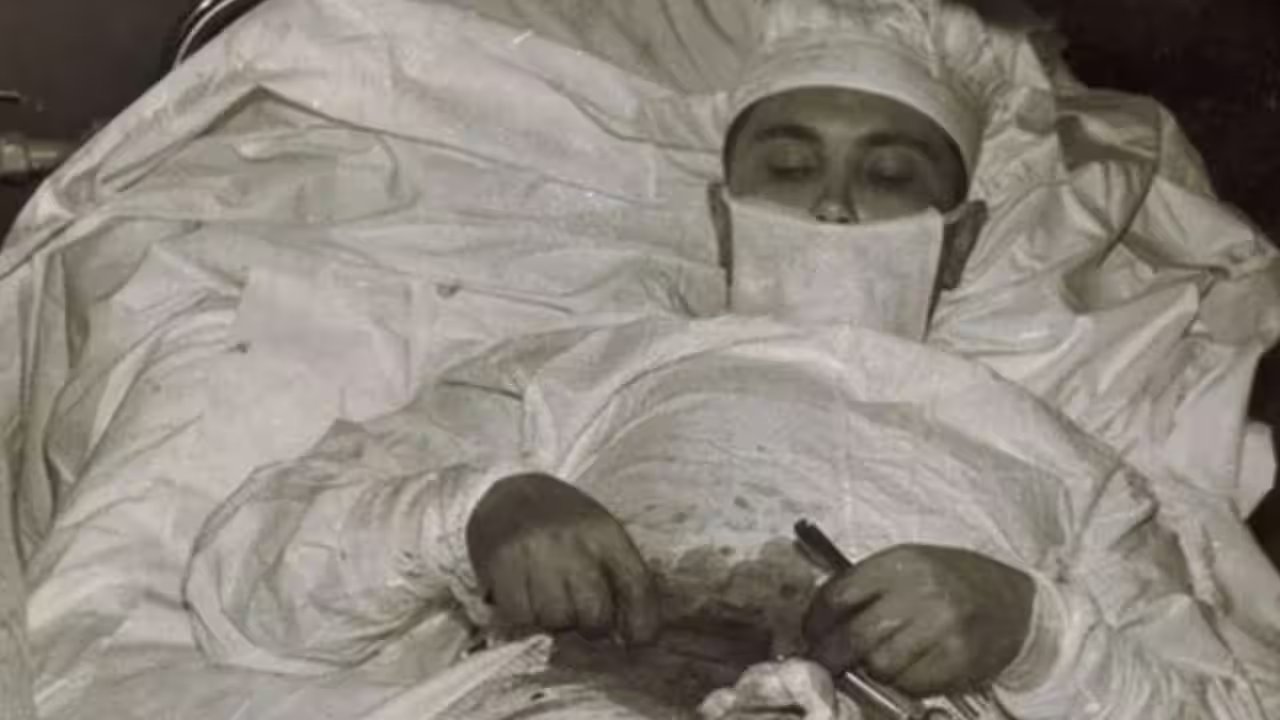
Trapped thousands of miles from the nearest hospital, Dr. Leonid Rogozov faced a grim biological deadline. He could cut into his own abdomen or die of systemic infection beneath Antarctic blizzards. He chose the scalpel.
The 27-year-old surgeon was the only physician among a 12-man team at the newly built Novolazarevskaya Station, completely marooned by pack ice and fierce polar storms. With his body weakening from acute appendicitis on April 30, 1961, Rogozov cleared his quarters, conscripted a mechanic and a meteorologist into surgical service, and excised his own appendix in a two-hour ordeal under local anaesthesia.
Rogozov had sailed from Leningrad aboard the research vessel Ob on November 5, 1960, as part of the sixth Soviet Antarctic expedition. Following a 36-day ocean passage, the polar team landed on the continent and constructed an outpost at the Schirmacher Oasis. Station Novolazarevskaya was officially commissioned on February 18, 1961.
But seasonal timing worked against them. The ship departed as the polar winter closed in, sealing the sea in solid pack ice and leaving the team isolated for an entire year without resupply. In that frozen wilderness, Rogozov pulled triple duty: he treated the men, logged meteorological readings, and drove the base's heavy terrain vehicle.
The crisis began on April 29, 1961. Rogozov developed sudden weakness, nausea, and a rising fever. Then came the pain—a localized ache in the upper abdomen that migrated steadily to the lower right quadrant. Drawing on his surgical training, Rogozov diagnosed acute appendicitis. He jotted his grim prognosis into his private diary, concealing the development from the crew to avert panic.
Yet conservative treatment failed. By April 30, antibiotics had done nothing to halt the infection, and frequent bouts of vomiting set in. An untreated inflamed appendix carries a near-certain risk of rupture, leading to fatal peritonitis. Evacuation was entirely out of the question: blizzards grounded all aircraft, and the frozen ocean blocked any approach by sea. With no other doctor on the continent within reach, Rogozov had to cut into himself.
Rogozov systematically prepared an improvised operating room. He ordered his living quarters cleared of furniture, leaving behind only his bed, two tables, and an examination lamp. He assigned specific surgical duties to his colleagues. One held a mirror and positioned the light; another handed him instruments, while a third stood by as a backup in case the primary assistants succumbed to nausea. Rogozov also drilled his team on emergency resuscitation, demonstrating how to administer artificial ventilation and cardiac injections if he lost consciousness.
Positioning himself in a semi-reclining posture with his right hip slightly elevated, Rogozov sterilized the room and his team's hands. He injected his abdominal wall with Novocain for local anaesthesia and sliced open an incision measuring 10 to 12 centimetres. Because the hand mirror reversed the field of vision, he abandoned visual cues and relied almost entirely on tactile feedback, working by touch inside his own abdominal cavity.
Disaster nearly struck mid-procedure. Around 40 minutes into the surgery, Rogozov was hit by severe dizziness and physical weakness, forcing him to take repeated pauses while his assistants mopped sweat from his forehead. During the internal exploration, he accidentally nicked the caecum—a section of the large intestine—and had to suture the perforated tissue immediately before proceeding. He then successfully located the severely inflamed appendix, resected it, and sutured the incision shut.
The entire operation lasted roughly two hours. Rogozov later calculated that had he delayed the procedure by another 24 hours, the organ would have ruptured, proving fatal in the polar outpost.
| Mission & Clinical Parameter | Official Detail |
|---|---|
| Lead Surgeon & Patient | Dr. Leonid Rogozov (Age 27) |
| Expedition & Post | Sixth Soviet Antarctic Expedition, Novolazarevskaya Station |
| Date of Surgery | April 30, 1961 |
| Operative Duration | Approximately 2 hours |
| Anaesthetic Used | Novocain (Local infiltration) |
| Primary Complication | Nicked caecum (repaired intraoperatively) |
Rogozov's recovery unfolded under the close observation of his 11 base colleagues. He maintained a regimen of systemic antibiotics to ward off secondary peritonitis. His body temperature normalized five days after the surgery, and by the seventh day, Rogozov removed his own surgical stitches. Within two weeks, he had resumed full active duty across the research station.
Rogozov departed Antarctica upon the conclusion of the sixth expedition, returning home to the Soviet Union in October 1962. He spent the remainder of his professional career practicing and teaching surgery in Leningrad. Rogozov died in Saint Petersburg on September 21, 2000, at the age of 66.
| Post-Operative Milestones |
| Temperature normal at 5 days; sutures removed at 7 days; back on duty at 14 days |