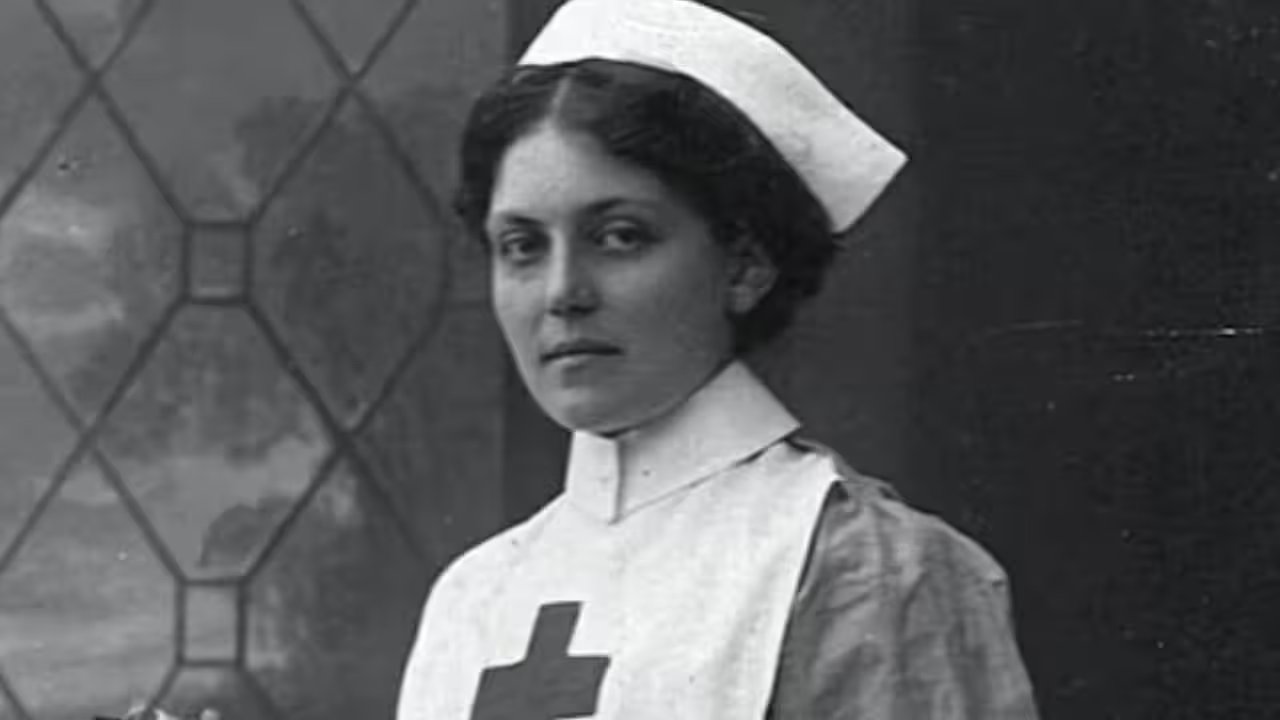
Violet Jessop stared down three of the twentieth century's deadliest maritime catastrophes—and refused to abandon the sea.
The Argentine-born stewardess walked away from the 1911 hull-ripping collision of the RMS Olympic, survived the freezing plunge of the RMS Titanic in 1912, and escaped the sinking HMHS Britannic in 1916 after leaping into churning waters beneath spinning bronze propellers. She was no casual passenger aboard luxury liners. Jessop worked the decks as a salaried employee, serving wealthy travellers and tending wounded soldiers while three sister ships built by Harland and Wolff crumbled around her.
She earned the title 'Miss Unsinkable'.
Her endurance began long before she ever set foot on a gangway. Born in Argentina in 1887 to Irish immigrants, Jessop was the eldest of a large family and contracted severe tuberculosis during early childhood. Doctors predicted an early death. She beat the infection anyway. Following her father's death, the family uprooted and moved to England. When her mother fell ill and could no longer work as a liner stewardess, Jessop cut her schooling short, took up the same uniform, and signed aboard the Royal Mail Line's Orinoco in 1908 to support her siblings. In 1911, the White Star Line hired her to staff its flagship vessel, the RMS Olympic.
Disaster struck during Jessop's first year with White Star Line. On September 20, 1911, the 45,000-ton Olympic rammed the British Royal Navy cruiser HMS Hawke in the Solent off the Isle of Wight. The cruiser tore a massive breach into the Olympic's hull. The liner limped back to port under its own power without a single casualty. White Star hauled the damaged vessel into dry dock for extensive repairs, but the incident never rattled Jessop. In April 1912, the company transferred her to the brand-new Titanic at Southampton for its maiden voyage across the Atlantic.
She boarded on April 10, 1912, as a first-class stewardess. Four nights later, at 11:40 p.m. on April 14, the liner scraped an iceberg in the North Atlantic. Water surged through five forward compartments.
Officers ordered Jessop onto the boat deck to demonstrate calm behavior to panic-stricken passengers who spoke no English. Crewmen loaded her into Lifeboat 16 as an example to hesitant travelers. Just as the boat swung from the davits, an officer thrust an unidentified infant into her arms. Jessop cradled the child through the freezing night until the rescue ship RMS Carpathia pulled the lifeboats from the water the following morning, where the child's frantic mother reclaimed the baby. More than 1,500 passengers and crew perished in the freezing water. Jessop landed in New York, boarded a return steamer to Southampton, and reported back for duty.
| Vessel | Date of Incident | Incident Nature | Total Fatalities | Jessop's Escape Route |
|---|---|---|---|---|
| RMS Olympic | Sept 20, 1911 | Collision with HMS Hawke | 0 | Remained on board; vessel docked safely |
| RMS Titanic | April 14–15, 1912 | Iceberg impact & sinking | 1,500+ | Evacuated via Lifeboat 16 |
| HMHS Britannic | Nov 21, 1916 | German naval mine strike |
When the First World War engulfed Europe in 1914, Jessop traded first-class cabins for hospital wards. She volunteered as a nurse with the British Red Cross and the Voluntary Aid Detachment, eventually boarding the HMHS Britannic—the third and largest of the Olympic-class sisters, refitted to carry wounded troops.
On November 21, 1916, an explosion shattered the ship's starboard side in the Aegean Sea. A German naval mine had detonated beneath the waterline. Water flooded through watertight compartments at twice the rate seen on Titanic.
The Britannic listed violently. Two early lifeboats dropped prematurely into the sea and drifted backward into the vessel's exposed, counter-rotating propeller blades. Jessop realized her boat was drifting into the shredding machinery and leaped into the open sea. The suction dragged her under the ship's keel. She slammed her head against underwater wreckage before bobbing to the surface, where crewmen hauled her out of the water.
The Britannic slipped beneath the surface in 55 minutes. Out of 1,066 people aboard, 30 died. Jessop escaped with severe trauma and later discovered the impact had fractured her skull.
I leaped into the water but was sucked under the ship's keel which struck my head.
Violet Jessop, *Titanic Survivor*
Yet she refused to stay ashore. Jessop rejoined the White Star Line in 1920, later transferred to the Red Star Line, and completed two around-the-world cruises on the ocean liner Belgenland. She concluded her service with the Royal Mail Line before retiring in 1950 at the age of 63, logging forty-two years on the high seas. She settled into a thatched cottage in Great Ashfield, Suffolk, where she documented her memories with co-author John Maxtone-Graham for her memoir, Titanic Survivor. Jessop died of congestive heart failure on May 5, 1971, at age 83, closing one of the most improbable records in international maritime history.
| 30 |
| Jumped overboard; survived fractured skull |