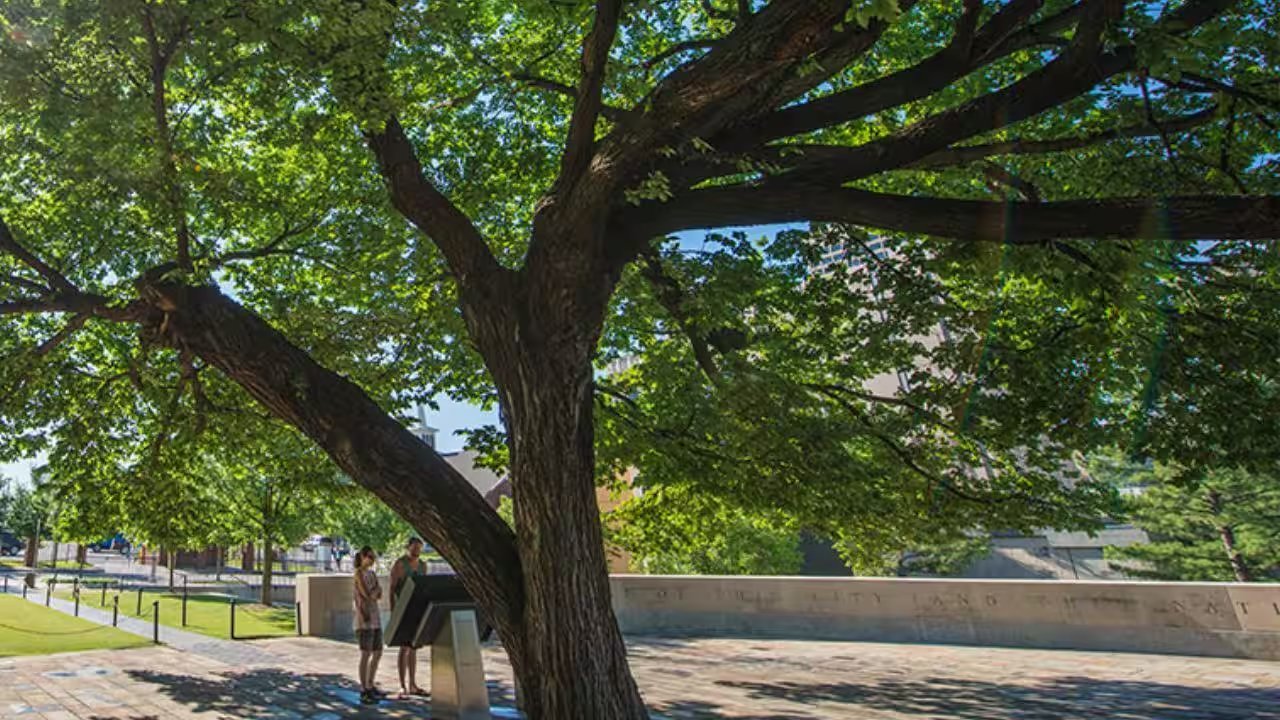
Planted in the early 1920s, the American elm grew behind a family home that would later vanish under commercial redevelopment. As the streets of downtown Oklahoma City evolved, the tree survived the removal of surrounding trees when a parking lot was built. By 1947 photographs show it already a mature specimen, its branches brushing the roof of what would become the Oklahoma City National Memorial & Museum.
On April 19, 1995 the 4,000‑pound bomb detonated beneath the Alfred P. Murrah Federal Building, shattering the skyline and killing 168 people. The elm stood directly across the street, its trunk battered by the blast yet remaining upright amid the rubble. The damage was severe, but the tree endured, a living witness to the tragedy.
In the immediate aftermath, plans emerged to remove the tree so that embedded shrapnel could be recovered. Those plans were abandoned, allowing the elm to stay on site. The Oklahoma City National Memorial & Museum now identifies the tree as the Survivor Tree, a symbol of the city’s resilience.
Today, visitors pause before the tree, noting its scars as a reminder of loss and endurance. The Survivor Tree stands beside the Reflecting Pool, its presence a quiet testament to the city’s capacity to heal.