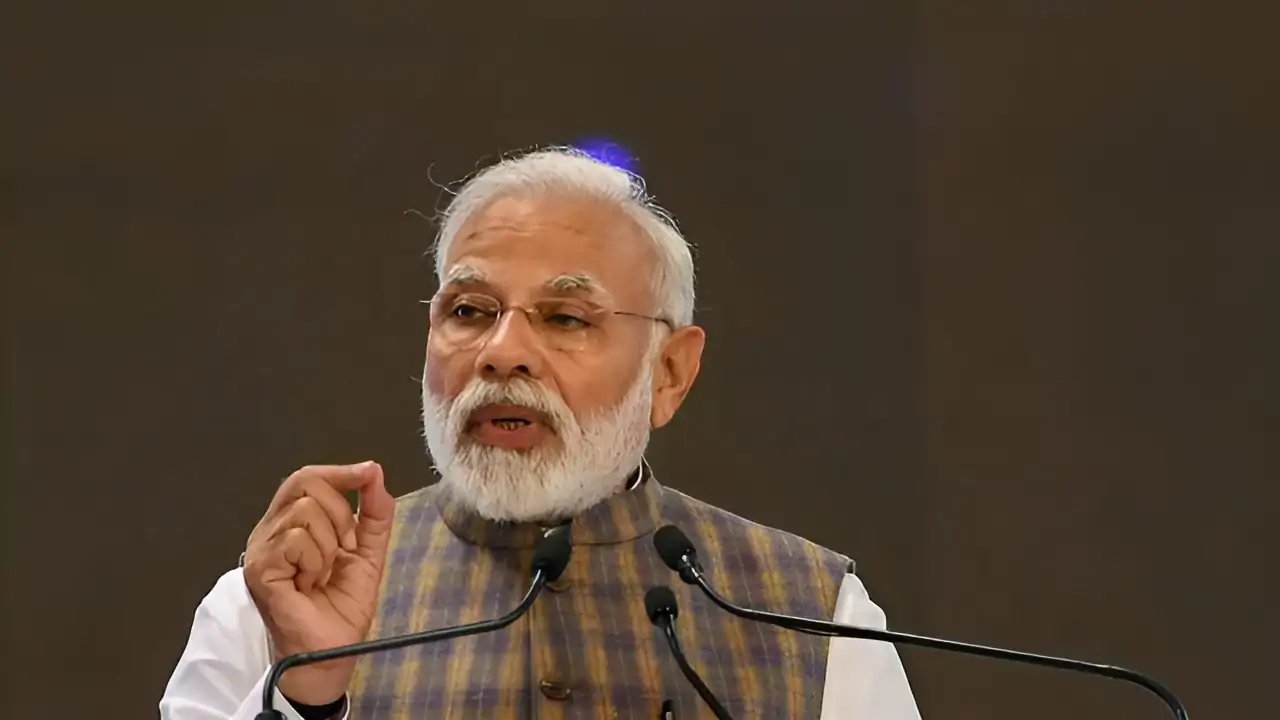
NEW DELHI — Prime Minister Narendra Modi lashed out at the Congress party on Thursday, accusing its leadership of reducing India's founding charter to a personal prop.
Speaking at the Bharat Agriculture Conference in New Delhi on November 12, Modi launched an unmistakable veiled attack on Leader of Opposition in the Lok Sabha Rahul Gandhi, slamming the habit of brandishing pocket-sized copies of the Constitution at political rallies. The critique was blunt. Modi asserted that certain opposition leaders operate under a persistent illusion of entitlement, acting as if democratic legitimacy belongs exclusively to their lineage.
These days, some people take out the Constitution from their pocket. They think that the nation's Constitution and its democracy are right there in their pockets.
Narendra Modi, Prime Minister
The Prime Minister told the gathering that being out of office had done nothing to diminish this sense of supreme authority.
"Even while not in government, they seem to be under a peculiar, intoxicating spell of power," Modi said, translating the mindset as an inability to accept administrative reality away from the seat of power in Delhi.
To illustrate what he described as long-standing intolerance of democratic merit, Modi reached back to his tenure as Chief Minister of Gujarat.
Gujarat had captured the top spot in a nationwide ranking of best-performing state economies. The assessment was rigorous, anchored by prominent economists, and run by a premier research institution named after a former Prime Minister. Modi refrained from explicitly naming the institute, remarking dryly that the namesake was "enough of a hint."
But the acclaim provoked immediate political retaliation from the central government then ruling in Delhi. Unable to digest Gujarat's rising developmental profile, the ruling establishment targeted the very researchers and economists who authored the evaluation.
"These are the same people who preach about martyrdom and democracy," Modi said. "This was a long time ago, and you can find out what happened after this by doing research."
Beyond the sharp political broadsides, Modi pivoted directly to the rural economy, framing agricultural modernization as the non-negotiable bedrock of national expansion.
Power without productivity leads nowhere. Modi stressed that empowering farmers through smarter cultivation practices and fortified agricultural infrastructure remains vital to realizing the vision of a developed India under the 'Viksit Bharat' framework. The transition requires modern technology, reliable rural credit, and robust farm-gate logistics capable of insulating cultivators from price shocks.
The clash sets a combative tone for the coming weeks, as Parliament prepares to convene with both the treasury benches and the opposition drawing battle lines around constitutional stewardship and agrarian welfare.