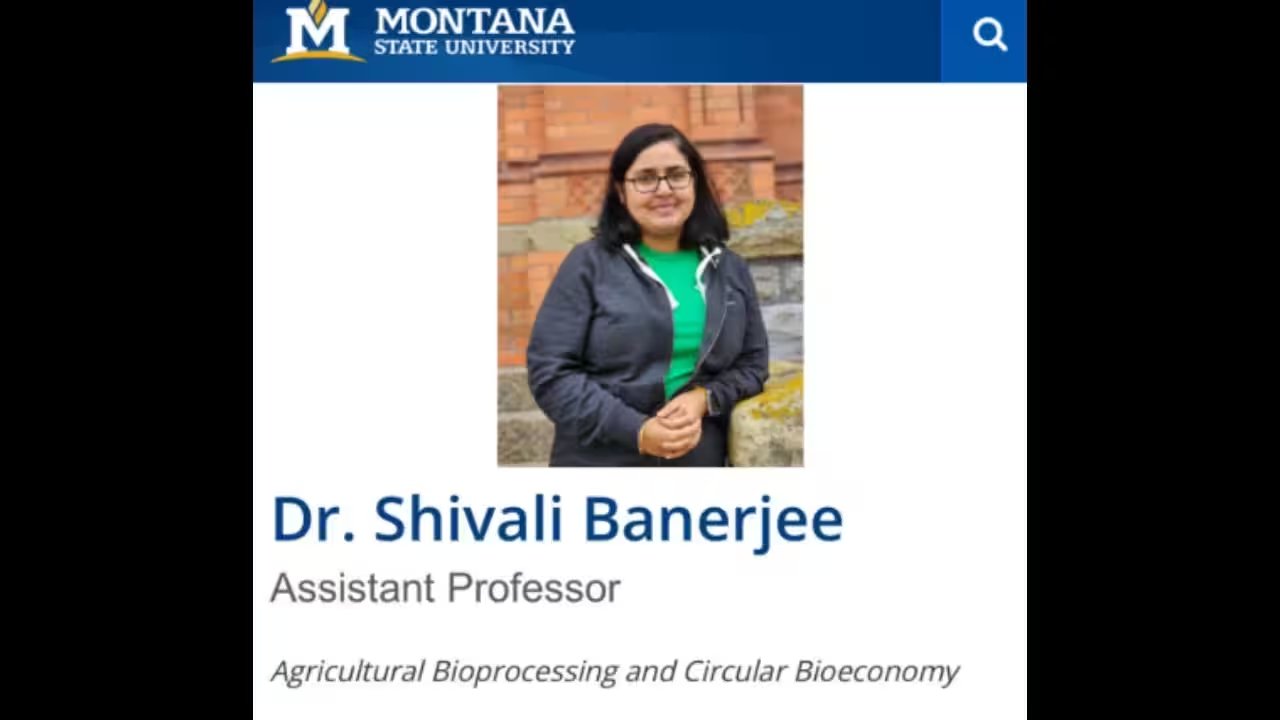
A social media post intended as a political skirmish turned into a public lesson in academic prestige. The account targeted four Indian faculty members at Montana State University, listing their undergraduate institutions—Punjab Agricultural University, Kerala Agricultural University, IIT Bombay, and IIT Guwahati—as if these were markers of mediocrity. The intent was obvious: to frame these hires as evidence of declining standards in US higher education, a narrative often pushed during trade friction and political tensions.
The account’s logic failed on contact with reality. The screenshots it posted inadvertently highlighted the faculty’s elite credentials. Dilpreet Singh Bajwa, the head of the Mechanical/Industrial Engineering Department, completed his MS and PhD at the University of Illinois. Sreekala Bajwa, Dean of the College of Agriculture, earned her master’s at IIT Kharagpur and her doctorate at the University of Illinois. Shivali Banerjee, a professor, is an alumnus of IIT Bombay. Amalesh Jana, another professor, studied at IIT Guwahati and Jadavpur University before completing his PhD at Oregon State University.
Netizens immediately pounced on the irony. "How's getting into IIT Bombay a bad thing," one user asked, pointing out that admission to IIT Bombay is statistically more difficult than entry into Harvard or MIT. Another commenter noted the absurdity of the critique: "It's harder to get into IIT Bombay than it is to get into Harvard or MIT." The discourse shifted quickly from political jabs to a defense of the faculty’s intellectual pedigree, with users noting that these individuals represent the "best of the best" in Indian engineering and agriculture.
The backlash was sharp and personal. One user offered a pointed reality check: "I know of an IITB graduate multimillionaire in Silicon Valley whose entire house staff is white Americans. Reel in your racism, your next job could be doing laundry for an IITB graduate." The incident occurred against the backdrop of Governor Greg Gianforte’s recent trip to India for trade talks, a period when online discourse between the two nations has grown increasingly vitriolic. Yet, this specific attempt to undermine the faculty’s legitimacy has only served to reinforce their credentials in the eyes of the public.
Montana State University has not issued a formal statement regarding the viral post, but the faculty in question continue their academic duties. The incident serves as a reminder that in the digital age, a lack of research can turn a political attack into a self-inflicted embarrassment. The next step remains unclear, as the account has not deleted the post, leaving the door open for further public scrutiny and potential legal or institutional response from the university.