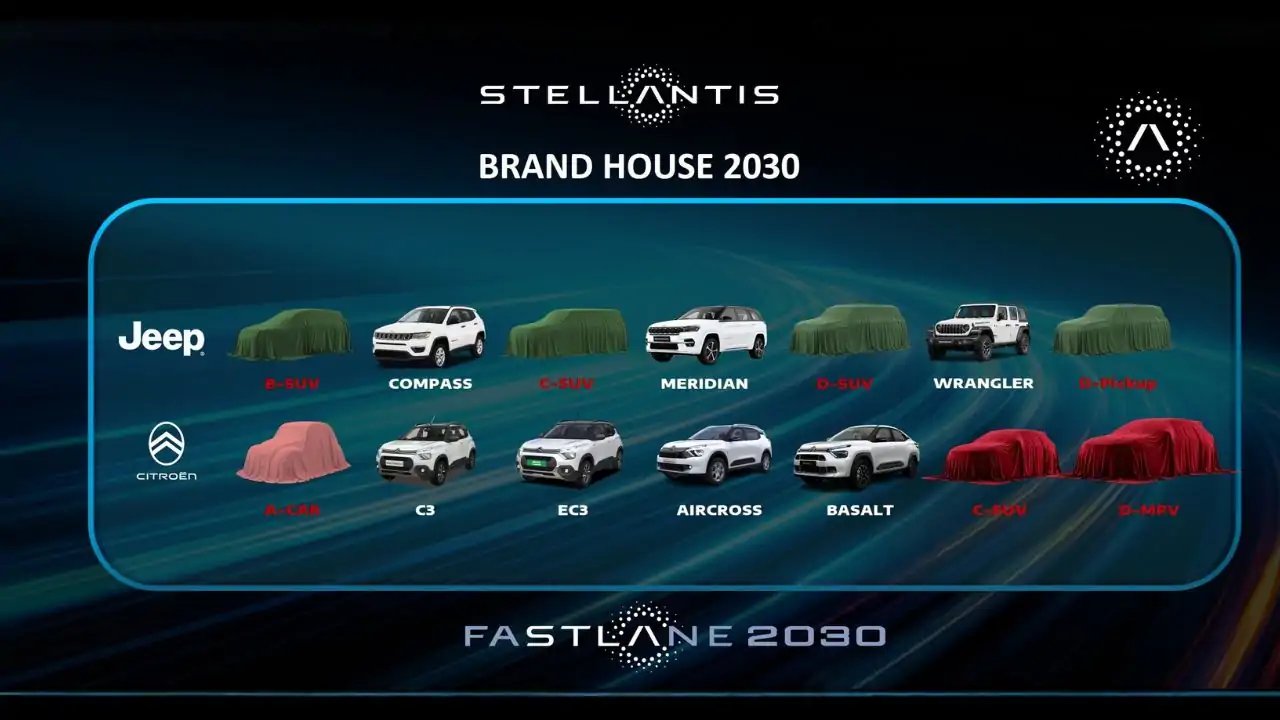
If you’ve been waiting for Jeep to move beyond the current Mahindra-built lineup, or for Citroen to finally offer a viable alternative to the Ertiga and Innova in the MPV space, the wait is officially on a timer. Stellantis India has confirmed a ₹4,000 crore investment to roll out 12 new products under its FaSTLAne 2030 roadmap. That’s seven all-new models and five major upgrades hitting Indian showrooms over the next three years. The first of these is scheduled to land in Q2 2027, giving buyers a tangible date to mark their calendars.
The strategy is a clear split in personality. Jeep is doubling down on its premium SUV stronghold, aiming to cement its status against the Toyota Fortuner and Ford Endeavour. Citroen, however, is taking a volume play, targeting the mainstream and higher-volume categories with vehicles ranging from entry-level cars to a premium pickup. This isn’t just about adding SKUs; it’s about occupying space that currently feels thin in the Indian market. For instance, the mention of an MPV and a premium pickup suggests Stellantis is eyeing segments where they currently have zero presence, directly challenging Maruti Suzuki’s dominance in the budget segment and Tata’s grip on pickups.
Powertrain options will be a multi-pronged affair. Rather than forcing an EV narrative where it doesn’t fit, the group is adopting a pragmatic mix of internal combustion engines, hybrids, plug-in hybrids, and battery-electric systems. The choice for each model will depend on charging infrastructure maturity and customer demand. This approach is likely to appeal to the Indian buyer who is still skeptical about EV range anxiety but wants the efficiency of a hybrid. Stellantis is also targeting 90% localisation, which means these cars won’t just be imports; they’ll be built here, leveraging the existing plants in Maharashtra and Tamil Nadu.
The financial backing is substantial. Total investment in India is projected to reach between ₹11,000 crore and ₹15,000 crore by 2030. This isn’t accidental. Stellantis wants India to be a manufacturing and export hub, not just a sales market. Currently, 95% of the engines and gearboxes produced at the Hosur facility are already shipped internationally. With this new push, India-developed vehicles are likely to join the export fleet, potentially to other Asia-Pacific markets. For the buyer, this means better local support and potentially more competitive pricing as economies of scale kick in.
The timing is aggressive. The first product arrives in Q2 2027. That’s less than a year away from now. With Citroen’s retail sales up 68% year-on-year in Q2 2026, momentum is building. But the real test will be execution. Can Stellantis deliver 12 distinct products in 30 months while navigating India’s complex regulatory landscape? The specific model names and prices are still under wraps, but the blueprint is clear: a broader, more localized, and more diverse lineup that finally gives Indian buyers real options in the premium and mainstream segments.