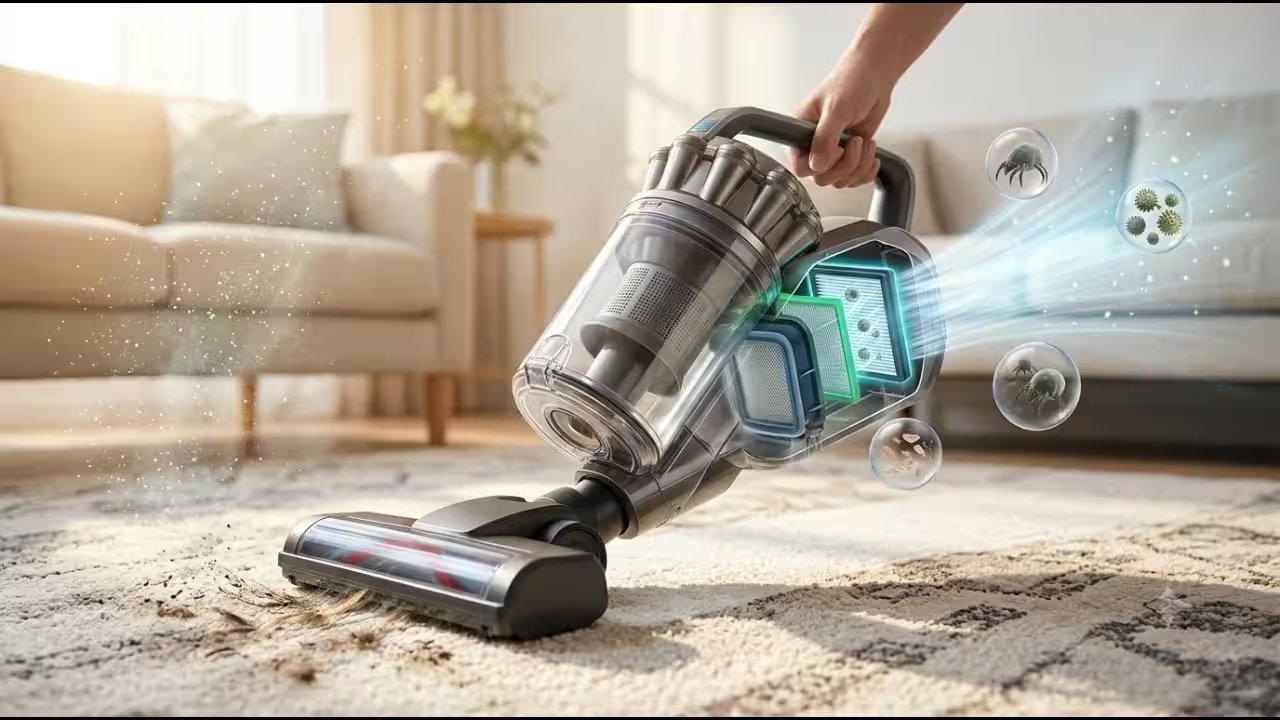
The floor looks spotless. The grit underfoot is gone, and the carpets show crisp grooming lines. But look closer at the sunlight cutting across the room.
Household dust is far nastier than inert grey fluff. It is an airborne stew of shed human skin cells, frayed fabric fibres, pollen grains, outdoor soil, and microscopic dust mite waste. When an ordinary vacuum cleaner runs over a rug, its motor pulls that debris into a collection container or bag. Then the trouble starts. Air drawn into the machine must vent back out. In cheaper or poorly engineered models, fine particles blast right through loose paper filters and unsealed plastic seams, settling back into your breathing space seconds after the motor shuts off.
A machine does not protect your lungs simply because it carries strong suction. Filtration efficiency decides what stays trapped and what escapes.
Genuine High-Efficiency Particulate Air (HEPA) systems operate under strict, standardized benchmarks: they must capture at least 99.97% of particles measuring 0.3 microns in diameter. That microscopic threshold catches pollen, pet dander, and fine particulate matter that easily slips through standard cloth or mesh barriers. Yet an expensive filter inside a shoddy chassis delivers zero protection. If air leaks around the filter edges or escapes through cracks in the casing before passing through the media, the vacuum cleaner bypasses its own defence system entirely.
| Filtration Feature | Standard HEPA Specification | Ordinary Cleaners |
|---|---|---|
| Particle Capture Efficiency | Minimum 99.97% of particulate matter | Varies widely; retains visible dirt only |
| Critical Particle Size | Traps down to 0.3 microns (pollen, dander) | Lets sub-micron particles pass through |
| Airflow Integrity | Requires fully sealed chassis to prevent bypass | Vents exhaust through loose seams and gaps |
| Odour Neutralisation | Often paired with activated charcoal stages | Standard single-stage porous bag or cup |
Packaging can deceive. Brands frequently slap the word 'HEPA' on exterior boxes when only an intake screen meets the standard, leaving the rest of the unit unsealed.
Before spending hard-earned money on a new unit, demand specific engineering details:
Verify Sealed System Construction: Confirm that the manufacturer guarantees a whole-machine sealed design. If air escapes before hitting the final HEPA stage, the specification sheet means nothing.
Inspect Filter Longevity and Formats: Determine whether the primary filter is washable or requires recurring replacements. Washable filters save cash, but damp or degraded pleats choke motor airflow and reduce suction over time.
Check for Odour Barriers: Homes with pets often fight stubborn smells alongside dander. Look for designs that pair the HEPA barrier with an activated charcoal filter to neutralize organic odours before the exhaust hits the living room.
Stock Availability: An advanced filtration vacuum turns useless the moment replacement cartridges disappear from local shelves. Confirm filter supply lines before checking out.
For homes with bare tiles and no allergy histories, a well-built ordinary cleaner handles daily floor grit with ease. But where family members battle asthma, pet dander sensitivity, or dust mite reactions, only an airtight machine retaining 99.97% of sub-micron debris keeps the room truly clean.
Pair your cleaning routine with washed bedding, moisture control, and cross-ventilation. A vacuum cleaner catches what settles—keeping your living space healthy requires tackling the source.