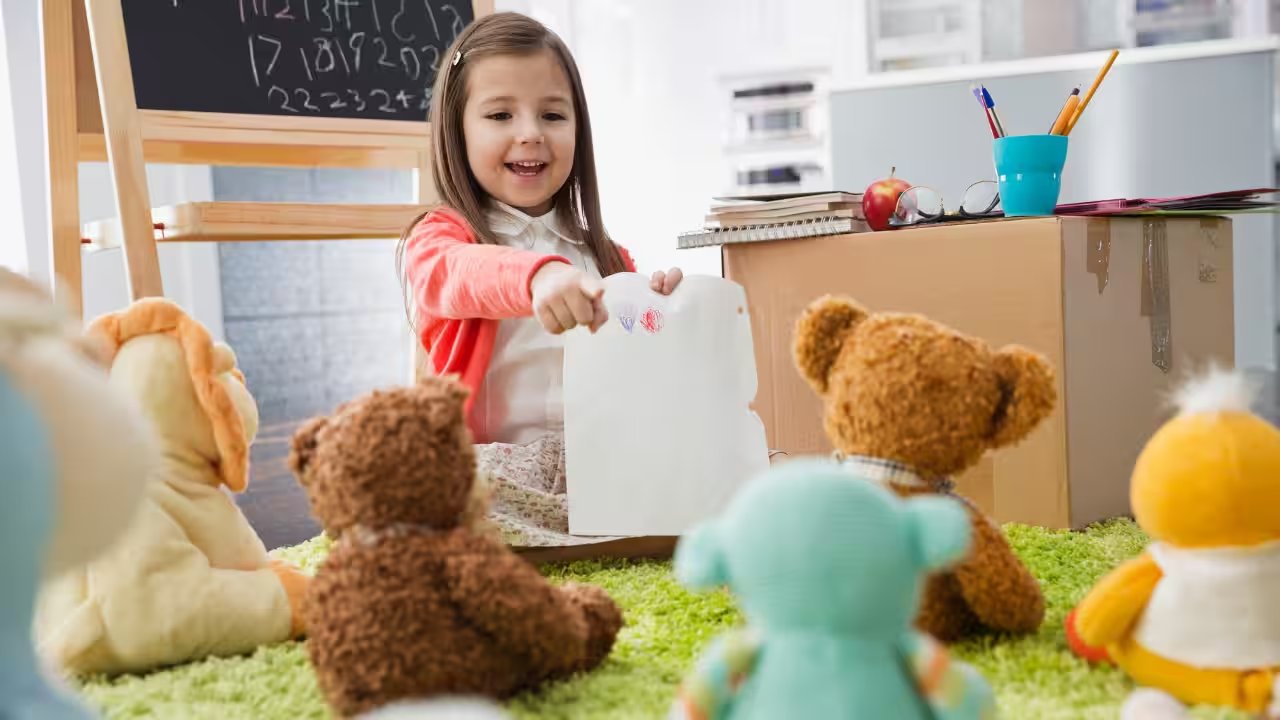
A little girl lines up stuffed animals across a quilt, sets her jaw, and snaps: "Sit properly. No talking in class." Next door, her brother presses a plastic stethoscope to a teddy bear's chest, announcing urgent treatment is required. Across the hallway, a toddler spoons pretend cereal into a doll's mouth while repeating her mother's precise cadence—complete with exasperated sighs.
Children watch everything. When they step into adult shoes, they test out authority before they possess any.
Psychologist Lev Vygotsky framed this phenomenon in research published through the University of Virginia, observing that in play, "it is as though [the child] were a head taller than himself." Pretend games serve as an imaginative dressing room. Because children cannot run clinics or manage classrooms, they slip into those positions early, testing social realities that remain years out of reach.
A 2024 meta-analysis in Educational Psychology Review tracked how children use make-believe scenarios to grasp basic human hierarchies. Toddlers do not simply mimic sounds when they set up classroom desks or checkout counters. Instead, they assign roles—storekeeper, shopper, physician, patient—and systematically negotiate the boundaries of power.
They hash out who speaks first, who distributes commands, and what consequences follow broken rules. Pretend play functions as a mental workbench where youngsters integrate and solidify knowledge they observed in passing.
Yet researchers at the University of Virginia's Early Development Lab identified an unexpected preference: children consistently favored real tasks over make-believe work. But between the ages of 3 and 4, pretend roles spark intense interest. Stepping into the shoes of a physician or parent gives a four-year-old an immediate thrill of competence.
| Research Source | Primary Milestone / Finding | Behavioral Implication |
|---|---|---|
| Lev Vygotsky / Univ. of Virginia | Child stands "a head taller" in imaginative play | Tests adult responsibilities years before real access |
| Univ. of Virginia Early Development Lab | 3- to 4-year-olds display strong pull toward pretend roles | Children favor real tasks, but toddlers seek grown-up authority |
| Educational Psychology Review (2024) | Meta-analysis on role-taking (teachers, doctors, shopkeepers) | Children actively negotiate power dynamics and behavioral rules |
| Psychological Bulletin (2013) | Angeline Lillard review on intelligence and empathy links | Child traits and home environments drive gains, not make-believe alone |
Popular parenting folklore insists that dressing up makes children smarter, kinder, and quicker to empathize. But the empirical evidence tells a more cautious story.
A landmark 2013 research review in Psychological Bulletin led by psychologist Angeline Lillard challenged the premise that make-believe automatically builds intellect or kindness. Lillard and her team pointed out that third factors—such as an attentive parent, a well-resourced household, or a child's natural temperament—may drive cognitive gains rather than the tea party itself.
Scientists writing for SAGE acknowledge that Lillard's cautions carry weight, yet developmental researchers continue studying whether fantasy games provide direct training for self-regulation. When an energetic child forces herself to stay motionless because she plays the "sleeping patient," she practices impulse suppression.
So the next time your preschooler scolds a teddy bear using your exact lecture, step back. They are not merely mocking you—they are running clinical trials on how adulthood operates.
| SAGE Publishing Analysis | Long-term tracking of fantasy play and emotional control | Ongoing scientific evaluation of make-believe in building self-regulation |