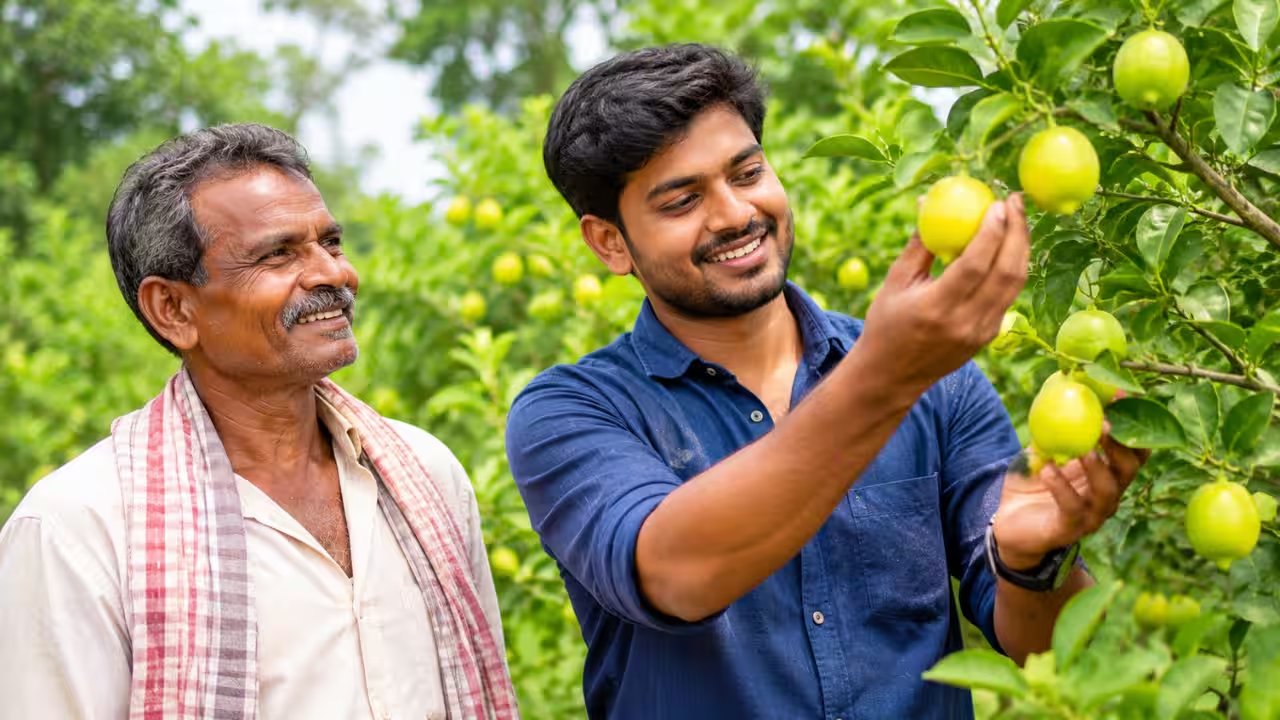
Wild herds swept out of Panasha Taila forest every harvest season, trampling paddy fields and tearing through groundnut patches. In Ogi village, tucked into Odisha's Angul district, Kartika Sahu watched his livelihood disappear overnight into the bellies of hungry elephants and marauding monkeys. Traditional crops were financial suicide. So fifteen years ago, Kartika walked into the local horticulture department office and spent exactly ₹100 on 50 indigenous Kagzi lemon saplings.
Each plant cost ₹2. It was a desperate shield, not a grand business venture. Kagzi lemon trees carry razor-sharp thorns, bitter acidic pulp, and a pungent, citrus-heavy foliage oil that grazing wildlife despises. The animals retreated. The saplings flourished. Kartika began multiplying cuttings from his own grove, handing saplings across boundary fences to struggling neighbours. When he passed away seven years ago, his son Santosh inherited the farm—and spotted an untapped regional gold rush.
Santosh looked past mere harvesting. Ogi's growers possessed prime citrus but no route to wholesale terminal markets. Middlemen siphoned their margins or let the surplus rot on village verandas. Santosh stepped in to aggregate.
Today, Santosh runs an operation turning over more than ₹1 crore annually. On his own one-acre homestead, he tends roughly 120 mature trees. But his real trading engine runs on aggregation: he buys fresh harvests from more than 200 partner farmers across the district, hauling metric tonnes of citrus across state borders.
"Growing the fruit was only half the challenge," Santosh stated, outlining his logistics network. "Farmers in the village had fruit hanging heavy on the branch, but zero access to city buyers. We created the bridge."
Halves of green and yellow citrus now move along dedicated highway routes from Angul into Bhubaneswar, Cuttack, and Dhenkanal, before rolling across the border to Jamshedpur in Jharkhand. Consignments packed in Ogi have even cleared international customs, landing on supermarket shelves across the United Kingdom and the United States.
Lemon trading is a game of daily cash velocity. Santosh procures citrus in lots of 100, paying local cultivators between ₹220 and ₹280 based on caliber, skin texture, and moisture density. He flips those lots into urban wholesale terminals for ₹300 to ₹320.
Around 60% of his gross annual turnover flows directly back into farmers' bank accounts. Alongside commercial fruit trading, Santosh nurtures nursery stock, supplying grafted Kagzi saplings at ₹20 each to regional growers looking to replace vulnerable groundnuts. That nursery cash remains separate from his core trading ledger.
| Operational Parameter | Production & Financial Metric |
|---|---|
| Initial Investment (15 Years Ago) | ₹100 (50 saplings at ₹2 each) |
| Current Annual Business Turnover | Exceeds ₹1 crore |
| Cultivators Supplying Santosh Sahu | Over 200 local farmers |
| Village Adoption in Ogi | ~500 out of ~700 households (150+ acres) |
| Average Annual Farmer Net Earnings | ₹25,000 to ₹30,000 per family |
| Farmer Procurement Payout Share | ~60% of gross turnover |
Success in citrus farming hinges on disciplined spacing and seasonal cycles. Ogi's growers drop new saplings into the soil during peak monsoon showers, letting monsoon moisture lock young root balls into place. Rows are plotted with six-metre gaps to give canopies room to breathe.
Trees take three to four years of vegetative growth before throwing commercial fruit. Once mature, the numbers explode. A ten-foot tree yields upwards of 600 lemons every seven days during high season. An eight- to nine-year-old specimen, stretching 12 feet into the sky, drops more than 1,000 fruits a week.
Pricing fluctuates on a strict calendar rhythm:
June to August: First harvest window. The fruit averages 30 grams, fetching a steady farmgate baseline of ₹1.25 per unit.
November to February: The prime winter cycle. Cold nights plump the fruit up to 60 grams, driving unit prices to ₹3.00 and ₹3.20.
March to May: Summer scarcity lifts open-market rates to ₹3.50 apiece, though commercial pickings remain thin during dry heat.
Wildlife still stalks the fringes of Panasha Taila forest. But in Ogi, the elephant corridors now skirt broad groves of armed green branches—anchoring a village economy that turned a ₹100 bet into an international trade line.
| High-Yield Tree Output (8–9 Years Old) | Over 1,000 lemons per week during peak |