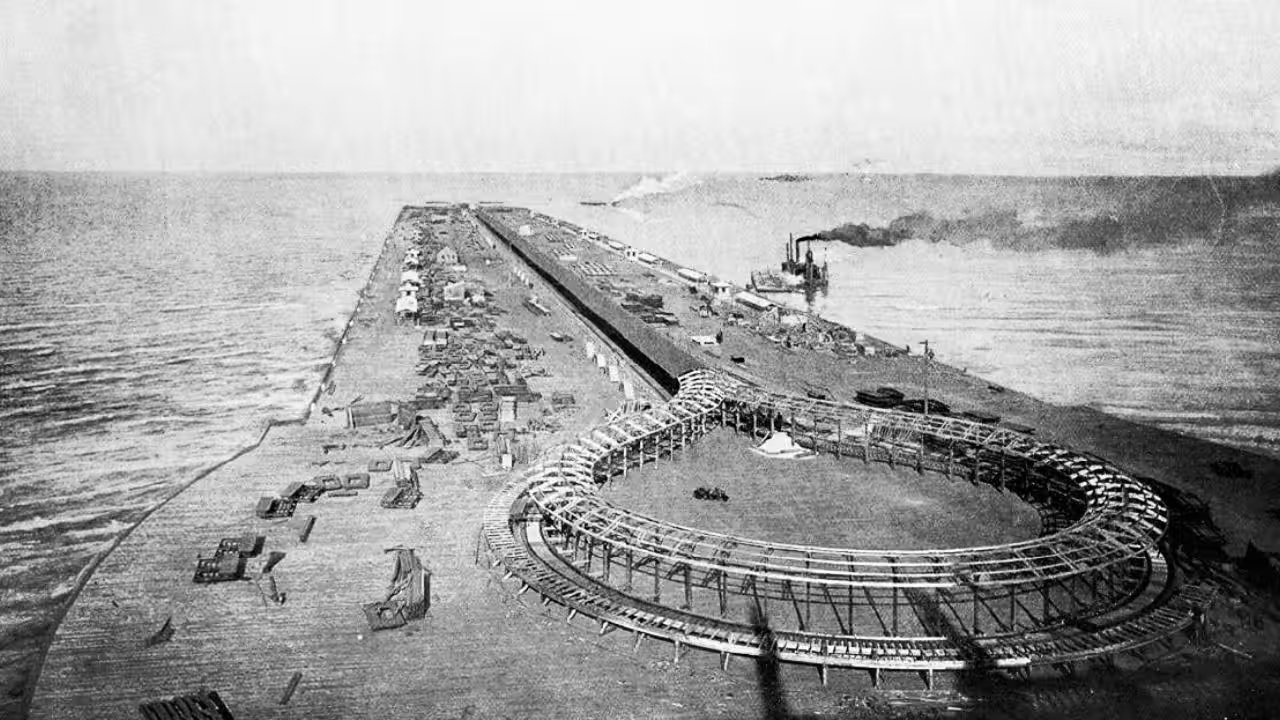
CHICAGO — Steamship passengers stepping onto the Lake Michigan pier in 1893 encountered a mechanical marvel that transformed urban transit overnight. The World’s Columbian Exposition launched the world’s first commercial moving walkway, running more than one kilometre along the waterfront directly to the fair's grand Peristyle entrance. Riders paid five cents for admission. The platform moved beneath their feet. It remains the longest installation of its kind in history.
According to the 1893 Official Guide to the World’s Columbian Exposition, authored by John J. Flinn, fair organizers cataloged the installation under practical visitor services as a "Moveable Sidewalk." The apparatus operated on an unusual split-velocity design. One continuous half rolled forward at three miles an hour, while the parallel platform raced at six miles an hour. Passengers chose between standing or sitting on designated levels as the wooden deck carried them past twenty ticketing turnstiles at the lakefront gate.
Yet the official records left technical voids. Flinn’s guide omitted how riders stepped between the differing speeds, how long the full trip lasted, or what machinery drove the heavy platforms. The system served as a direct transit conduit, funneling thousands off lake vessels straight into the heart of the fairgrounds.
But the novelty did not survive the decade. An 1894 fire destroyed the entire pier structure, ending the platform's brief run, according to records maintained by Guinness World Records.
The moving sidewalk formed just one component of an aggressive transit experiment across the Chicago fairgrounds. Visitors wanting perimeter travel boarded the electric Intramural Railway, which circled the grounds from the South Pond to the North Inlet at twelve miles an hour for a flat ten-cent fare. A complete circuit required twenty minutes. On land, attendees hired rolling chairs from gate depots to navigate packed avenues.
On the waterways, private fleets competed for passenger fares across the Basin and lagoons:
| Transit System | Operating Speed | Fare | Primary Route | Construction / Type |
|---|---|---|---|---|
| Moveable Sidewalk | 3 mph & 6 mph | 5 cents | Pier to Peristyle entrance | Split-level dual continuous platform (Over 1 km) |
| Intramural Railway | 12 mph | 10 cents | South Pond to North Inlet | Perimeter elevated circuit (20-min round trip) |
| Electric Boats | Variable | 25 to 50 cents |
Steam launches ferried sightseers directly into Lake Michigan before swinging back into the South Pond, charging twenty-five cents. Venetian gondolas steered by Italian crews commanded fifty cents for ceremonial lagoon circuits. While modern airports and transit hubs eventually adopted single-speed conveyor belts, the dual-speed Chicago design remains an unmatched high-water mark of nineteenth-century engineering.
| Lagoons, Basin, North Pond |
| 1-hour full tour or point-to-point shuttle |
| Venetian Gondolas | Manual | 50 cents | Fair lagoons | Operated by imported Italian gondoliers |
| Lake Steam Launches | Open water cruise | 25 cents | Lake Michigan into South Pond | Deep-water perimeter tour |