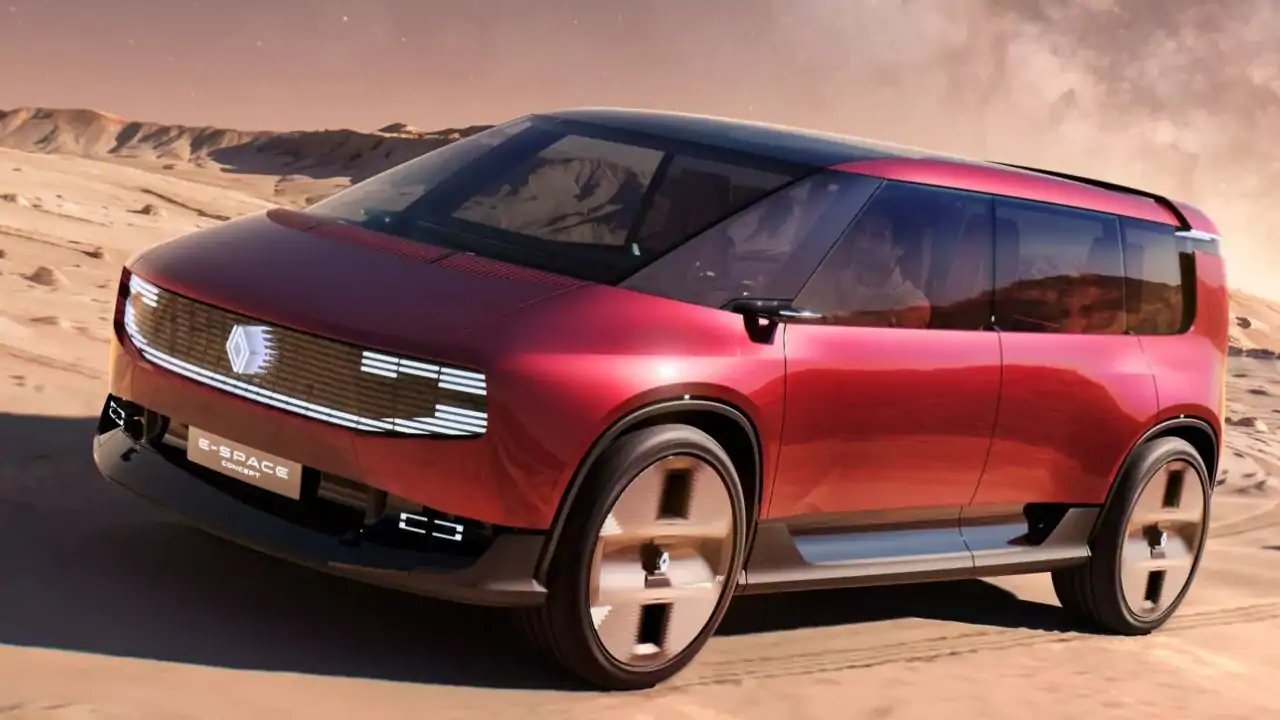
The family car is officially dead, or so the industry has been saying for the last decade. But Renault just threw a wrench in that narrative. At the 2026 Paris Motor Show, the brand revealed the E-Space Concept, a 4.7-metre, fully electric vehicle that looks less like a boxy minivan and more like a low-slung, aggressive tech vehicle. It’s a gamble. In a market where everyone is selling tall, upright SUVs, Renault is betting that buyers still want the practicality of a traditional multi-purpose vehicle, just stripped of the clunky aesthetics that killed the category.
Under the hood, there are no specs to obsess over yet. Renault hasn’t disclosed motor output, battery capacity, or driving range, which makes sense for a concept car. But the physical dimensions tell the real story. The car is 4.70 metres long, 2.02 metres wide, and just 1.67 metres tall. That low profile is the key differentiator. Instead of the high beltline you see on a Hyundai Creta or a Toyota Urban Cruiser, the E-Space uses a one-box silhouette with a massive glass area. It’s an attempt to make a six-seater feel like a premium sedan rather than a school bus.
Inside, the cabin is where things get interesting. You get six individual seats across three rows, no benching, no compromises on legroom. The second row is the game-changer here. Those seats rotate 180 degrees to face the third row, and they fold flat to create a table. Renault also threw in a 1,130mm wide curved display that spans the dashboard, replacing the traditional split between the driver’s cluster and the infotainment screen. There’s even a mobile console for passengers with built-in games. It’s a lot of tech, but the core idea is simple: make the back seat as comfortable as the front.
Let’s be clear about one thing: this is not hitting showrooms anytime soon. Renault has explicitly stated there are no plans for a production version at this stage. This is a design study, a way for the brand to test the waters and see if consumers are ready to ditch the SUV for a modernized MPV. The original Espace launched in 1984 and defined a generation of family cars. The question now is whether the 2026 version can do the same in a market that has largely forgotten what an MPV looks like.
For buyers, this is less about buying a car and more about watching a trend. If Renault sees enough interest in this concept, we could see a production model in the next few years. Until then, the segment remains dominated by the same old SUVs. But the E-Space reminds us that there’s a different way to move a family of five or six around. It’s just a matter of time before someone else tries to copy the formula.